

The Physics of Change

inertia-e1455505796605It’s called inertia.

That force that keeps us from doing things differently, even though we know it’s in our best interest, is called inertia. Isaac Newton first wrote about it back in 1687. While studying the physics of motion, he discovered that “an object that is at rest will stay at rest unless a force acts upon it.” Likewise, he observed that “an object that is in motion will not change its velocity unless a force acts upon it.”

Of course, while developing his First Law of Motion, Newton referenced primarily inanimate objects – things like apples and planets. He wasn’t really interested in understanding why people acted the way they did. However, the same principle that explains why the pen on my desk doesn’t move unless I pick it up points toward some realizations about how and why we respond to potential change.

In terms of human behavior, inertia represents the tendency to continue in whatever course of action we are presently engaged in. Sometimes, that means no action. Think about physical fitness, for example. It’s very difficult for a couch potato to change their behavior and suddenly start working out. But for individuals who do work out (or run, bike, etc.), asking them skip a session could earn you a dirty look. Why is it that a body at rest tends to stay at rest, while a body in motion tends to stay in motion?

We’re creatures of habit. The human brain is full of neural pathways – connections that link specific behaviors and consequences. Every new behavior creates a neural pathway. Subsequent repetitions of the same behavior reinforce that pathway. Over time, that pathway becomes well-defined, almost like a rut in a dirt road. When we go to perform an action, the brain looks for established patterns of behavior and follows the path of least resistance – the rut. Eventually, certain activities become so ingrained we don’t even have to concentrate on what we’re doing. Muscle memory takes over and we act without thinking.

Subtle shifts in behavior are often just as hard to make as drastic ones. When I go mountain biking, I’m often faced with trails that are riddled with ruts left by other bikers. Sometimes I’ll try to ride just to the side of existing ruts in order to provide for a smoother ride without causing significant further impact to the trail. However, I almost always find this method of riding difficult to sustain. Try as I might to ride the edge, I just keep sliding back into the rut. Carving an entirely new route can actually be easier. Without the convenience of an established path to fall back on, I have no choice but to embrace something new.

Breaking one habit requires creating another one. Even though I’ve begun the process of creating a new pathway, my next trip down the trail presents me with the same challenge. Until I’ve traveled the new path enough times for it to become established, I’ll have to fight the tendency to follow the old one – the rut. It takes time for my mind and body to see the new pathway as the obvious choice. Old habits die hard. It takes focus and determination to kill them.

So what does this mean for effectively implementing significant change, either personally, or in our teams? How do we approach change in a way that helps people accept it, embrace it, and stick with it?

1. Accept that significant change takes effort. Like pulling out of a rut on the bike trail, shifting behavior requires concentrated effort. It’s not easy. Just because someone has a tough time adjusting to a new process doesn’t necessarily mean they don’t agree with it. Even the easiest, most desirable change can take its toll on people. Recognize the effort that’s required.

2. Accept that significant change takes time. Meaningful change doesn’t occur overnight. Allow ample time for people to process what’s being asked of them and to come to terms with their own feelings about it. Set your expectations in such a way that, as an agent of change, you don’t become frustrated with what appears to be a failure to accept new processes.

3. Accept that significant change takes repetition. Understand that I order for a new process to become routine, old habits have to fade. For that to happen, new habits – new neural pathways – have to be created. Until the new route is firmly established, people will occasionally fall back into the rut.

As Newton discovered so long ago, change doesn’t just happen. With the right kind of approach, though, effective change can be realized. Using the right combination of focused effort, repetition, and time will allow you to overcome inertia.


JOIN THE CONVERSATION:

What keeps you motivated? Share your tips on our facebook page.

The Matrix of Change

sign-94966_640It’s often said that “the more things change, the more they stay the same.” In many ways, this appears to be the case. Change is all around us. And whether it’s technological, social, economic, political, or otherwise, the volume of speed at which change takes place is constantly on the rise.
Even when it’s good for them, people tend to resist change – not because they don’t want things to be better, but because it takes energy to change. It’s not change itself we fight, but transition; the act of moving from one state to another. That’s where the energy is required. So we balk at those changes that we perceive will take the most out of us.
I believe there are two factors behind the impulse to change. The degree to which they impact the status quo determines how strongly the desire to change manifests itself.

The first factor is the performance of a current process. Another phrase you may be familiar with, “if it ain’t broke, don’t fix it,” comes to mind. If the existing course of action is producing the desired result, then it’s difficult to justify changing it. The more “broken” a process appears to be, however, the more change becomes necessary.

The second factor is the acceptance of the current process by the people affected by it. If people are comfortable with the status quo, then it will be difficult to affect a change in their behavior. The more accepted a process is, the more difficult it is to get people to change – regardless of the process’ performance.

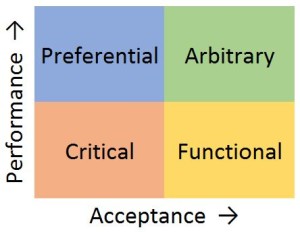
Based on the interplay of these two factors, I suggest that there are four types of change. Understanding these types can help us identify how strongly a change needs to be made as well as potential barriers we may face in implementing a change.

Critical Change
Changes made to functions low in performance and low in acceptance are considered critical. Not only is the desired result not being achieved, but the current process is not being accepted by those affected by it. When both performance and acceptance are low, something needs to change quickly.

Functional Change
Changes made to functions low in performance and high in acceptance are considered functional. While the desired result is not being achieved, people are comfortable with things the way they are. Changing things up may be necessary, but resistance can be anticipated due to the comfort level people have with the status quo.

change-matrix-300x232

Preferential Change
Changes made to functions low in acceptance and high in performance are deemed preferential. Even though results are being achieved through this current process, those involved in it may have reservations about it. They may perceive it as too difficult or time consuming. Change may be required in order to maintain employee engagement.

Arbitrary Change
Finally, changes made to functions high in both performance and acceptance may be considered arbitrary. No good reason for the change is apparent and potentially high levels of resistance can be expected.

How a proposed change is categorized depends on your perspective. We are human beings, after all, and our individual beliefs, goals, and preferences come into play when evaluating the need to change. For example, your wife may decide it’s time to paint the living room. She sees it as a preferential change as she has simply become bored with the color. For you, though, this may be perceived as an arbitrary change. The paint is in acceptable shape and you are perfectly happy with the existing color scheme. With differences of opinion such as this, conflict over the potential change can be expected.

When considering any change, it is important to take individual perspectives into account. Few of us like being subject to decisions affecting our lives if we see them as arbitrary. Communication and even compromise become important considerations in navigating change.

Change may indeed be the only constant. There is no progress without it. But how we – and others – view any given potential change has huge implications for effectively implementing it. Over the next couple of weeks, I’ll explore some of the specific reasons people have for resisting change and how we can work together to make change easier to implement and assimilate.

Consider a recent change you have been asked to make. How has your perception of the change impacted your reaction to it? What could have been done differently to make the transition easier?


JOIN THE CONVERSATION:

When do you find change most difficult? Share your thoughts on our facebook page.

Circle Up! Lead From the Huddle

Hands-In-e1448857238616Paul looked across the line of scrimmage at the other team. He glanced at the scoreboard and then at the stands; full of friends and family, all anxiously awaiting the next play. Then he scanned the faces of his teammates. Each one stared intently at Paul, eager to receive his instructions. It was 1892 and, as captain of the Gallaudet University football team, Paul Hubbard felt the weight of the world on his shoulders.

The two teams were fairly evenly matched. Defenses on both sides had had little difficulty in thwarting any big offensive moves. But that came as no surprise to Paul. It’s easy to anticipate your opponent’s next move when they spell it out for you. You see, Paul and his Gallaudet Bison teammates were all deaf; so were the players lined up across from them. Gallaudet and their rival school were both universities designed for the deaf and hard-of-hearing. Naturally, plays were relayed using American Sign Language. All you had to do was watch the quarterback’s hands, and you knew exactly what play he relayed to the rest of his team.

Paul suddenly realized that, unless he could devise a way to communicate with his team in a manner that prevented their rivals from seeing his signs, this would be a very long game. So he stepped back from the line and motioned his men to follow. Then he arranged them in a circle facing each other and relayed his instructions safe from prying eyes. In other words, he initiated the first football huddle.

Today, huddles are an expected part of any football game. In fact, just about every sport has adopted the huddle as way to bring the team together between plays. It’s a great way to share time-sensitive information, gain consensus, and boost motivation. Smart business teams also understand the value of the huddle. Teams that take advantage of opportunities to huddle routinely report increased productivity, camaraderie, and job satisfaction.

The thing I like most about the huddle is that it happens on the field – right in the midst of the game. When you’re in the middle of a huddle, its game time. There’s no time for practice. No time for debate. It’s all about execution. Once the huddle breaks, the game is on. That makes the huddle the most important meeting a team will ever have.

If you haven’t tried huddling with your team, maybe now is the time to give it a shot. Even if you currently utilize the huddle, you might want to check out Arina Vrable’s tips for running an effective team huddle. She provides some great ideas for incorporating this strategy into your daily routine.

  1. Keep it short. Shoot for no more than 15 minutes. You need to get out there and score some points.
  2. Keep it moving. This is not the time to make long-term plans. Focus on what’s needed to succeed today.
  3. Keep it going. Don’t let the practice die because it feels awkward at first. Like anything else, team huddles take some time to get right.

Leaders consistently ask me to help them with tips for motivating the team. I’m a long-time believer in the power of huddles to keep teams informed, focused, and accountable – all essential elements to motivation. Practiced consistently, a 15 minute huddle can dramatically impact the outcome of the day.

Committed teams look forward to the huddle. They see it as part of a game-winning strategy. And once the huddle breaks, every player knows exactly what they’re supposed to do in order to win. So what do you say, quarterback? Ready to win this game? OK then…circle up!

Breaking the Cycle of Unengagement

groundhog day

In the 1993 movie Groundhog Day, Bill Murray plays disengaged television meteorologist Phil Connors. Phil is sent to Punxsutawney, Pennsylvania to cover the annual groundhog ceremony whereby the famous rodent predicts the weather. Obviously frustrated by the menial assignment, Phil comes across as rude, condescending, and genuinely uninterested in both his coworkers and the townspeople around him. He arrives late for the live television feed and fakes his way through it; going through the motions in an obvious attempt to get things over with so he can get back home.

The people Phil comes in contact with make repeated attempts to connect with him. The mayor, his cameraman, and his producer all eventually get fed up with his brusque demeanor. Phil rushes the team back on the road, but a freak blizzard forces them to turn around and spend the night in Punxsutawney. He awakens the next morning to find he is trapped in a time loop, repeating the same day over and over again.

I don’t know about you, but I run into a lot of people who resemble Phil Connors. They isolate themselves from others and basically sleepwalk their way through the day. Any attempt to connect with them or collaborate is met with outright resistance or, at best, reluctant participation. They seem to exert the least possible amount of effort, performing just well enough to get through the day; but not really impacting anything or anyone. They’re miserable and it shows. And this goes on day after day after day.

In other words, they are unengaged.

A 2014 Gallup poll revealed that almost 70% of employees in the U.S. are unengaged. That means millions of people go to work every day uninvolved, unenthusiastic, and uncommitted. Employees classified as managers, executives, or officers apparently check out just as frequently. Sixty-two percent of that group said they are unengaged as well.

You don’t need a research study to figure out the implications of this. Unengaged employees obviously cost an organization in terms of sales, service, and innovation. Organizations with high levels of unengaged employees also have high turnover, incurring extra costs associated with hiring and training. The problem is real and, according to the research, widespread.

So what are we to do to combat the engagement dilemma? Well, the same Gallup survey identified a handful of organizations that seem to have cracked the code. And the number one reason for their higher-than-average levels of engagement? Involved leadership. Here’s a quote from an article detailing the findings:

“Leaders’ own attitudes, beliefs, and behaviors have powerful trickle-down effects on their organizations’ cultures. Leaders of great workplaces don’t just talk about what they want to see in the management ranks — they model it and keep practicing to get better at it every day with their own teams.”

The key to highly engaged employees is highly engaged leadership – involved leadership. Engagement doesn’t happen in a vacuum. It requires action. It requires participation. It requires getting up from the desk and interacting with people. That’s the only way you get to know them. That’s the only way you get to share with them your vision for the future. That’s the only way you can influence their desire to be a part of that vision.

How well do you know the people around you? How well do you know what’s going on in their lives? How involved are you in their work? How engaged are you?

Phil Connors tries desperately to break out of the repetitive time loop. At first he behaves erratically, thinking altering events around him will make a difference. It doesn’t. He tries running away from the problem by leaving town and even committing suicide. But every day winds up looking the same. It’s only when he decides to get involved in the lives of the people around him that something changes. It’s only when he gets to know them and decides to get engaged himself that the cycle is broken.

We don’t know how long it took Phil to break out of his time loop. The film doesn’t say. Director Harold Ramis suggested it took perhaps 10 years. Analysts of the events depicted in the movie have theorized Phil lived the same day over and over for 40 years or more. Hopefully it doesn’t take the rest of us that long to figure things out.

Can You Hear Me Now?

My wife and I were reminiscing recently about the early days of our marriage. In November, we’ll have been married 24 years and we’ve both changed a lot since saying “I do.” Sure, the physical changes are the most obvious; but most significant are the changes in how we treat each other. I must admit though, I’ve had to change a lot more than she has.

For example, I distinctly remember a conversation we had one afternoon just a few months after our wedding. I came home from work late and still had events of the day on my mind as I walked through the door. Susan immediately began telling me about her day. She followed me through the house as I pulled off my jacket and tie, quickly moving to put on comfortable clothes.

Suddenly it dawned on me that the pace of Susan’s speech was increasing. She talked faster and faster until the words practically jumbled together into nonsense. She finally stopped to inhale, gasping for breath. I looked at her and asked “Why are you talking so fast?” Her response hit me like a ton of bricks. “I have a lot to tell you, but I know that any second you’re going to tune me out.”

Wow. Before me stood the person that most mattered to me in the world and within weeks of promising to give her everything, I’d managed to renege on that promise. All she needed was for me to listen – to give her a few minutes of undivided attention – and already I’d proven unable to do it.

We humans have a listening problem. Our ears work; we hear just fine. It’s listening – an activity that takes place in the brain – that seems difficult.

Listening is often touted as a key sales skill; but it goes much further than that. Listening is a key customer service skill. It’s a key leadership skill. It’s a key relationship skill. It’s a key life skill. And as simple as it sounds, we struggle to get it right.

We live in a busy world. Information bombards us from every direction. People and email and social media all vie for our attention and there just doesn’t seem to be enough time in the day to get it all done. So we multi-task. We eat lunch while we read through email while we listen in on the conference call while we “listen” to the person that just walked into the office. But we’re fooling ourselves. Multi-tasking makes us feel better by allowing us to cross off more items on the to-do list. It helps us “get things done.” But it doesn’t help get things done right. Studies have actually shown that dividing our attention makes us less efficient than focusing on one task, or one person, at a time.

The real victims are those on the other end of the exchange. People can sense when they don’t have your full attention, just like my wife did. They can tell you’re preoccupied. And it makes them feel horrible. You’ve been there. Remember the last time you tried talking to someone who wasn’t really listening? How did it make you feel? Unwanted? Unwelcome? Unworthy?

So how do you practice listening? How do you let me know that you’re really paying attention? Let’s start with three small steps:

  1. Make time for me. Is now not a good time for us to talk? Then tell me so. Suggest a time when we can speak without interruption. I want your attention. I need you to listen to me. And if I’m as important to you as you say then you’ll make one-on-one time a priority.
  2. Look at me. Put down your cell phone. Turn away from the computer. Stop pacing around your office searching for a file related to the next meeting on your calendar. Scrape the daydream glaze off of your face and point it in my direction. If your eyes aren’t focused on me, then your brain isn’t either.
  3. Participate with me. Listening is not a passive exercise. It involves asking questions, clarifying, and even offering information. Body language and nonverbal matter. Head nods and robotic “uh huhs” are sure signs that your attention is elsewhere. Listening requires involvement.

I am your customer. I am your employee or coworker. I am someone significant. And what I have to say is very, very important. Are you listening? Do I have your attention? Can you hear me now?

31 Days of Praise

thank you wordle

According to Meriam-Webster Dictionary, to praise is to say or write good things about someone or something or to express approval of someone or something. Sadly, even with so clear a definition on hand, praise remains a mystery to a great many people. Given the opportunity to provide feedback, we’re much more likely to communicate criticism than approval.

While terms like “constructive criticism” seem to imply that there’s a higher purpose behind offering negative feedback, most attempts fall woefully short. All the recipients hear is that they’ve failed. And negativity only seems to breed more negativity. That’s because we tend to emulate the environment around us. We communicate in the way we are communicated to. We give what we get.

High performing teams use praise to great advantage. In a study conducted by the Harvard Business Review, top performing teams were found to have given each other more than five positive comments for every criticism. Low performing teams, those at the bottom of the barrel in terms of financial performance and customer satisfaction ratings, shared almost three negative comments for every positive one. Praise, it seems, goes straight to the bottom line.

If you think about it, that makes a lot of sense. Criticism introduces self-doubt and hesitation. It makes us less likely to take chances for fear of disappointing someone again and revisiting the land of failure. So teams and organizations characterized by primarily negative communication move slower, innovate less, and miss out on opportunities for growth.

Teams and organizations that share a lot of praise, however, benefit from more vibrant working relationships. They enjoy working together and are therefore more likely to collaborate. The positive emotions elicited by praise cause us to work harder, stretch farther, and achieve more. We crave praise, so we tend to repeat behaviors that garner positive feedback.

There’s precious little praise floating around these days, though. It’s bad enough that news and social media outlets feed off of negativity; but so much of what we communicate to each other day to day winds up being derogatory. It’s going to take some focused effort to reverse our downward spiral.

So I’m issuing a challenge.

July has 31 days. I’m challenging you to make a focused effort to praise for 31 days. Each day of July, I want you to identify one individual who has done something good – something praise worthy – and recognize them for it. Choose a coworker, boss, or team member. Pick a classmate or family member. Identify a friend or even an enemy. Just find someone each day of the month and praise them for something.

You don’t have to advertise this. There’s no need to let the world (or even me) know what you’re doing. The best praise is personal anyway. It’s delivered one on one, with sincerity. That said, I would like to suggest a few guidelines should you choose to accept my challenge.

  1. Be specific. Offer more than a “good job.” Praise is most effective when the recipient knows exactly what they did to receive it.
  2. Get personal. Let the recipient of your praise understand why you appreciate them. That means letting them know what they (and what they’ve done) means to you personally.
  3. Let the praise stand on its own. Any positive comments you deliver will be lost if accompanied by criticism. Even if you have suggestions for improvement, save them for another time. Let the good news work its magic.

There it is. The gauntlet has been thrown down. For 31 days, let’s turn the tide. Let’s start an avalanche of positive feedback and see what happens.

Are you with me? Will you step up? Do you accept the challenge?

The Act of Leadership: What Do Leaders Do?

leading

Your actions speak so loudly, I can not hear what you are saying. -Ralph Waldo Emerson

I’ve written recently about the things a leader sees and the things a leader says. But it’s hard to ascertain the true measure of a person by what catches their eye. And anyone can come up with a great quote or two. What makes great leaders stand out is the sum of their actions. In short, you know someone is a leader by what they do.

Here are a few of the observable traits of effective leaders.

1. Leaders decide the direction. We’re each faced with a thousand decisions each day. Some are more critical than others. But some decisions affect lives other than just our own. When it comes to making the big decisions – the ones that impact customers, coworkers, and the future of the organization, leaders don’t hesitate. They instinctively know what the right thing to do is and they do it. Leaders step up and make the right call.

2. Leaders act with intention. Leaders see the promise of the future, and they communicate that vision regularly. Leaders also visualize a clear path to that vision. So when a leader acts, you can be sure there’s a reason for it. There’s an agenda. It may not always be readily discernable, but it’s there. Watch a leader long enough and you’ll start to see the master plan take shape. Leaders plan their work and work the plan.

3. Leaders serve as an example. I have three kids. I try to remind myself that they are always watching me. They see everything I do – the decisions I make, the way I respond to circumstances beyond my control, and how I treat other people. They follow my example and emulate my actions. Knowing this, I try to make sure that my example is a good one. Leadership is a lot like parenting. Leaders act knowing that others are watching and learning from their example.

4. Leaders equip others for success. I’ve said many times that I believe the number one responsibility of a manager is to develop those they lead. Ultimately, the job of a leader is to produce other leaders. Because the impact of a great leader is not felt in their presence, but in their absence. So leaders actively seek out resources that will help their team grow stronger. They look for opportunities to delegate responsibility. And they celebrate when the leader in others is revealed. Leaders participate in the education and growth of those around them.

5. Leaders let others lead. No man is an island. And no leader has what it takes to succeed in every circumstance. Strong leaders understand their own limitations and are comfortable with taking a back seat from time to time. That’s because leaders don’t focus on their own egos. They focus on achieving the vision. When someone else is better equipped to take point, strong leaders respond by following. Leaders happily step aside and others lead where appropriate.

This list could go on. There is no end to the list of positive things that leaders do. One thing I know for certain though, is that leadership is not a passive activity. Leading requires action – in a very real sense, leading is action. How will you lead this week?

Give Thanks. No, Really Give It!

thank you wordleTis the season to be thankful, right? By now you’ve probably read a number of Facebook posts or newspaper articles about the origins of the Thanksgiving holiday; so I won’t bore you with those details. Suffice it to say that the fourth Thursday in November has become the traditional day of the year to express gratitude for the blessings you enjoy. Now, obviously, you should be thankful throughout the year, not just on a particular day. Thanksgiving is just the day we set aside time to really think about it.

But what about those other 364 days of the year? Shouldn’t we make a special effort to express our gratitude every day? Don’t you like it when someone tells you “Thank you” or goes out of their way to show appreciation for something you’ve done?

Author and speaker Stephanie Chandler thinks so. She’s compiled a list of 12 Ways to Thank Your Customers. These are all pretty basic ideas and most of these suggestions have been discussed in our basic sales & service training classes. See how many of these you already have in place.

  1. Greeting Cards. Think of all the major, minor, and wacky unofficial holidays on the calendar during the year. Why not send out a card to celebrate with your customer?
  2. Personal Notes. Forget the email or form letter. Pull out the stationery and a pen. Now write a few short lines that mean something personal to your customer.
  3. Invitations. Call up a customer and invite them to come in for some face-to-face time. Call it a portfolio review or research study. Spend some quality time listening to your customer and see what a huge impact it makes.
  4. Small Gifts. They don’t have to be lavish or expensive. They just have to say “I was thinking of you.”
  5. Food. We like getting food at work right? Why not return the favor?
  6. Gift Cards. Know what your customer likes? Get them a gift card to their favorite store or restaurant. Don’t know what they like? Try Amazon!
  7. Referral Rewards. When a customer thinks enough of you to refer new business your way, it’s time to say “Thank You!”
  8. Reverse Referrals. I’ll bet your business customers like to receive referrals too.
  9. Customer Appreciation Days. Plan something around Founder’s Day or Customer Appreciation Week. Or just choose some arbitrary day and make it special.
  10. The Gift of Information. See an article or book you think might interest your customer? Why not send it their way with a special note?
  11. Host Events. Hosting an open house or cook out is an easy way to show your appreciation.
  12. Life Events. Did your customer receive a promotion? Did a son or daughter graduate? Did they get married, open a new location, or close a big sale? Let them know you noticed.

There’s no rocket science involved here. The key is to develop an attitude of gratitude and perpetuate it all the time – not just once a year. And if you don’t currently have an active “appreciation strategy,” now is the perfect time to start. Just pick one of these ideas and get to it.

I think it’s also worth mentioning that most of these suggestions also work for coworkers. That’s another group just begging for some appreciation. Whew, I don’t know about you; but I’ve got a lot of work to do.

Happy Thanksgiving!

P.S. Got a great way of saying “Thank you?” I’d love to hear about it.

What’s Wrong with Your Face?

Cyclists 1895Writing about the Tour de France last week got me thinking about the history of the bicycle. Here are a few of the facts I found interesting:

* Bicycles were introduced in Europe during the 19th century.

* The modern bicycle design evolved from that of the dandy-horse.

* The first pedaled bicycle was developed in 1839 by Kirkpatrick MacMillan, a Scottish blacksmith. He is also associated with the first recorded bicycle-related traffic offense.

* The most popular model of bicycle in the world (and the most popular vehicle of any kind) is the Chinese Flying Pigeon.

* There are more than twice as many bicycles in the world as there are automobiles.

But by far the most interesting thing I uncovered was a mysterious bicycle-related illness known as “bicycle face.”

It seems that bicycle-riding enjoyed a huge surge during the late 1800’s, around the time chain-driven models were introduced. And as bicycling became more popular, it drew its share of detractors as well. Some didn’t like the congestion on the streets. Some didn’t like the impact bicycling had on fashion (women began to shun long dresses for clothing that allowed greater freedom of movement). Some bemoaned the lost art of one-on-one communication allowed by walking or taking the carriage to your destination. Thanks to a growing number of bicyclists who would opt for a Sunday morning ride over attending church, some even argued that cycling led to spiritual damnation.

Soon doctors were writing to medical journals describing the impact of cycling on one’s physical health. In addition to appendicitis, dysentery, and infertility; excessive riding, they argued, could lead to “bicycle face.” This disease was caused by the constant need to focus on balancing yourself on the bicycle while also scanning your surroundings to avoid collision with something or someone else. The anxiety produced by this level of concentration would lead to bulging eyes, flushed skin, and tense jaws. If not corrected in time, they warned, the effects of bicycle face would become permanent.

Over one hundred years later we can laugh about this obviously fictitious disease. But take a look around. How many people do you know who walk around every day with “bicycle face?”

Employees today are stressed. They’re stressed about the demands on their job. They’re stressed about the future of the company. They’re stressed about the future of the industry. They’re stressed about the next customer interaction. They’re stressed about meeting your expectations. And they’re stressed about balancing all of this with all of the other stuff that stresses them out at home. According to the American Psychological Association, the number one stressor for people 18-33 is work. And twenty percent of this group has been diagnosed with clinical depression. Now before you go thinking “Wow. I’m glad that doesn’t happen here. My employees aren’t stressed,” think again. They are.

It’s up to us as managers to address this problem. It’s up to us to address the issues causing stress amongst our employees. As work-related stress goes up, job satisfaction and productivity obviously go down. In addition, all that stress gets transferred to your customers, leaving a negative impression and impacting future business. Nobody wants to conduct business with a company full of stressed out, anxiety-ridden employees. The only ones who can make an immediate, positive impact on the organization are the leaders – and you are part of that group.

So come on fellow leaders, let’s fix this. Let’s talk to our employees and find out what’s causing all this stress. Then let’s do something about it.

After all, who wants to work all day next to Mr. Bicycle Face?

To Believe or Not To Believe

PinocchioAs a former advertiser, I love a good commercial. One of the more popular ones currently playing is from Geico. The commercial features Pinocchio as a motivational speaker. If you haven’t managed to see this one, you can catch it on YouTube. I think they got Pinocchio spot on – the look, the voice, everything.

This commercial is funny, but the more I watch it, the sadder it appears. Watch it again, this time focusing on the man Pinocchio speaks to. This poor guy has come to a motivational seminar looking for validation of his self-worth.

As Pinocchio proclaims the presence of “potential” in the room, the man begins to feel a rising sense of purpose. When Pinocchio points him out specifically, saying “You have potential,” the man’s face breaks into a huge grin.

Then Pinocchio’s nose begins to grow.

In an instant, our friend in the audience has his confidence shattered. His face falls as he realizes Pinocchio doesn’t see value in him at all. And because the authority in the room sees no potential in him, he adopts the same belief.

Words are powerful. You’ve heard that “Sticks and stones may break my bones, but words will never hurt me.” The words of a leader, however, carry more weight than the average person’s. Those in charge have the power to make someone’s day – or ruin it – with just a few words.

Even more important than the words a leader says is the belief behind them. Sometimes the right words are said, but they’re not meant. A compliment, delivered insincerely, is the worst kind of insult.

You see, as a leader; you are always leading – either building people up or tearing them down. People need leadership. Every single one of us needs someone to point out the goal, provide direction, and give feedback.  And we all follow the example of the leader. Whatever feelings we derive from our interaction with them, we pass on to others -coworkers, customers, even family members.

Leadership is a noble calling. But it is not something to be taken lightly. What kind of leadership are you providing? How do people feel after a typical interaction with you? How does your leadership impact the service your team provides to others?