

Are You a Former Performer?

sad-597089_640Just about every workplace has one; that guy or gal who never delivers, but always has an excuse. It’s never their fault. There’s always some external reason that explains why the project wasn’t completed on time or the sales goal wasn’t met or customer satisfaction is down. Despite their best efforts, someone or something got in the way. And it’s too bad, really, because they would’ve hit a home run if not for the obstacle in their path.

But press these people on the details and you’ll find out there really never was a plan for success; just another string of excuses. You quickly start to deduce that they never really intended to perform at all. While others are working hard all around them, their goal is to expend as little effort as possible. They just show up every day doing the bare minimum necessary to collect a paycheck.

It’s always a tragedy when a top performer quits and leaves. It’s worse when they quit and stay. I call these people former performers. At one time, they represented the organization’s best and brightest. They were full of potential and full of passion. Others looked up to them, went to them for advice, and trusted them to show the way. [Tweet “It’s always a tragedy when a top performer quits and leaves. It’s worse when they quit and stay.”]

But something changed. Something caused them to lose their passion. The fire inside died and they’ve grown cold. Without that internal spark, there’s nothing to push them on, nothing driving them to succeed or challenging them to create something new. Now they’ve quit. They don’t perform, they just get in the way and slow things down – like a speedbump. And everybody hates speedbumps.

Some lose the spark following a big letdown. A major project didn’t go their way. They no longer occupy a key position. Someone else has risen up and stolen their limelight. They feel like they’ve fallen from the summit (or been pushed off) and the grapes are sour.

Others just get used to being told “no.” Their ideas have turned down so many times, it feels like death by a thousand cuts. Eventually, they start coming up with obstacles themselves. I guess it’s less painful to recognize a perceived barrier and abandon your idea than it is to have someone else squash it for you.

Perhaps for some, it’s a more natural degradation of passion. Their interests no longer align with that of the organization or the team. Industry changes have sucked some of the fun out of the job. Changes to their life situation has shifted personal priorities. Maybe burn out has set in.

Regardless of the cause, former performers hurt the team. Their passive aggressive approach sucks the energy from a room and steals the momentum from the team. The impact is even more profound when you consider that these individuals typically occupy leadership positions. That’s right, former performers are usually found in management – the perfect place to kill productivity while avoiding accountability.

Former performers talk a good game – in fact, they are often very good at fooling the executive suite – but they absolutely fail the test when it comes to personal accountability. They don’t perform. They don’t take responsibility. They don’t care. And because they don’t leave, others are forced to pick up the slack.

Here’s how you avoid becoming a former performer:

  1. Commit to always doing your best. Don’t give up or give in just because there are obstacles in the way. Remind yourself that the easy road isn’t always the right one and that the tough victories are always the sweetest. Keep in mind that giving yourself permission to stop caring, even for a brief period, is a dangerous step. Don’t go there. Just don’t.
  2. Align yourself with other top performers. Misery loves company, but so does success. If you’re not regularly working alongside people who seek excellence at every turn, then you’re likely hanging out with losers. Stick around too long, and you’ll become one yourself. Find the best and become part of that group.
  3. Work toward a vision. If you don’t have a vision of some better future state, then you are doomed to wander aimlessly. What do you want your job, the team, and the organization to look like a year from now? If you can’t articulate this, then what is it that’s driving you forward? Work with the other “A” players around you to create a vision of what could be and then push each other, and yourselves, to make it a reality.

Are you a top performer, or a former performer? Can you make an honest assessment? If you look in the mirror and see a former performer, it’s not too late for you. It’s not too late to reignite the spark and regain the passion that once fueled your best work. It’s there if you want it. So are the top performers around you. They’re waiting to add your passion and creativity to theirs. All you have to do is decide to join them.


JOIN THE CONVERSATION:

What advice do you have for former performers? Share your tips on our facebook page.

The Matrix of Change

sign-94966_640It’s often said that “the more things change, the more they stay the same.” In many ways, this appears to be the case. Change is all around us. And whether it’s technological, social, economic, political, or otherwise, the volume of speed at which change takes place is constantly on the rise.

Even when it’s good for them, people tend to resist change – not because they don’t want things to be better, but because it takes energy to change. It’s not change itself we fight, but transition; the act of moving from one state to another. That’s where the energy is required. So we balk at those changes that we perceive will take the most out of us.
I believe there are two factors behind the impulse to change. The degree to which they impact the status quo determines how strongly the desire to change manifests itself.

The first factor is the performance of a current process. Another phrase you may be familiar with, “if it ain’t broke, don’t fix it,” comes to mind. If the existing course of action is producing the desired result, then it’s difficult to justify changing it. The more “broken” a process appears to be, however, the more change becomes necessary.

The second factor is the acceptance of the current process by the people affected by it. If people are comfortable with the status quo, then it will be difficult to affect a change in their behavior. The more accepted a process is, the more difficult it is to get people to change – regardless of the process’ performance.

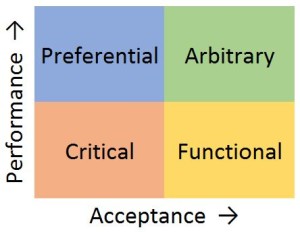
Based on the interplay of these two factors, I suggest that there are four types of change. Understanding these types can help us identify how strongly a change needs to be made as well as potential barriers we may face in implementing a change.

Critical Change
Changes made to functions low in performance and low in acceptance are considered critical. Not only is the desired result not being achieved, but the current process is not being accepted by those affected by it. When both performance and acceptance are low, something needs to change quickly.

Functional Change
Changes made to functions low in performance and high in acceptance are considered functional. While the desired result is not being achieved, people are comfortable with things the way they are. Changing things up may be necessary, but resistance can be anticipated due to the comfort level people have with the status quo.

change-matrix-300x232

Preferential Change
Changes made to functions low in acceptance and high in performance are deemed preferential. Even though results are being achieved through this current process, those involved in it may have reservations about it. They may perceive it as too difficult or time consuming. Change may be required in order to maintain employee engagement.

Arbitrary Change
Finally, changes made to functions high in both performance and acceptance may be considered arbitrary. No good reason for the change is apparent and potentially high levels of resistance can be expected.

How a proposed change is categorized depends on your perspective. We are human beings, after all, and our individual beliefs, goals, and preferences come into play when evaluating the need to change. For example, your wife may decide it’s time to paint the living room. She sees it as a preferential change as she has simply become bored with the color. For you, though, this may be perceived as an arbitrary change. The paint is in acceptable shape and you are perfectly happy with the existing color scheme. With differences of opinion such as this, conflict over the potential change can be expected.

When considering any change, it is important to take individual perspectives into account. Few of us like being subject to decisions affecting our lives if we see them as arbitrary. Communication and even compromise become important considerations in navigating change.

Change may indeed be the only constant. There is no progress without it. But how we – and others – view any given potential change has huge implications for effectively implementing it. Over the next couple of weeks, I’ll explore some of the specific reasons people have for resisting change and how we can work together to make change easier to implement and assimilate.

Consider a recent change you have been asked to make. How has your perception of the change impacted your reaction to it? What could have been done differently to make the transition easier?


JOIN THE CONVERSATION:

When do you find change most difficult? Share your thoughts on our facebook page.

Feet to the Fire: Keys to Personal Accountability

andrew-mirror-e1452990922179By now, close to a third of all New Year’s resolutions have been abandoned. Think about that. Millions of people announced an intention to make some kind of significant change in 2016; and less than three weeks later have walked away from that commitment. Is it any wonder that more and more people have decided to stop making resolutions altogether?

I guess some figure it’s just too hard to keep their resolutions. Losing weight sounds like a great idea, but when you really think about it, losing weight is not easy. It requires changing the way you think. It requires changing the way you act. It requires developing new habits. And change is very, very difficult.

But isn’t that the point? Aren’t resolutions supposed to be hard? Shouldn’t meaningful change come at a cost? After all, if it was really that easy to make significant changes to your daily life, you’d have already done it, right? There’d be no need to set some kind of goal for improvement.

We make resolutions in good faith. We set goals for ourselves with the most sincere of intentions. So many attempts at change fail though because we just don’t hold ourselves accountable. Starting a new routine tomorrow sounds great, but when tomorrow comes – with all of its unexpected twists and turns – the road isn’t as easy as we thought it would be and we give ourselves permission to back off. How can we hold our feet to the fire so that the meaningful change we desire takes root?

Renew your commitment to yourself.

  • Remind yourself why you set the goal in the first place. There’s a reason you identified this goal. Something happened that caused you to decide things had to be different. Hold on to that thought. Hold on to the emotions that welled up inside you and led you to declare that, going forward, your life would be different. Let those feelings propel you through the toughest parts of your transformation.
  • Give yourself permission to let other things take a back seat. One of the most common reasons for abandoning new routines in our life is lack of time. Guess what? That’s an excuse – nothing more, nothing less. We all have the same amount of time every day. We just choose to allocate it differently. Someone once said “I don’t have time” is another way of saying “That’s not important.” If you want something bad enough, you won’t have to find time for it. You’ll make time. Learn to let lesser things slide in pursuit of your identified priorities.
  • Write it down. Post it. Look at it. Commit to your goal in writing. Tape it to the bathroom mirror, the refrigerator, or the television. Make sure you can’t go a single day without being reminded of the commitment you made to yourself.

Create systems to hold yourself accountable.

  • Schedule it. Remember the SMART Goal filter? Conducted properly, that exercise will provide you with specific action steps to accomplish your goal. Now take those steps and identify exactly when and where you are going to take them. Write them on your desk calendar. Enter them into your smartphone. What gets scheduled gets done.
  • Create reminders. Now go back and set reminders to yourself so appointments don’t sneak up on you and catch you off guard. Set an alarm each night to remind you to pack the gym bag. Put a post-it note on the door to remind you to grab your lunch. Use texts and emails to stay on top off your new commitments.
  • Partner with others. One of the best ways to hold yourself accountable is to hold someone else accountable at the same time. Find someone who shares the same goal and work together. They say misery loves company. I say success is better when shared, and a little competition is good for the soul. Anyone want a Fitbit buddy?

Ask for accountability.

  • Tell others what you are doing. This time next year, people are going to expect Mark Zuckerberg to have delivered on his personal challenge to build an artificial intelligence system for his home. He publicly announced his intentions, essentially asking others to hold him accountable. A goal kept secret is easy to walk away from, but a public declaration invites accountability.
  • Give others permission to ask for updates. Having announced your goal to others, ask them to challenge you. Beg them to do it now, while your resolve is firmest. Share with them why this is important to you and request that they periodically check on your progress.
  • Welcome consequences. I define accountability as the application of both truth and consequences. Define some milestones and associate rewards (positive consequences) with reaching them. Identify some negative consequences with failure. We are naturally drawn to things we want and move away from things we don’t want. Use this basic instinct to your advantage and ask friends to help keep you honest.

Personal accountability is easy when the task is easy. Persevering in the face of obstacles requires discipline. Ultimately, you have to decide how you want to perceive yourself. Are you a champion, or an also-ran? Champions hold themselves accountable. They do what has to be done. If you want to be a champion, then be one. Don’t think about it. Don’t hope for it. Don’t wait for it to happen to you. Just be a champion. Do the things champions do – every day.


JOIN THE CONVERSATION:

How do you hold yourself accountable? Share your tips on our facebook page.

For Better Results, Trying Slowing Things Down

campfire-e1449461880550A few weeks ago, I started watching a television series called Longmire. Originally produced by A&E and picked up by Netflix last year, the show focuses on the exploits of Walt Longmire, a Wyoming sheriff. The sheriff and his deputies investigate a variety of crimes while navigating racial tensions between the locals and the inhabitants of a nearby Cheyenne Indian reservation – all against a backdrop of beautiful mountain scenery.

What appeals to me most about this series is the way Sheriff Longmire goes about solving each case. He never settles for the easy answer, instead preferring to dig deep into the facts and personalities surrounding each one. He makes plenty of mistakes, but his desire to do the right thing forces him to work harder and look further than others around him.

Longmire’s determination also means that some cases take several episodes to solve. The show is what I call a “slow burn.” As pieces of the puzzle start to come together, viewers are treated to some great character development and get to play detective right along with the cast. The end result is a story that’s more satisfying than most.

I think we could use a little more slow burn these days. It seems like life (particularly work life) has become so fast-paced and harried, that we just don’t have time to engage in a study of any one aspect for very long. We’ve become used to fast answers, obvious solutions, and projects that are organized and efficient. Along the way, we settle for the easiest option. We jump to conclusions. And we avoid those people or issues that might require more than a cursory glance to understand.

But the slow burn comes with some pretty compelling benefits; more in-depth information, better decisions, and stronger relationships. As desirable as those are, they typically lead to even better things – increased loyalty, higher productivity, more sales, and stronger revenues. Those are results any business would be happy to invest in.

For most of us though, slowing down takes conscious effort. It doesn’t come naturally. Only those with a desire for something more than moderate success are willing to endure the slow burn. If you think you are up to the challenge, here are three disciplines to pursue.

  1. Take time to build relationships. Most of the people we work with are little more than strangers. Make an effort to change that. Have real, honest conversations with people. Learn about their history, their passions, and their dreams.
  2. Take time to make better decisions. Resist the urge to dismiss an idea because it’s new, risky, or goes against your preferred way of operating. Commit to keeping your mind open to new possibilities.
  3. Take time to let things build. Recognize that, for best results, you often have to allow things to develop over time. After all, Rome wasn’t built in a day – and good things come to those who wait. Give worthy projects the time they need to mature.

Netflix just announced plans for a fifth, expanded season of Longmire. It seems like the slow burn is working for the show – and for Netflix. While there are times that moving quickly is called for, I for one plan to try taking advantage of this tactic as I start my next season. I invite you to tune in as well.

To Uncover Your Team’s Potential, Dig Deep

Moai_at_Rano_Raraku_-_Easter_Island_5956405378-e1447374867392Growing up, I was fascinated by far-away places; still am. My parents subscribed to National Geographic magazine and I eagerly looked forward to each issue, knowing that opening the cover would reveal a variety of stories about strange cultures and new discoveries – all accompanied by the most incredible photographs. From my room in Madison, Tennessee each article transported me to another place and time.

One of my favorite stories was about Rapa Nui, more commonly known as Easter Island. It’s the planet’s most remote island; 3,000 miles from the coast of Chile and over 1,800 miles from the nearest inhabited island. It’s famous for the hundreds of giant stone statues, called “moai,” scattered around the landscape. For centuries, people have been trying to understand how the locals were able to carve these statues, how they were able to transport them, and what they were meant to represent.

Many of the moai became buried over time due to flooding and landslides. In fact, it was only a few decades ago that archeologists, excavating around some of the larger statues, discovered the moai were full body statues rather than just large heads. Digging below the surface revealed not only a more fully formed sculpture, but traces of paint and carvings that had been protected from erosion. Each moai was found to be unique, possessing its own set of characteristics, rather than a clone of the same model.

Unfortunately, too many leaders view the members of their team the same way we used to view the moai – just a bunch of heads, all cut from the same material with little to distinguish one from the other.

Whether it’s due to a lack of time, a lack of opportunity, or a lack of interest; we tend to look at the people around us in terms of what’s easily visible. We make judgement calls based on a cursory glance at only the most basic information. Rarely do we dig deep enough to discover the unique traits someone brings to the table. I mean, how much do you really know about the people in your own organization?

You probably know quite a bit about those operating in your immediate vicinity – those you interact with on a daily basis. You work closely together, have lunch, share personal anecdotes from the weekend, and even develop friendships. As these close relationships grow, you naturally learn more about their capabilities and interests.

But what about those outside of your inner circle? How much do you really know about them? If your perception of someone is based on a limited set of interactions, say a few email exchanges or telephone calls, then you don’t have the full picture. If you make assumptions of their potential value based on a narrow scope of work that’s readily available, you have no way of judging their true potential.

Effective leadership involves digging deeper. It requires learning about what lies beneath the surface. Of course, that takes time. It takes effort. It takes commitment. But then, that’s leadership.

As scientists learn more about the moai, they also learn more about the long-lost civilization that created them. An entire culture lies underground, waiting to be discovered. Who knows how the world might be enriched and expanded with just a little digging?

“Moai at Rano Raraku – Easter Island” by TravelingOtter is licensed under CC BY-SA 2.0.

What Makes a Top Performer?

image

Last week, I had a conversation with a couple of people about identifying their top customers. It’s been my experience that when asked to name their best customers – that is, those who contribute the most to the business – the majority of people get it wrong. A look into actual sales data and performance of actual accounts over time always reveals others who contributed more. In fact, those that were considered “top” customers often prove to be hurting the business. Their demands for refunds and special treatment make them a burden rather than an asset.

The same can be said of employees I think. A manager’s perception of their team’s top performers is very often skewed. Someone who knows the right things to say or manages to be in the right place at the right time is not necessarily a key contributor. Digging into some actual performance data reveals that the actual work was conducted by others, people who may not be in a position of influence. The one you think is a top performer may in fact be riding on the coattails of the organization’s true heroes.

How do you identify a top performer? How do you know you are one them?

Top Performers Will: Top Performers Won’t:
  • Volunteer for new challenges.
  • Wait for someone to tell them what needs to be done.
  • Give credit where credit is due.
  • Allow you to believe they contributed more than they did.
  • Have a track record of steady contribution.
  • Have a hard time explaining their individual contribution to the team.
  • Identify ways to improve the organization.
  • Bad-mouth the organization.
  • Look for opportunities to assist others.
  • Shrug their shoulders when others encounter difficulty.
  • Work to build a history of performance.
  • Rely on friendships or past successes.
  • Have the support of those who work closest to them.
  • Be resented for failing to act as part of the team.

As a manager, do you know who your top performers really are? Are you relying on hearsay, assumptions, or friendships to guide your perception of team performance? If you were to dig a little deeper into actual performance, who would stand out?

As an employee, are you contributing in a way that identifies you as a top performer? Are you producing actual work or claiming success that really isn’t yours? Would those who see what you do on a daily basis refer to you as a top performer?

We all want to be seen as a marquee player. And everyone wants to have superstars on their team. The good news is top performers, like top customers, are easy to spot. You just have to know what to look for. What attributes tell you someone is a top performer?

How to Rock Your Next Crisis

Scott and Andrew at the concert

Saturday night, my oldest son Andrew and I flew to Houston to see Def Leppard in concert. I’ve been a fan since I first heard them back in the early eighties and hadn’t seen them perform live since their Hysteria tour in 1988. It was a great show and brought back a lot of memories.

Several of the songs from the set list came from that Hysteria album. This was an incredibly successful release for the band. Seven cuts made the U.S. Hit 100 chart and the album itself has sold over 20 million copies.

But the album almost never got recorded. In fact, the band’s rise to Rock ‘n Roll stardom was nearly cut short by an unforeseen crisis.

In December of 1984, drummer Rick Allen was involved in a car accident that severed his left arm. The group was stunned. Allen was a core member of the band and an accomplished drummer. To replace him was unthinkable. But how could he perform with only one arm? The band was unsure how to recover from the setback.

Organizations are hit with crises every day. Out of the blue, an external event or internal oversight can send you into a tailspin. When that happens, most experts will start talking about “managing” the crisis – that is, figuring out how to minimize the damage and return as quickly as possible to the status quo.

But some organizations choose not to play it safe. Instead of managing the crisis, they seek to capitalize on it. They choose to see opportunity where others see disaster. And thankfully so. History is filled with new innovations and leaps in thinking that resulted from some sort of catastrophe. Not that anyone would willingly seek out a crisis in order to jumpstart a new technology or line of business; but faced with a roadblock, pioneers will adopt a progressive mindset over a conservative one. And it tends to pay off.

The members of Def Leppard decided to do that, and when Rick Allen said he wanted to continue as drummer, the others backed him 100%. Allen reached out to Simmons, a manufacturer of electronic drum kits, who jumped at the chance to collaborate on a customized set up for the band. Within months, Allen summoned the rest of the guys and showed of his new drums and new way of playing. An array of foot pedals allowed him to simulate the actions of his missing left arm and even allowed for new percussion combinations that hadn’t been possible before.

The band spent three years recording Hysteria and embarked on a 15 month tour that showcased Allen’s abilities by using a rotating stage – another innovative approach. The critics and fans were blown away. I, for one, bought tickets to see them twice during that tour.

Saturday’s concert would never have been possible had the group not decided to press forward in the face of adversity. Fortunately for fans like me, they are still going strong. A new album is due to be released later this year. By nature, crises are unpredictable. Our response to them, however, doesn’t have to be. When the chips are down, how will you respond?


Stop Motivating Your Team! (Do This Instead)

stop

Over the years, I’ve been asked a lot of questions by managers in a variety of roles across numerous organizations. By far, the most frequently asked question is “How do I motivate my team?” Some are looking to increase sales performance. Others want to improve customer service or productivity. In many cases, managers seem frustrated by an overall lack of engagement exhibited by members of their staff. Energy levels are low, efficiency suffers, and goals go unmet.

So concerned managers wrack their brains trying to find a way to turn things around. They see a problem that needs fixing and go in search of a solution. ”If I can just get people motivated,” they think, “things will start moving in the right direction.”

And therein, I think, lies the problem. Motivation sounds like what we need to get the troops out of the doldrums. But it doesn’t. It can’t. To understand why motivation isn’t the answer, we first need to understand what motivation is. Let’s look at the root word “motivate.”

motivate: to provide with a motive or motives; incite; impel

Motivation is an external action designed to cause an internal reaction. It’s something one person does in order to elicit a response from someone else. Think about the typical actions many associate with motivation. Contests, incentives, awards, raises, and other types of recognition/reward strategies are used to spur a change in behavior. So are things like deadlines, threats, disciplinary actions, and other punitive measures. All can be, and have been, considered motivational strategies.

The inherent problem with these and other external actions traditionally used as motivation is that the behavior shift that results is, at best, temporary. The high from winning a contest or being recognized only lasts so long. The sting from negative feedback or an ultimatum loses intensity as time goes on. And as temporary emotions fade away, so do the changes in behavior associated with them.

As employee behavior slides back into mediocre territory, managers dip back into the box of potential motivators in an effort to stop the decline. The cycle of performance drop/motivation/performance improvement then begins again. Employees settle into a routine of reacting to the temporary external stimulus with a temporary burst of activity sufficient enough to win/satisfy the requirement/get management off my back and then easing up until the next stimulus comes along.

But if motivation isn’t the answer, then what is?

The key to long-term performance is not a short-lived behavior modification, but a long-term transformation of core beliefs. The answer is not externally driven, but internally. The answer is not motivation, but inspiration. Let’s check out another definition.

inspire: to fill with an animating, quickening, or exalting influence.

Do you see the difference? Motivation focuses on the head while inspiration targets the heart. Inspiring someone causes an empty part of them to be filled and the result is change that influences how they approach the concept of work itself, not just a particular task. Motivation can be applied or withdrawn at any time with correspondingly immediate results. Inspiration, on the other hand, becomes part of you and drives how you fundamentally think about things. Inspiration creates a deep-rooted drive to behave differently. Motivation may spark a temporary shift in behavior, but inspiration ignites a long-term change in attitude.

Inspired people are inherently motivated. So, the real question then is “How do I inspire my team?“

Well, if you’ve been reading the past few weeks, you already know some of the basics. How does that old saying go? “People don’t care how much you know until they know how much you care.”

Once you’ve mastered the skill of developing relationships, people are instinctively drawn to you. And that’s important; because it’s only then – when they trust you and want to listen to you – that you can share your vision and ask them to participate in it. If done right, they’ll get on board; not as motivated worker-bees, but as inspired partners.

Inspiration isn’t a one-time action. It results from extended exposure to someone who sees people, not employees. It’s about fulfilling potential, not completing tasks. It’s about contributing to something bigger than myself as opposed to being a cog in the machine.

People don’t want to be motivated. But we all have a desperate, innate need to be inspired. Fulfill that need and see just how far the team will take you. Who will you inspire today?

Breaking the Cycle of Unengagement

groundhog day

In the 1993 movie Groundhog Day, Bill Murray plays disengaged television meteorologist Phil Connors. Phil is sent to Punxsutawney, Pennsylvania to cover the annual groundhog ceremony whereby the famous rodent predicts the weather. Obviously frustrated by the menial assignment, Phil comes across as rude, condescending, and genuinely uninterested in both his coworkers and the townspeople around him. He arrives late for the live television feed and fakes his way through it; going through the motions in an obvious attempt to get things over with so he can get back home.

The people Phil comes in contact with make repeated attempts to connect with him. The mayor, his cameraman, and his producer all eventually get fed up with his brusque demeanor. Phil rushes the team back on the road, but a freak blizzard forces them to turn around and spend the night in Punxsutawney. He awakens the next morning to find he is trapped in a time loop, repeating the same day over and over again.

I don’t know about you, but I run into a lot of people who resemble Phil Connors. They isolate themselves from others and basically sleepwalk their way through the day. Any attempt to connect with them or collaborate is met with outright resistance or, at best, reluctant participation. They seem to exert the least possible amount of effort, performing just well enough to get through the day; but not really impacting anything or anyone. They’re miserable and it shows. And this goes on day after day after day.

In other words, they are unengaged.

A 2014 Gallup poll revealed that almost 70% of employees in the U.S. are unengaged. That means millions of people go to work every day uninvolved, unenthusiastic, and uncommitted. Employees classified as managers, executives, or officers apparently check out just as frequently. Sixty-two percent of that group said they are unengaged as well.

You don’t need a research study to figure out the implications of this. Unengaged employees obviously cost an organization in terms of sales, service, and innovation. Organizations with high levels of unengaged employees also have high turnover, incurring extra costs associated with hiring and training. The problem is real and, according to the research, widespread.

So what are we to do to combat the engagement dilemma? Well, the same Gallup survey identified a handful of organizations that seem to have cracked the code. And the number one reason for their higher-than-average levels of engagement? Involved leadership. Here’s a quote from an article detailing the findings:

“Leaders’ own attitudes, beliefs, and behaviors have powerful trickle-down effects on their organizations’ cultures. Leaders of great workplaces don’t just talk about what they want to see in the management ranks — they model it and keep practicing to get better at it every day with their own teams.”

The key to highly engaged employees is highly engaged leadership – involved leadership. Engagement doesn’t happen in a vacuum. It requires action. It requires participation. It requires getting up from the desk and interacting with people. That’s the only way you get to know them. That’s the only way you get to share with them your vision for the future. That’s the only way you can influence their desire to be a part of that vision.

How well do you know the people around you? How well do you know what’s going on in their lives? How involved are you in their work? How engaged are you?

Phil Connors tries desperately to break out of the repetitive time loop. At first he behaves erratically, thinking altering events around him will make a difference. It doesn’t. He tries running away from the problem by leaving town and even committing suicide. But every day winds up looking the same. It’s only when he decides to get involved in the lives of the people around him that something changes. It’s only when he gets to know them and decides to get engaged himself that the cycle is broken.

We don’t know how long it took Phil to break out of his time loop. The film doesn’t say. Director Harold Ramis suggested it took perhaps 10 years. Analysts of the events depicted in the movie have theorized Phil lived the same day over and over for 40 years or more. Hopefully it doesn’t take the rest of us that long to figure things out.

Can You Hear Me Now?

My wife and I were reminiscing recently about the early days of our marriage. In November, we’ll have been married 24 years and we’ve both changed a lot since saying “I do.” Sure, the physical changes are the most obvious; but most significant are the changes in how we treat each other. I must admit though, I’ve had to change a lot more than she has.

For example, I distinctly remember a conversation we had one afternoon just a few months after our wedding. I came home from work late and still had events of the day on my mind as I walked through the door. Susan immediately began telling me about her day. She followed me through the house as I pulled off my jacket and tie, quickly moving to put on comfortable clothes.

Suddenly it dawned on me that the pace of Susan’s speech was increasing. She talked faster and faster until the words practically jumbled together into nonsense. She finally stopped to inhale, gasping for breath. I looked at her and asked “Why are you talking so fast?” Her response hit me like a ton of bricks. “I have a lot to tell you, but I know that any second you’re going to tune me out.”

Wow. Before me stood the person that most mattered to me in the world and within weeks of promising to give her everything, I’d managed to renege on that promise. All she needed was for me to listen – to give her a few minutes of undivided attention – and already I’d proven unable to do it.

We humans have a listening problem. Our ears work; we hear just fine. It’s listening – an activity that takes place in the brain – that seems difficult.

Listening is often touted as a key sales skill; but it goes much further than that. Listening is a key customer service skill. It’s a key leadership skill. It’s a key relationship skill. It’s a key life skill. And as simple as it sounds, we struggle to get it right.

We live in a busy world. Information bombards us from every direction. People and email and social media all vie for our attention and there just doesn’t seem to be enough time in the day to get it all done. So we multi-task. We eat lunch while we read through email while we listen in on the conference call while we “listen” to the person that just walked into the office. But we’re fooling ourselves. Multi-tasking makes us feel better by allowing us to cross off more items on the to-do list. It helps us “get things done.” But it doesn’t help get things done right. Studies have actually shown that dividing our attention makes us less efficient than focusing on one task, or one person, at a time.

The real victims are those on the other end of the exchange. People can sense when they don’t have your full attention, just like my wife did. They can tell you’re preoccupied. And it makes them feel horrible. You’ve been there. Remember the last time you tried talking to someone who wasn’t really listening? How did it make you feel? Unwanted? Unwelcome? Unworthy?

So how do you practice listening? How do you let me know that you’re really paying attention? Let’s start with three small steps:

  1. Make time for me. Is now not a good time for us to talk? Then tell me so. Suggest a time when we can speak without interruption. I want your attention. I need you to listen to me. And if I’m as important to you as you say then you’ll make one-on-one time a priority.
  2. Look at me. Put down your cell phone. Turn away from the computer. Stop pacing around your office searching for a file related to the next meeting on your calendar. Scrape the daydream glaze off of your face and point it in my direction. If your eyes aren’t focused on me, then your brain isn’t either.
  3. Participate with me. Listening is not a passive exercise. It involves asking questions, clarifying, and even offering information. Body language and nonverbal matter. Head nods and robotic “uh huhs” are sure signs that your attention is elsewhere. Listening requires involvement.

I am your customer. I am your employee or coworker. I am someone significant. And what I have to say is very, very important. Are you listening? Do I have your attention? Can you hear me now?