
When Good Leaders Do Bad Things

egg-583163_640Addressing conflict is one of the key responsibilities of a leader. It’s not a fun job; in fact it’s often quite messy. Nevertheless, it has to be done in order for a team or organization to operate effectively. Conflict rarely resolves itself. While things may eventually seem to smooth out on the surface, there are always scars. Poorly handled conflict results in missed growth opportunities, the loss of top performers, and an unstable environment for those left behind.

It’s worth noting that, even as they should be working to resolve conflict, many managers act in ways that cause or escalate it. Certain actions, or inactions, by those in charge actually create tension and uneasiness that leads to conflict. Adept leaders regularly assess their own performance to ensure they aren’t adding to the very issues they try to prevent.

In a 2003 study of group dynamics and conflict, researchers identified five core beliefs that seem to move individuals toward conflict with each other. As leaders, we need to be on the lookout for these and do our best to address them before things get out of hand.

The first of these beliefs is Superiority. This is the feeling that I or my group is in some way superior to another individual or group. This belief can foster a sense of entitlement or protected status that puts people at odds. Managers who treat certain groups or individuals differently than others – giving them special privileges or ignoring sub-standard performance – cultivate this belief.

The second conflict-promoting belief is Injustice. This s the feeling that I have mistreated or slighted in some way. The pursuit of justice or even revenge can lead to escalating levels of conflict. Managers create a sense of injustice by adopting policies or practices that seem unfair, self-serving, or unequally applied.

A third belief to be aware of is Vulnerability. Here, an individual or group feels they have little control over important aspects of their work. A feeling of vulnerability can cause someone to act defensively or even aggressively if they feel a core part of their identity is being threatened. Managers make people feel vulnerable when they withhold resources and information necessary to do their best work and when they turn a deaf ear to reasonable requests.

Distrust is another belief that leads to conflict. Often due to being let down in some fashion, individuals who develop a feeling of distrust for others are less likely to collaborate. Teams who distrust others, or the organization, often isolate themselves and develop subcultures that eventually come into conflict with others. Managers sow distrust by failing to follow through on commitments, communicating dishonestly, and generally acting in ways contrary to their stated values.

Finally, Helplessness can lead to conflict. Helplessness is the belief that nothing you do matters in the big scheme of things. No matter how carefully you plan and act, the odds are stacked so heavily against you that success is impossible. Managers create a feeling of helplessness by setting unrealistic goals and regularly focusing on the negative without recognition of positive performance.

Keep in mind that these are core beliefs held by an individual or team. It doesn’t matter whether or not an actual injustice has occurred. All that matters is the perception that it has taken place exists. It’s become part of the affected person’s worldview. It is this belief that lays the foundation for conflict to occur. Perception is reality and, without something to counteract them, these beliefs can fester and grow until conflict erupts.

Anyone who thinks being in charge is easy doesn’t know what they’re talking about. Being a leader – a true leader – requires a great deal of focus, energy, and sacrifice. It starts by examining your own actions and taking the steps necessary to create an environment where people feel valued and engaged. Conflict is inevitable, but our participation in it is not.


JOIN THE CONVERSATION:

Have an opinion on this post? Share your thoughts on our facebook page.

Communicating Effectively Is a Lot Like Washing Your Hair

shower-1027904_640By the time German inventor Hans Schwarzkopf introduced liquid shampoo to the public in 1927, people had been washing their hair with various mixtures for centuries. The earliest examples involved mixing soapberries, gooseberry, and other herbs and using the extract to lather the hair. Later, Europeans would take to boiling shaved soap in water. Herbs were still typically added to give the soap soup a pleasing aroma. But Schwarzkopf’s shampoo was the first to be sold in a pre-mixed, liquid form.

Shampoo works by removing some of the sebum from your hair. Sebum is secreted by our sebaceous glands and provides a coating that protects the hair from drying out and becoming damaged. Sebum also, however, attracts dirt leading to a build-up that makes hair unmanageable and unattractive. Shampoo works by introducing surfactants, compounds which bind with the sebum. When you rinse the shampoo from your hair, the sebum – as well as the dirt – goes with it. Shampooing removes the unwanted material, allowing your hair’s natural beauty to show through.

Communicating effectively is a lot like washing your hair. Over time, your team’s understanding of the goals and job functions they should be focused on gets dirty. Various bits and pieces of other information, from a variety of sources, start attaching themselves, making it hard to manage individual priorities day to day. Proper communication serves to clear away misconceptions and competing priorities, leaving behind clarity and allowing people to do their best work. To improve communication, all we have to do is follow the instructions on any shampoo bottle.

Step 1. LATHER. You only need to use a little bit of shampoo at a time, but it’s only effective when worked well into the hair. By massaging your scalp, you ensure that the shampoo makes its way below the surface, touching every part of your head. In the same way, small bits of communication, well applied, work better than sporadic rambling messages. Focus on communicating single concepts in a way that ensures people get the message. Don’t rely on a single email or memo to get the job done. Follow up with personal contact and check for understanding before moving on to the next step.

Step 2. RINSE. Applying the shampoo is only the first step. The real magic happens during the rinse. This is when the dirt is cleared away leaving behind clean, unobstructed hair. Effective communication works to remove misunderstandings and competing priorities. Make sure to clarify, as succinctly as possible, those things that are most important and should be retained. Allow people to voice their questions and provide clear answers to avoid uncertainty. Make sure that your communication clears up the ambiguous instead of adding to it.

Step 3. REPEAT. A single application of shampoo doesn’t always remove all the dirt. It might take another lather/rinse cycle to really clean things up. When communicating, be prepared to revisit complicated topics as necessary to ensure everyone is on the same page. Expect that, despite your best efforts, your initial communication may be misinterpreted, forgotten, or even ignored. Plan on putting in the effort to communicate effectively over time. Approach the topic from different angles to reach people with different learning styles. Communication is a process rather than a single act.[Tweet “Communication is a process rather than a single act.”]

I don’t know about you, but I wash my hair every day. It’s not even something I think about – I just do it. If I happen to miss a day, because I’m camping or ill, I really notice the difference. My hair feels gross, my scalp starts to itch. I find myself desiring that shampoo bottle. Washing my hair has become such an automatic part of my routine, that its absence is more conspicuous than its presence.

With practice, effective communication too becomes second nature. It’s the absence of good communication that gets our attention. It’s in those times when information is scarce and the way forward is unclear that we really understand the importance of clear messages. You’re never not communicating. Like it or not, you send out messages constantly. The challenge is to communicate in a way that brings clarity and focus to the team.


JOIN THE CONVERSATION:

Have an opinion on this post? Share your thoughts on our facebook page.

Question What You Know

head-776681_640In the course of history, a lot of very smart, successful people have made statements that, in hindsight, seem rather silly. Given their position, expertise, and experience, they felt comfortable making predictions that proved untrue. Consider these examples:

“The abdomen, the chest, and the brain will forever be shut from the intrusion of the wise and humane surgeon”. –Sir John Eric Ericksen, British surgeon, appointed Surgeon- Extraordinary to Queen Victoria 1873

“I think there is a world market for maybe five computers.” — Thomas Watson (Chairman of IBM), 1943

“We don’t like their sound, and guitar music is on the way out.” — Decca Recording Co. rejecting the Beatles, 1962

“640K ought to be enough for anybody.”– Bill Gates, 1981

While these assumptions may appear laughable, they should serve as a warning. Every day, people make assumptions that negatively impact the future of their business, their team’s effectiveness, and even their own relationships. In the absence of good information, seemingly reasonable people fill in the blanks with their own preconceived notions of what is true.

Most people are reluctant to question what they think they know. Some may be reluctant to ask, fearful of looking foolish rather than confident. Others feel comfortable relying on third-hand information to form their opinions. And we’ve all made assumptions about what others think by misinterpreting behavioral clues presented by those around us.

Whatever the cause, effective leaders know better than to make key decisions based solely on a gut feeling. When the business, teammates, or customers are on the line, they take action to verify their feelings. Here are some quick tips for moving from assumption to certainty.

Ask – Effective communicators know the importance of listening. That’s why the best ask more than they tell. If you want to know what people are thinking or doing, there’s no better strategy than simply asking them. Be a leader who asks a lot of questions.

Clarify – If it can be misunderstood, it likely will. Assuming you know what someone means can easily send you down the wrong path. Instead of making your own judgment about someone’s intentions, make an effort to clear up any potential misunderstanding. Be a leader who clarifies the ambiguous.

Confirm – Don’t assume that, just because you sent an email to roll out a new process or announced expectations during a meeting, that employees are acting appropriately. Inspect what you expect. Get to the bottom of things by securing proof either first-hand, or from a trusted colleague. Be a leader who confirms what they think.[Tweet “Top leaders know when to trust their instincts and when to ask for help.”]

Everyone falls victim to assumptions now and then. What makes top leaders stand out is that they have learned when to trust their instincts and when those instincts need a little help. As you develop your own leadership skills, learn to rely on assumptions less and less.


JOIN THE CONVERSATION:

Have an opinion on this post? Share your thoughts on our facebook page.

Taking Stock

chess-1464959_640My oldest son started back to school this morning. It will be his last semester of Nursing School and he’ll be an RN (hopefully) in December. My other two kids will be heading back to high school in a couple of weeks. Like a lot of families, our conversations this weekend periodically morphed into discussion of the various challenges and expectations the new school year will hold. We talked about strengths and weaknesses and bounced around strategies to try and get the most out of the fall semester.

 The transition from one season to another is also a good time to take stock of where your team stands, both individually and collectively. As everyone gears up to take on the stretch into winter, it can be beneficial to circle the troops for a discussion of team dynamics, market conditions, and customer expectations. One tool that’s proven helpful in this regard is the SWOT analysis. Using this framework, teams and individuals can develop a better understanding of the internal and external landscape they will navigate over the coming months. Here are some questions this exercise can help you answer.

[Tweet “I’ve often found that answers are just waiting for the right question to be asked.”]

FOR TEAMS:
S – Strengths.
What’s going right? Where does the team excel? What particular talents and abilities do individuals possess that make them an asset to the organization? What are the significant client relationships and areas of differentiation that make your team stand out?

W – Weaknesses. What aspects of your business model put you at a disadvantage? What cultural limitations present hurdles for you? What talents need to be shored up, and where do internal roadblocks impede the team’s ability to excel?

O – Opportunities. What external factors, such as economic conditions or market changes, stand to provide you with an unexpected leg up? What shifts in the competitive landscape will provide you with an open door? What relationships with customers and/or prospects are evolving in ways that could provide windows into new business?

T – Threats. What factors beyond your control stand in your way of success? Are there regulatory issues looming on the horizon? How will the political climate over the next several months impact your business model? How might your growth strategy (you do have one, don’t you?) be thwarted by issues you have no ability to influence?


FOR INDIVIDUALS:
S – Strengths. What are you naturally good at? What skills have you developed recently? How strong is your personal network? What positives do others see in you?

W – Weakness. What bad habits hold you back? What training or education do you need to pursue? Have constructive criticism have you received that needs to be heeded? What do others see as your primary flaws?

O – Opportunities. Where can your particular talents be of the most use? What gaps exist in the team or organization that you could help fill? What changes are coming down the road that you need to be prepared to advantage of?

T – Threats. What stands in the way of your growth? What’s keeping you from contributing at the highest possible level? What might be lurking around the corner that could derail your career plans?


Effective communication – with the team or with yourself – is about finding answers. I’ve often found that answers are just waiting for the right question to be asked. A SWOT analysis is simply a catalyst for asking those questions. By understanding your strengths, weaknesses, opportunities, and challenges, you can prepare to make the most of the days ahead.


JOIN THE CONVERSATION:

Have an opinion on this post? Share your thoughts on our facebook page.

The Matrix of Change

sign-94966_640It’s often said that “the more things change, the more they stay the same.” In many ways, this appears to be the case. Change is all around us. And whether it’s technological, social, economic, political, or otherwise, the volume of speed at which change takes place is constantly on the rise.
Even when it’s good for them, people tend to resist change – not because they don’t want things to be better, but because it takes energy to change. It’s not change itself we fight, but transition; the act of moving from one state to another. That’s where the energy is required. So we balk at those changes that we perceive will take the most out of us.
I believe there are two factors behind the impulse to change. The degree to which they impact the status quo determines how strongly the desire to change manifests itself.

The first factor is the performance of a current process. Another phrase you may be familiar with, “if it ain’t broke, don’t fix it,” comes to mind. If the existing course of action is producing the desired result, then it’s difficult to justify changing it. The more “broken” a process appears to be, however, the more change becomes necessary.

The second factor is the acceptance of the current process by the people affected by it. If people are comfortable with the status quo, then it will be difficult to affect a change in their behavior. The more accepted a process is, the more difficult it is to get people to change – regardless of the process’ performance.

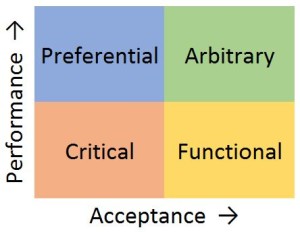
Based on the interplay of these two factors, I suggest that there are four types of change. Understanding these types can help us identify how strongly a change needs to be made as well as potential barriers we may face in implementing a change.

Critical Change
Changes made to functions low in performance and low in acceptance are considered critical. Not only is the desired result not being achieved, but the current process is not being accepted by those affected by it. When both performance and acceptance are low, something needs to change quickly.

Functional Change
Changes made to functions low in performance and high in acceptance are considered functional. While the desired result is not being achieved, people are comfortable with things the way they are. Changing things up may be necessary, but resistance can be anticipated due to the comfort level people have with the status quo.

change-matrix-300x232

Preferential Change
Changes made to functions low in acceptance and high in performance are deemed preferential. Even though results are being achieved through this current process, those involved in it may have reservations about it. They may perceive it as too difficult or time consuming. Change may be required in order to maintain employee engagement.

Arbitrary Change
Finally, changes made to functions high in both performance and acceptance may be considered arbitrary. No good reason for the change is apparent and potentially high levels of resistance can be expected.

How a proposed change is categorized depends on your perspective. We are human beings, after all, and our individual beliefs, goals, and preferences come into play when evaluating the need to change. For example, your wife may decide it’s time to paint the living room. She sees it as a preferential change as she has simply become bored with the color. For you, though, this may be perceived as an arbitrary change. The paint is in acceptable shape and you are perfectly happy with the existing color scheme. With differences of opinion such as this, conflict over the potential change can be expected.

When considering any change, it is important to take individual perspectives into account. Few of us like being subject to decisions affecting our lives if we see them as arbitrary. Communication and even compromise become important considerations in navigating change.

Change may indeed be the only constant. There is no progress without it. But how we – and others – view any given potential change has huge implications for effectively implementing it. Over the next couple of weeks, I’ll explore some of the specific reasons people have for resisting change and how we can work together to make change easier to implement and assimilate.

Consider a recent change you have been asked to make. How has your perception of the change impacted your reaction to it? What could have been done differently to make the transition easier?


JOIN THE CONVERSATION:

When do you find change most difficult? Share your thoughts on our facebook page.

Circle Up! Lead From the Huddle

Hands-In-e1448857238616Paul looked across the line of scrimmage at the other team. He glanced at the scoreboard and then at the stands; full of friends and family, all anxiously awaiting the next play. Then he scanned the faces of his teammates. Each one stared intently at Paul, eager to receive his instructions. It was 1892 and, as captain of the Gallaudet University football team, Paul Hubbard felt the weight of the world on his shoulders.

The two teams were fairly evenly matched. Defenses on both sides had had little difficulty in thwarting any big offensive moves. But that came as no surprise to Paul. It’s easy to anticipate your opponent’s next move when they spell it out for you. You see, Paul and his Gallaudet Bison teammates were all deaf; so were the players lined up across from them. Gallaudet and their rival school were both universities designed for the deaf and hard-of-hearing. Naturally, plays were relayed using American Sign Language. All you had to do was watch the quarterback’s hands, and you knew exactly what play he relayed to the rest of his team.

Paul suddenly realized that, unless he could devise a way to communicate with his team in a manner that prevented their rivals from seeing his signs, this would be a very long game. So he stepped back from the line and motioned his men to follow. Then he arranged them in a circle facing each other and relayed his instructions safe from prying eyes. In other words, he initiated the first football huddle.

Today, huddles are an expected part of any football game. In fact, just about every sport has adopted the huddle as way to bring the team together between plays. It’s a great way to share time-sensitive information, gain consensus, and boost motivation. Smart business teams also understand the value of the huddle. Teams that take advantage of opportunities to huddle routinely report increased productivity, camaraderie, and job satisfaction.

The thing I like most about the huddle is that it happens on the field – right in the midst of the game. When you’re in the middle of a huddle, its game time. There’s no time for practice. No time for debate. It’s all about execution. Once the huddle breaks, the game is on. That makes the huddle the most important meeting a team will ever have.

If you haven’t tried huddling with your team, maybe now is the time to give it a shot. Even if you currently utilize the huddle, you might want to check out Arina Vrable’s tips for running an effective team huddle. She provides some great ideas for incorporating this strategy into your daily routine.

  1. Keep it short. Shoot for no more than 15 minutes. You need to get out there and score some points.
  2. Keep it moving. This is not the time to make long-term plans. Focus on what’s needed to succeed today.
  3. Keep it going. Don’t let the practice die because it feels awkward at first. Like anything else, team huddles take some time to get right.

Leaders consistently ask me to help them with tips for motivating the team. I’m a long-time believer in the power of huddles to keep teams informed, focused, and accountable – all essential elements to motivation. Practiced consistently, a 15 minute huddle can dramatically impact the outcome of the day.

Committed teams look forward to the huddle. They see it as part of a game-winning strategy. And once the huddle breaks, every player knows exactly what they’re supposed to do in order to win. So what do you say, quarterback? Ready to win this game? OK then…circle up!

The Act of Leadership: What Do Leaders Do?

leading

Your actions speak so loudly, I can not hear what you are saying. -Ralph Waldo Emerson

I’ve written recently about the things a leader sees and the things a leader says. But it’s hard to ascertain the true measure of a person by what catches their eye. And anyone can come up with a great quote or two. What makes great leaders stand out is the sum of their actions. In short, you know someone is a leader by what they do.

Here are a few of the observable traits of effective leaders.

1. Leaders decide the direction. We’re each faced with a thousand decisions each day. Some are more critical than others. But some decisions affect lives other than just our own. When it comes to making the big decisions – the ones that impact customers, coworkers, and the future of the organization, leaders don’t hesitate. They instinctively know what the right thing to do is and they do it. Leaders step up and make the right call.

2. Leaders act with intention. Leaders see the promise of the future, and they communicate that vision regularly. Leaders also visualize a clear path to that vision. So when a leader acts, you can be sure there’s a reason for it. There’s an agenda. It may not always be readily discernable, but it’s there. Watch a leader long enough and you’ll start to see the master plan take shape. Leaders plan their work and work the plan.

3. Leaders serve as an example. I have three kids. I try to remind myself that they are always watching me. They see everything I do – the decisions I make, the way I respond to circumstances beyond my control, and how I treat other people. They follow my example and emulate my actions. Knowing this, I try to make sure that my example is a good one. Leadership is a lot like parenting. Leaders act knowing that others are watching and learning from their example.

4. Leaders equip others for success. I’ve said many times that I believe the number one responsibility of a manager is to develop those they lead. Ultimately, the job of a leader is to produce other leaders. Because the impact of a great leader is not felt in their presence, but in their absence. So leaders actively seek out resources that will help their team grow stronger. They look for opportunities to delegate responsibility. And they celebrate when the leader in others is revealed. Leaders participate in the education and growth of those around them.

5. Leaders let others lead. No man is an island. And no leader has what it takes to succeed in every circumstance. Strong leaders understand their own limitations and are comfortable with taking a back seat from time to time. That’s because leaders don’t focus on their own egos. They focus on achieving the vision. When someone else is better equipped to take point, strong leaders respond by following. Leaders happily step aside and others lead where appropriate.

This list could go on. There is no end to the list of positive things that leaders do. One thing I know for certain though, is that leadership is not a passive activity. Leading requires action – in a very real sense, leading is action. How will you lead this week?

What’s Wrong with Your Face?

Cyclists 1895Writing about the Tour de France last week got me thinking about the history of the bicycle. Here are a few of the facts I found interesting:

* Bicycles were introduced in Europe during the 19th century.

* The modern bicycle design evolved from that of the dandy-horse.

* The first pedaled bicycle was developed in 1839 by Kirkpatrick MacMillan, a Scottish blacksmith. He is also associated with the first recorded bicycle-related traffic offense.

* The most popular model of bicycle in the world (and the most popular vehicle of any kind) is the Chinese Flying Pigeon.

* There are more than twice as many bicycles in the world as there are automobiles.

But by far the most interesting thing I uncovered was a mysterious bicycle-related illness known as “bicycle face.”

It seems that bicycle-riding enjoyed a huge surge during the late 1800’s, around the time chain-driven models were introduced. And as bicycling became more popular, it drew its share of detractors as well. Some didn’t like the congestion on the streets. Some didn’t like the impact bicycling had on fashion (women began to shun long dresses for clothing that allowed greater freedom of movement). Some bemoaned the lost art of one-on-one communication allowed by walking or taking the carriage to your destination. Thanks to a growing number of bicyclists who would opt for a Sunday morning ride over attending church, some even argued that cycling led to spiritual damnation.

Soon doctors were writing to medical journals describing the impact of cycling on one’s physical health. In addition to appendicitis, dysentery, and infertility; excessive riding, they argued, could lead to “bicycle face.” This disease was caused by the constant need to focus on balancing yourself on the bicycle while also scanning your surroundings to avoid collision with something or someone else. The anxiety produced by this level of concentration would lead to bulging eyes, flushed skin, and tense jaws. If not corrected in time, they warned, the effects of bicycle face would become permanent.

Over one hundred years later we can laugh about this obviously fictitious disease. But take a look around. How many people do you know who walk around every day with “bicycle face?”

Employees today are stressed. They’re stressed about the demands on their job. They’re stressed about the future of the company. They’re stressed about the future of the industry. They’re stressed about the next customer interaction. They’re stressed about meeting your expectations. And they’re stressed about balancing all of this with all of the other stuff that stresses them out at home. According to the American Psychological Association, the number one stressor for people 18-33 is work. And twenty percent of this group has been diagnosed with clinical depression. Now before you go thinking “Wow. I’m glad that doesn’t happen here. My employees aren’t stressed,” think again. They are.

It’s up to us as managers to address this problem. It’s up to us to address the issues causing stress amongst our employees. As work-related stress goes up, job satisfaction and productivity obviously go down. In addition, all that stress gets transferred to your customers, leaving a negative impression and impacting future business. Nobody wants to conduct business with a company full of stressed out, anxiety-ridden employees. The only ones who can make an immediate, positive impact on the organization are the leaders – and you are part of that group.

So come on fellow leaders, let’s fix this. Let’s talk to our employees and find out what’s causing all this stress. Then let’s do something about it.

After all, who wants to work all day next to Mr. Bicycle Face?

To Believe or Not To Believe

PinocchioAs a former advertiser, I love a good commercial. One of the more popular ones currently playing is from Geico. The commercial features Pinocchio as a motivational speaker. If you haven’t managed to see this one, you can catch it on YouTube. I think they got Pinocchio spot on – the look, the voice, everything.

This commercial is funny, but the more I watch it, the sadder it appears. Watch it again, this time focusing on the man Pinocchio speaks to. This poor guy has come to a motivational seminar looking for validation of his self-worth.

As Pinocchio proclaims the presence of “potential” in the room, the man begins to feel a rising sense of purpose. When Pinocchio points him out specifically, saying “You have potential,” the man’s face breaks into a huge grin.

Then Pinocchio’s nose begins to grow.

In an instant, our friend in the audience has his confidence shattered. His face falls as he realizes Pinocchio doesn’t see value in him at all. And because the authority in the room sees no potential in him, he adopts the same belief.

Words are powerful. You’ve heard that “Sticks and stones may break my bones, but words will never hurt me.” The words of a leader, however, carry more weight than the average person’s. Those in charge have the power to make someone’s day – or ruin it – with just a few words.

Even more important than the words a leader says is the belief behind them. Sometimes the right words are said, but they’re not meant. A compliment, delivered insincerely, is the worst kind of insult.

You see, as a leader; you are always leading – either building people up or tearing them down. People need leadership. Every single one of us needs someone to point out the goal, provide direction, and give feedback.  And we all follow the example of the leader. Whatever feelings we derive from our interaction with them, we pass on to others -coworkers, customers, even family members.

Leadership is a noble calling. But it is not something to be taken lightly. What kind of leadership are you providing? How do people feel after a typical interaction with you? How does your leadership impact the service your team provides to others?

The Art of Simplicity

You’ve probably heard of the old adage “Keep It Simple Stupid.” Commonly known as the KISS principle, this timeless piece of advice suggests that, in most cases, the simplest solution is the best. When you think about it, this makes sense. The more complicated an idea is – the more moving parts it has – the more likely something will go wrong.

This is a concept most commonly voiced in engineering and manufacturing circles. Machines with more moving parts have more potential points of failure. Software loaded with bells and whistles often has more bugs in it than code focused on a few core features. As a result, we constantly have to juggle patches and updates to shore up the short-comings inherent in complicated products and processes.

I believe the idea of simplicity has a lot of relevance in the world of organizational management as well. As leaders, it’s very easy to over-complicate things for those looking to us for direction.

In my experience, leaders tend to fail when they try to achieve too much at one time. You’ll be far more effective when you break complex ideas into simple, easy-to-digest parts.

If you want to communicate effectively, keep the message simple.

If you want employees to learn, keep instructions simple.

If you want your team to perform, keep goals simple.

If you want customers to respond, keep the value proposition simple.

I’m a talker by nature and by trade. I often have a great deal of information to share, and could probably write a book about any given subject when all that’s needed is a couple of short sentences. I’ve found that I’m much more effective as a speaker, leader, and consultant when I keep things simple.

In fact, I’m having to resist writing too much right now on the subject of simplicity. So I’ll sum things up with a few simple questions.

What part of your business could use simplifying?

How can you simplify things for your employees or your customers?

And what steps will you take today to incorporate the KISS principle into your day-to-day activities?