

What Do You Believe?

cartoonI’ve never really thought of myself as an artist. The ability to draw has always felt like an innate talent – some people have it; most don’t. From the get-go, I put myself firmly in the “doesn’t have it” category. I used to watch in awe as friends would sketch out beautiful landscape scenes or quirky cartoon characters, seemingly without even thinking about it. Occasionally, I would make my own feeble attempts at a drawing and then quickly hide it from sight; secure in my belief that drawing was just not my thing.

Then last week, I came across this TEDx presentation by artist Graham Shaw: “Why people believe they can’t draw – and how to prove they can.” He starts by asking how many people in the audience feel they can draw. Not surprisingly, very few hands go up. Shaw goes on to say that the ability to draw actually has very little to do with talent, but a great deal to do with belief. Just like I used to think, he says most people simply adopt the belief that they can’t draw, can’t sing, or produce any other enviable talent. It’s that belief that keeps us from actually accomplishing the things we want.

But the most interesting thing about Shaw’s presentation is that he walks the audience through a process that actually proves they can draw. I won’t spoil it for you here. You need to watch the video for yourself. Grab a pen and a piece of paper and be prepared to follow along. That’s what I did.

As the video concluded, and I looked down at my own piece of paper, covered with reasonably good cartoons (like the one I’ve shared here), I couldn’t help but think of the other ways my own lack of confidence has held me back. Could it be that what really keeps us from achieving our goals isn’t a lack of talent, but a lack of belief? Maybe you’ve expressed (or at least thought) one or more of these limiting beliefs:

“I’m not a leader.”
“I can’t sell.”
“I wish I was a better writer.”
“If only I was good at ___.”

What if, as Graham Shaw suggests, we challenged those beliefs? What we decided that, in spite of a lack of resources, experience, or outside influences, we were going to give it a shot – and we just gave it our best effort? Then we tried again, and again, and again…until our beliefs actually caught up to our ability? What could we accomplish?

Obviously, fifteen minutes of drawing doesn’t make me an accomplished artist. You won’t see my work showcased in a gallery any time soon. However, by following Shaw’s lead, I’ve been encouraged to make additional attempts. None are perfect, but each is better than the last.

I can’t draw well, but now I believe I can draw; and each attempt gives me the confidence I need to try again and continue the process of getting better at it. Ultimately, I think that is the belief we need to hold on to – that we can, and should, always be working to improve.

Moving to Mastery

the-nature-is-stronger-695013_640Do you remember your first day on the job? What emotions did you feel? I bet there was excitement, nervousness, and pride all at once. There was a sense of anticipation; almost an eagerness to see what challenges you could accept.
Even before you started, in that middle ground between accepting a new job and actually starting, the mind starts racing with the possibilities. You can’t help but imagine what stepping into this new role will be like. You begin to picture yourself in action, solving problems and making a difference. In your mind’s eye, everything goes perfectly. You can’t fail.

This is called Fantasy; by definition, an idea with no basis in reality. During this fantasy stage of employment, we can’t help but think about a potential version of the journey we’re about to embark on. Our mind turns our conscious and unconscious wishes into a fantastic, and fantastical, scenario that we play over and over and over again.

But pretty soon, reality sets in. Before you know it, that perfect world imagery has been replaced with real-world … well, reality. Things don’t go exactly as we’d planned. There are obstacles we cannot overcome. There are personalities that we struggle to get along with, and job expectations that aren’t exactly the stuff of dreams. The fantasy is over. We find ourselves in a new phase of our career called Survival.

In survival mode, the emotions are much different. There’s frustration, anxiety, and disappointment. Days are filled with either fire-fighting and never-ending to-do lists, or the monotonous drudgery of repetitious, mindless button-pushing. Goals seem further and further away, with progress coming only sporadically. We begin each day, not with anticipation, but with dread.

It’s here, in survival mode, that most people spend the entirety of their careers. Decades go by. The dreams that once inspired you to step into a new adventure fade away into the fog of a daily routine and the promise of an all-too-short weekend. Good times, huh?

But what if I told you that there’s another phase of your career just around the corner? What if there was something more than just survival? Would you be interested in that? Would you be willing to do what it takes to escape from survival and embrace something more? Are you ready to turn the corner?

There’s a phase of your career called Mastery; and it’s incredibly compelling.

Mastery represents control. It is, by definition, accomplishment. Masters dominate a particular skill or skill set. They are in control of their day, not the other way around. Back in the 13th century, “mastery” meant “victory.”

Mastery represents a return of the confidence and pride that colors the Fantasy stage. This time, though, those emotions are indeed based in reality – a reality that you have created for yourself. To-do lists are replaced with systems. Fire-fighting gives way to efficiency. Stagnation becomes progress and growth.

The great thing about moving to mastery is that you don’t have to wait for it to happen. You don’t need special tools or the right circumstances. All you need is the right attitude. You see, mastery is a mind-set. It’s a belief that you have been created for a purpose and a determination to see that purpose fulfilled.

Masters are merely those who have decided that survival is not enough. They are the few who have made the choice to live their lives intentionally. Roadblocks still exist. Problems still pop up. Nothing about the job or the environment is different. That’s because mastery is not a circumstance; it is a decision.

How do you see yourself today? Are you a survivor, or a master?

5%

boy-scout-1897050_640It’s 10:25 in the morning, Saturday, September 30th. My son Alex just walked into one of the most important interviews of his life. He’s a Boy Scout and this is his board of review for the rank of Eagle.

Eagle is the highest rank in scouting. Those who reach this level have spent years working their way through a myriad of requirements. Along the way, they learn outdoor skills, demonstrate leadership within their troop, and participate in numerous service activities that benefit their community.

Each year, thousands of boys enter the scouting program, but statistics show that only five percent become Eagles. Out of every 100 scouts, 95 will fall short of the ultimate goal.

While I am extremely proud of what Alex has accomplished, I can’t help but think of all those who fall short of reaching their goal. Why is it that so many start, but so few finish? What is it about the 5% that allows them to succeed where the majority fail?

Some boys get distracted by other things. Alex did. As he got old enough, he got a job. He got involved in extracurricular activities at school. He picked up hobbies that ate into his limited time and attention span. He was forced to reduce his involvement in scouting. Still, he achieved his goal.

Some find the obstacles in their path are greater than they anticipated. Alex did. His final requirement, the Eagle Scout Service Project, fell completely apart due to circumstances beyond his control. He had to start over, reaching and developing an entirely new concept – not an easy task for a teenage boy. Still, he achieved his goal.

Some start to think the reward doesn’t justify the effort. Alex did. In the beginning, progress was easy. But as he grew older, he grew frustrated with the level of focus and detail required to complete the final steps. This caused him to question his participation in the scouting program. Still, he achieved his goal.

Many will argue that they lacked the resources and guidance necessary to succeed. While I concede that Alex benefited from an active scout troop and men who willingly acted as mentors along his journey, these factors alone did not make the difference. I know of numerous scouts who earned their Eagle rank despite a weak troop structure and a lack of support from family members. And I know of plenty who had a wealth of resources at their disposal, yet failed to finish what they started.

What made the difference for Alex, and for the rest of the 5%, was the decision to be successful.

You face a million choices every day; what to wear, what to eat, what to say and do. It is your choices that define you. You decide the kind of man or woman you want to be. Victor or victim, success or failure, one of the select few or just another face in the crowd.

The sad fact is that most people are ok with being ok. They aspire to get by. Their goal is to blend in. They’ve chosen to be part of the 95%. I wish I could take credit for Alex’s achievement, but I can’t. Yes, I encouraged him. I made myself available and helped where I could, but you can’t drag an Eagle across the finish line. The program is designed such that the boy must make a series of conscious decisions on his own. It’s a lot like life in that respect.

Wasted potential is a sad fact of life. It’s a shame to want success for someone far more than they seem to want it for themselves. But I see it every day. The lure of average is incredibly strong.

Thirty-five minutes after he walked into his board of review, Alex emerged. He was visibly nervous and waited anxiously while the committee deliberated over his body of work and his responses to their questions. When he was finally called back and given the good news, Alex was visibly relieved. However, I never had a doubt he would be successful. He’d decided long ago that he would be.

Inner Space: What Your Desk Tells Other People About You

desk
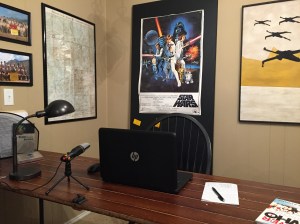
This is my creative corner.

He called it the “writing box.”

It had a surface area roughly the size of a laptop computer, but was deep enough to house a drawer for paper, pen, and ink. Designed by Thomas Jefferson while a delegate to the 1776 Continental Congress, this portable work space would serve him well. It’s where he wrote the Declaration of Independence – and it’s where he would draft many important documents over the next 50 years. That simple box now occupies a place of honor in the Smithsonian.

You may not have designed your current desk or work space, but there’s no doubt that important work takes place there. Significant decisions are made, agreements are signed, and innovative ideas are born. Think about the lives you have been influenced from the few inches of real estate you occupy from nine to five. Imagine the lives you’ve yet to touch. Yet, most of us take our desks for granted.

According to psychologist Sam Gosling, the way you arrange and decorate your workspace can reveal insights into your personality. In his book, Snoop: What Your Stuff Says About You, Gosling shares some basic assumptions that customers and coworkers are likely to make simply by observing your desk.

For instance, a well-organized desk communicates dependability and punctuality. While some argue that a messy desk is a sign of creativity, Gosling says it usually sends a negative signal. He suggests you keep things tidy and showcase your personality in other, less obtrusive ways.

One way to accomplish this is by decorating your workspace with unusual or original pieces that hold significance for you. If you avoid cluttering up the space while displaying one or two personal items that communicate an open, innovative spirit, others will be drawn to you. They are likely to see you as someone who can solve problems in new and different ways.

Interestingly, Gosling advises we stay away from displaying inspirational quotes. These are clichéd and often used by people who are highly stressed as a means to calm their anxiety. Instead, seek to create an inviting space – one that encourages communication and collaboration. An open door, a comfortable, and even a candy jar can serve to foster relationships. The goal is to appear open and approachable.

Ultimately, you want a desk that allows you to do your best work. That involves balance. Create a space that inspires you, promotes efficient activity, and intrigues those you want to partner with. Pay attention to organizational policies, but give it some thought. Like other aspects of your appearance, your work surface shouldn’t be left to chance.

What does your desk, your cubicle, or your service window say about you? Does it send the right kind of message, or could it use a make-over? Sometimes all it takes is a small change to create a space that changes the way you approach your work. And given the amount of time we spend in such a small environment; shouldn’t we maximize its potential?

My desk may never find its way to the Smithsonian, but it has great significance to me. I’ve done great work here. I’ve had incredible conversations. I’ve created things that I’ll forever be proud of. By no means am I finished yet.

Change the Way You Think

woman-1148923_640As a young professional, I used to listen to motivational guru Zig Ziglar. He was a top salesman turned motivational speaker who published a number of books and other materials regarding the keys to success. During my long work commutes in Nashville, Tennessee, I would often forgo the radio in favor of an audio book by Zig or one of his contemporaries. They always used to fire me up and put me in the right frame of mind for a successful day at the office.

Zig Ziglar used to say “If your thinking is stinking, then so is your business.” His point was that your mindset has a huge impact on the course of your work. The way you think determines, to a great extent, the outcomes you experience. Stinky thinking involves focuses your mind on negative things – failures, problems, worse case scenarios. Ruminating on these things causes you to unconsciously encourage them to come about.

I’ve seen this play out in my own life. The days where my mind is occupied by negative thoughts are my worst days. The more I let my mind drift into stink thinking, the more my mood suffers, and the more bad things happen. Conversely, when I consciously decide to focus my mind on positive things, my mood is better and good things tend to happen.

Mental health is a lot like physical health in that what you choose to put in determines what you get. If you want to feel better and be more physically fit, you have to eat the right kinds of food and participate in the right kind of exercise. Doing so prepares your body to move in ways that are beneficial vs. harmful. The way you approach your mental diet and exercise is, I believe, just as important.

As I prepare for the new year, one thing I plan to focus on is the way I think. I stopped making resolutions a long time ago. Instead, I make a list of three personal challenges. I write them down and post them on my mirror where I can see them every day. This helps me stay committed throughout the year.

My first personal challenge for 2017 is to change the way I think.

I’m going to picture success. Too many days find me in a bad mood before I even hit the office. My mind is picturing a confrontation with someone who cut me off on the drive in. I’m anticipating a heated debate regarding a controversial issue. I’m dreading a meeting that I don’t want to attend. These are symptoms of stinky thinking and I need to address them before they take root.

Before tackling the day, I’m going to try and create a mental image of a successful day. What will my meetings sound like? How will the various interactions unfold? What will I have accomplished by the time I go home that signals a good day? By envisioning the future that I want, I will be taking the first step toward making it a reality.

I’m going to focus on what’s possible. How often do you find yourself worrying about things beyond your control? There are times when I spend valuable mental energy griping internally about other people who don’t think the way I do or act in ways that seem counterproductive. I waste time waiting for others to get engaged or decide to move on projects I feel are important. These are also symptoms of stinky thinking and I need to redirect my thoughts in a sweeter-smelling direction.

I’m going to train my mind to zero in on the actionable steps that I can control instead of the things I can’t. What forward movement can I take, however small it may be? How can I prepare for opportunities that might lie just around the corner? What can I do with what I have, where I am, right now? By keeping a forward focus, I’ll be able to identify specific ways to contribute to my success.

I’m going to seek out positive inputs. My mental diet over the past several months has been horrendous. I’ve consumed a steady stream of negative political ads, name-calling, bickering, and general doom-and-gloom based news. Everything from my television to my Facebook feed has trended negative. This can’t possibly be good for my own mental outlook.

I’m going to make a conscious effort to seek out sources of positivity. I’ve already taken steps to block social media friends who post nothing but negative news or attacks on others. I plan to identify some constructive podcasts and excuse myself from gripe sessions when they start up around me. When what I listen to, watch, and even participate in is stinky, my thinking starts to smell as well. It’s up to me to fix it. By inviting more constructive things in, I’ll leave little room for the negative.

I’m confident that purposefully addressing the mental part of my game will have significant benefits for me in 2017. I’m curious to know what your mental diet looks like. What does your image of success look like? What do you do to keep yourself focused on the right things? Where do you find positive inputs to exercise your mind constructively? I invite you to share. Next week, I’ll share my second personal challenge for the year.


JOIN THE CONVERSATION:

Have an opinion on this post? Share your thoughts on our facebook page.

Are You Still Hungry?

waiting2-e1450143761943Christmas is right around the corner. The New Year is less than two weeks away. And as you prepare to close the books on 2015, I have just one question for you…

Are you still hungry?

Remember the excitement you felt when you first started this job? Remember the fire that burned deep inside – the one that made you dream big and work hard? Do you still feel the drive to do great things?

Hunger is the most basic of needs. When you are hungry, nothing matters until you sate your appetite. When you are hungry – really hungry – you think of nothing else except satisfying that need. Hunger keeps you moving. It keeps you searching. It keeps you working.

This has been a good year. It’s been a great year. If you haven’t already, you need to stop right now and make a list of all the things you’ve accomplished over the past 12 months. I am shocked at what my team and I have done in such a short amount of time. But with all we’ve done – with all you and your team have done – there’s still more to do.

Is your head still in the game?

Do you still believe there are great things to be accomplished?

Are you still convinced that you have something special to offer?

Is this the team?

Are you the one?

Are you still hungry?

Because if you are, then this is not the end of the year; it’s the beginning. It’s not the finish line; it’s the starting line. And it’s time to get moving.

Everything up to this point has been practice. Everything up to now has been conditioning. Everything up to today has been preparation for our best work. As far as I’m concerned, you ain’t seen nothin’ yet.

My grandmother used to cook some incredible holiday meals. She would work all day to prepare a feast fit for a king. In the days leading up to a family gathering, she would say repeatedly “I hope you’re hungry. Bring your appetite.” I always did.

I remember one year at Christmas one of my cousins arrived having already eaten elsewhere. He didn’t have much of an appetite and only nibbled here and there. The look of disappointment on my grandmother’s face was unmistakable. Here was a bounty just waiting to be enjoyed. The table was set. The smells were overwhelming. The bounty was within arm’s reach – just waiting to be tasted. But he wasn’t hungry enough to act.

The table is set.

The feast is about to begin and there’s plenty for those who want it.

Are you still hungry?

Creating Fanatical Fans

Exclamation-PointsMy, how time flies. Where have the months gone? It seems like just yesterday we were singing Auld Lang Syne and here we are in December; just a few days away from the biggest event of the year.

I’m talking, of course, about the premier of Star Wars: The Force Awakens on Friday. I was nine years old when the original Star Wars film came out; before it was referred to as Episode IV: A New Hope. It was simply Star Wars.

I remember the anticipation I felt on the way to the theater to see the film. The advertisements for it on television had convinced me I was in for something special. And I was not disappointed. From the moment the movie started – with those iconic blue letters spelling out “A long time ago, in a galaxy far, far, away…” – I was hooked. At the age of nine, I became a life-long fan.

Now that I think about it though, the word ”fan” isn’t quite good enough to describe my feelings for the Star Wars franchise. I was a fanatic. By Christmas of 1977 my bedroom resembled a shrine to my new passion. I had Star Wars sheets on my bed, Star Wars curtains on my windows, and every toy imaginable. If it had Star Wars on it, I wanted it. It’s safe to say I was a fanatic.

Fanatical fans are the goal of every business. A loyal fan base means repeat business, ongoing revenue, and enthusiastic referrals. But building a business worthy of that type of following isn’t easy. It takes an equally fanatical focus on the part of both management and staff to create something so special that, like Star Wars, it almost defies explanation.

To see if you have what it takes to command such a strong following, see how many of these blockbuster elements are present in what you have to offer:

  • A strong cast. It’s hard to create fans without a roster of superstars. Make sure to hire A-listers in order to ensure the quality of work only the best can offer. Pay attention to both those in front of the camera and those behind the scenes. Details count when your goal is producing a hit.
  • A compelling story. Do you have something interesting to share? Or does your pitch sound just like any number of tales that have been told before? Make sure to define what makes you different in order to stand out from the crowd.
  • A unique presentation. The most memorable movies present something viewers have never seen before – something that changes the industry. Everything that comes after is compared to this new standard. Identify what differentiates you from the competition and make sure to put it front and center.

Nearly forty years after first seeing Star Wars, I’m still a fan. I can’t wait for the new movie. Come Friday, you’re sure to find me sitting in the theater, popcorn in hand, grinning from ear to ear; feeling like I’m nine years old again. As long as the franchise keeps delivering the same level of experience, I’ll keep handing over my money.

See you at the movies!

Stop Motivating Your Team! (Do This Instead)

stop

Over the years, I’ve been asked a lot of questions by managers in a variety of roles across numerous organizations. By far, the most frequently asked question is “How do I motivate my team?” Some are looking to increase sales performance. Others want to improve customer service or productivity. In many cases, managers seem frustrated by an overall lack of engagement exhibited by members of their staff. Energy levels are low, efficiency suffers, and goals go unmet.

So concerned managers wrack their brains trying to find a way to turn things around. They see a problem that needs fixing and go in search of a solution. ”If I can just get people motivated,” they think, “things will start moving in the right direction.”

And therein, I think, lies the problem. Motivation sounds like what we need to get the troops out of the doldrums. But it doesn’t. It can’t. To understand why motivation isn’t the answer, we first need to understand what motivation is. Let’s look at the root word “motivate.”

motivate: to provide with a motive or motives; incite; impel

Motivation is an external action designed to cause an internal reaction. It’s something one person does in order to elicit a response from someone else. Think about the typical actions many associate with motivation. Contests, incentives, awards, raises, and other types of recognition/reward strategies are used to spur a change in behavior. So are things like deadlines, threats, disciplinary actions, and other punitive measures. All can be, and have been, considered motivational strategies.

The inherent problem with these and other external actions traditionally used as motivation is that the behavior shift that results is, at best, temporary. The high from winning a contest or being recognized only lasts so long. The sting from negative feedback or an ultimatum loses intensity as time goes on. And as temporary emotions fade away, so do the changes in behavior associated with them.

As employee behavior slides back into mediocre territory, managers dip back into the box of potential motivators in an effort to stop the decline. The cycle of performance drop/motivation/performance improvement then begins again. Employees settle into a routine of reacting to the temporary external stimulus with a temporary burst of activity sufficient enough to win/satisfy the requirement/get management off my back and then easing up until the next stimulus comes along.

But if motivation isn’t the answer, then what is?

The key to long-term performance is not a short-lived behavior modification, but a long-term transformation of core beliefs. The answer is not externally driven, but internally. The answer is not motivation, but inspiration. Let’s check out another definition.

inspire: to fill with an animating, quickening, or exalting influence.

Do you see the difference? Motivation focuses on the head while inspiration targets the heart. Inspiring someone causes an empty part of them to be filled and the result is change that influences how they approach the concept of work itself, not just a particular task. Motivation can be applied or withdrawn at any time with correspondingly immediate results. Inspiration, on the other hand, becomes part of you and drives how you fundamentally think about things. Inspiration creates a deep-rooted drive to behave differently. Motivation may spark a temporary shift in behavior, but inspiration ignites a long-term change in attitude.

Inspired people are inherently motivated. So, the real question then is “How do I inspire my team?“

Well, if you’ve been reading the past few weeks, you already know some of the basics. How does that old saying go? “People don’t care how much you know until they know how much you care.”

Once you’ve mastered the skill of developing relationships, people are instinctively drawn to you. And that’s important; because it’s only then – when they trust you and want to listen to you – that you can share your vision and ask them to participate in it. If done right, they’ll get on board; not as motivated worker-bees, but as inspired partners.

Inspiration isn’t a one-time action. It results from extended exposure to someone who sees people, not employees. It’s about fulfilling potential, not completing tasks. It’s about contributing to something bigger than myself as opposed to being a cog in the machine.

People don’t want to be motivated. But we all have a desperate, innate need to be inspired. Fulfill that need and see just how far the team will take you. Who will you inspire today?

Can You Hear Me Now?

My wife and I were reminiscing recently about the early days of our marriage. In November, we’ll have been married 24 years and we’ve both changed a lot since saying “I do.” Sure, the physical changes are the most obvious; but most significant are the changes in how we treat each other. I must admit though, I’ve had to change a lot more than she has.

For example, I distinctly remember a conversation we had one afternoon just a few months after our wedding. I came home from work late and still had events of the day on my mind as I walked through the door. Susan immediately began telling me about her day. She followed me through the house as I pulled off my jacket and tie, quickly moving to put on comfortable clothes.

Suddenly it dawned on me that the pace of Susan’s speech was increasing. She talked faster and faster until the words practically jumbled together into nonsense. She finally stopped to inhale, gasping for breath. I looked at her and asked “Why are you talking so fast?” Her response hit me like a ton of bricks. “I have a lot to tell you, but I know that any second you’re going to tune me out.”

Wow. Before me stood the person that most mattered to me in the world and within weeks of promising to give her everything, I’d managed to renege on that promise. All she needed was for me to listen – to give her a few minutes of undivided attention – and already I’d proven unable to do it.

We humans have a listening problem. Our ears work; we hear just fine. It’s listening – an activity that takes place in the brain – that seems difficult.

Listening is often touted as a key sales skill; but it goes much further than that. Listening is a key customer service skill. It’s a key leadership skill. It’s a key relationship skill. It’s a key life skill. And as simple as it sounds, we struggle to get it right.

We live in a busy world. Information bombards us from every direction. People and email and social media all vie for our attention and there just doesn’t seem to be enough time in the day to get it all done. So we multi-task. We eat lunch while we read through email while we listen in on the conference call while we “listen” to the person that just walked into the office. But we’re fooling ourselves. Multi-tasking makes us feel better by allowing us to cross off more items on the to-do list. It helps us “get things done.” But it doesn’t help get things done right. Studies have actually shown that dividing our attention makes us less efficient than focusing on one task, or one person, at a time.

The real victims are those on the other end of the exchange. People can sense when they don’t have your full attention, just like my wife did. They can tell you’re preoccupied. And it makes them feel horrible. You’ve been there. Remember the last time you tried talking to someone who wasn’t really listening? How did it make you feel? Unwanted? Unwelcome? Unworthy?

So how do you practice listening? How do you let me know that you’re really paying attention? Let’s start with three small steps:

  1. Make time for me. Is now not a good time for us to talk? Then tell me so. Suggest a time when we can speak without interruption. I want your attention. I need you to listen to me. And if I’m as important to you as you say then you’ll make one-on-one time a priority.
  2. Look at me. Put down your cell phone. Turn away from the computer. Stop pacing around your office searching for a file related to the next meeting on your calendar. Scrape the daydream glaze off of your face and point it in my direction. If your eyes aren’t focused on me, then your brain isn’t either.
  3. Participate with me. Listening is not a passive exercise. It involves asking questions, clarifying, and even offering information. Body language and nonverbal matter. Head nods and robotic “uh huhs” are sure signs that your attention is elsewhere. Listening requires involvement.

I am your customer. I am your employee or coworker. I am someone significant. And what I have to say is very, very important. Are you listening? Do I have your attention? Can you hear me now?

Who Is the Third Man?


ca. 2003 --- Hand Reaching --- Image by © Royalty-Free/Corbis
ca. 2003 — Hand Reaching — Image by © Royalty-Free/Corbis

For centuries, drowning sailors pulled from the sea have told stories of a mysterious companion. They speak of another sailor, unknown to them, who appeared beside them in the water. This person stayed at their side, treading water and issuing words of encouragement, until the danger had passed. But rescuers looking to bring these additional sailors to safety never find them. In fact, there’s no evidence that they ever existed. They seem to be ghosts; figments of the imagination that surface when needed.

This phenomenon isn’t just found on the ocean. Mountain climbers, hikers, and others enduring long, difficult, and perilous journeys also regularly report the presence of another person during the most trying of times. They appear from the shadows and then disappear when they are no longer needed. They seem to require neither recognition nor thanks and slip into the mist leaving those behind speaking almost reverently of their presence. Without them, survivors say, they surely would have perished.

These sightings occur so regularly that the spectres have been given a name: the Third Man.

I’ve never been in a situation where I feared for my life; but there are plenty of times I would welcome the third man. I enjoy camping and hiking and even sailing, but I’m not talking about anything to do with being outside. I’m talking about those times when I’m sitting at work, or at home, and I feel things slipping out of my grasp.

We’ve all been in situations where we felt as if we were drowning; overwhelmed by circumstances both within and outside of our control. We’ve felt the grip of fear. We know the sense of panic that accompanies the realization that we’re lost. It’s in those moments that a friendly face is so desperately needed. It’s then that a voice of encouragement becomes priceless. It’s then that having someone beside us to share the burden means the world.

But as much as we each need a third man, it’s more important that we be the third man.

The most important people in our lives are those who are there for us when we need them the most. They are the people who lift us up; who encourage us to hold on and keep fighting when we want to give up. They are the ones who remind us that we have greatness within us and push us to find that little bit of extra gas in the tank. But who are those people? They are us.

Right now – right this very moment, someone you know desperately needs the validation, inspiration, and motivation that only you can provide. Because you know them well enough to say what needs to be said; to push the buttons that need to be pushed. To spur them into action.

We all need a helping hand from time to time. We all need to be that helping hand as well. Will you accept the call when it comes? Will you recognize the need and respond? Not for recognition or compensation or even out of obligation; but because you can.

Are you the third man?