How to Keep Your Meetings (And Your Team) Moving Forward

rails-253134_640Over the past few weeks, I’ve been writing on the topic of team meetings. This series of articles started with a review of 3 meetings you should stop having. That was followed by 4 meeting types that you should be having. I touched on 3 elements that make for a productive meeting, and then last week the focus was on using questions to prepare for a meeting – regardless of whether you are the meeting’s organizer or a participant.

Today, I’m wrapping up the series with a look at meeting effectiveness. How can you be sure your meeting actually helps move the team forward? That’s really the reason why we have meetings in the first place, isn’t it … to help move things along? If people are spending their time in a meeting rather than engaged in performing the actual job tasks they were hired to do, then the meeting ought to help improve the way they perform those tasks. For example, if my job is selling widgets, any time spent away from that specific task (like attending a meeting) should serve to make me a better widget sales person.

It’s critical that we start here. You have to understand that meetings are a disruption. They keep people from completing their core job responsibilities. I’m not saying meetings aren’t important; they absolutely are. But too many managers put more planning and energy into a meeting than they do the work our meetings are intended to support. We have to keep meetings in their proper place. The first and most critical step to better meetings is to view them as a vehicle that enables people to do their best work. When you start looking at meetings through this lens, the rest of your meeting-related decisions become much easier.

Starting with the belief that a meeting’s purpose is to improve the ability of people to perform, here are three ways to ensure the right things happen once the meeting is adjourned.

Expect active participation from everyone. Effective meetings do not have attendees, they have participants. If your meeting is considered a spectator sport, it’s time to clarify expectations. Active participation includes asking questions, taking notes, and sharing personal insights to improve everyone’s understanding of whatever topic is on the table. Active participation requires preparation, such as reviewing related material or completing pre-meeting assignments.

Active participation does not include looking at your phone, holding side conversations, or multi-tasking. These are signs that people are bored, uninterested, or simply disrespectful. If the meeting organizer has done their part to prepare an engaging agenda, then the rest of the team should honor that commitment by participating.

Focus on what’s important. Effective meetings stay focused. Inevitably, participants will bring up tangential topics. It’s like browsing the internet – you start off searching for something very specific, but get distracted by links to other topics that are somewhat related. Before you know it, your search for a good apple pie recipe has morphed into an hour-long review of bad plastic surgery pics. To keep your meeting on track, you have to recognize when things are getting off topic and step in before it goes too far.

Keep a running list of “parking lot” items; topics that come up, but aren’t germane to the core discussion. These can be tackled offline, or added to the next meeting’s agenda. I once worked with an organization that kept a small bell in the middle of the conference room table. Each participant in a meeting had permission to ring the bell when they felt a discussion was drifting too far off-topic. They then made a note on a white board so the related-but-separate concept wasn’t lost and pulled the team back on track.

Hold people accountable. Discussion of each agenda item should conclude with the assignment of next steps. If a topic doesn’t inherently require one or more specific actions, then it shouldn’t be on the agenda. Simply sharing general information shouldn’t be the focus of a meeting discussion – it should be an email. Remember, the purpose of a meeting is to enable participants to better perform their core job tasks.

If a topic is on your team’s meeting agenda, meaning it’s taking people away from their job, it’s because people need to start (or stop) doing something related to that job. End each meeting with a review of action items. Use this format to keep assignments clear: [Who] will [do what] by [when]. Start each subsequent meeting with a review of the action items from the prior one. Do this consistently, and hold people accountable for fulfilling their commitments.

Workplace meetings aren’t going away anytime soon. Most people consider them a necessary evil. Top teams see them as a critical way to stay focused, united, and moving in the right direction. How your meetings are perceived, and how productive they are, is up to you.


JOIN THE CONVERSATION:

Have an opinion on this post? Share your thoughts on our facebook page.

The Price of Apathy

meh[1]

Every day, managers struggle with problems caused by employee turnover. Finding and keeping good people is hard. Vacant positions put a strain on the rest of the team as they work to pick up the slack. Of course the problem isn’t solved once a hire is made. Getting a new member of the team up to speed takes time. They have to learn not only the mechanics of the job, but related policies and procedures – not to mention the culture of the team. In some cases, turnover is so high that it feels like you can never get caught up.

It hurts when good people quit and leave. It hurts worse when they quit and stay.

Apathy is a silent killer lurking inside just about every organization. It’s deadly because it drains the life out of anything and anyone it touches. Projects and presentations fall flat. Communication stops. Customers and coworkers languish in a sea of confusion and frustration. Forward momentum halts and business suffers.

I’m not talking about the occasional case of burnout. We all have experienced burnout from time to time. The disengagement I’m referring to goes deeper. Author Kristi Hedges reports that almost half of all US workers say they don’t even like their job, and 18% of leaders are actively disengaged.

Recently, this last statistic was hammered home with me. I was involved in a conversation with a manager whose business is losing customers like crazy. Through the first four months of the year, his territory has lost millions of dollars in revenue. When presented with the suggestion to seek out assistance with developing a strategic plan, his response was “I don’t care.”

So what causes good people to check out? Hedges offers these eight common workplace demotivators.

  1. Micromanagement
  2. Lack of progress
  3. Job insecurity
  4. No confidence in leadership
  5. Lack of accountability
  6. Poor communication
  7. Unpleasant coworkers
  8. Boredom

As today is Memorial Day, the day set aside to honor those who gave their life while serving our country, I can’t help but think about the men and women this day commemorates. Talk about engaged. Talk about the opposite of apathy.

How petty of me to mentally check out from my work when they bought my freedom by going “all in.” What better way to honor their sacrifice by giving my all to the work I have chosen.

Will you join me? Will you shrug off whatever negative feelings are keeping you from doing your best? Will you instead commit to fully engaging in making the world around you a better place?

Your organization needs you. Your team members need you. Your customers need you. They need you to wake up and plug in. They need you to care.

I hope you enjoyed your holiday weekend. I also hope you returned to work refreshed, refocused, and recommitted to do your best.

Why You Should Leave Work

5396019ca2464Yesterday was Labor Day and, like many of you, I was blessed with a day off. I hoped you enjoyed the holiday and were able to spend it doing something that didn’t feel like work. Labor Day became an official U.S. holiday in 1894, having first been proposed back in 1882 as a way to recognize the contributions of working men & women to the strength of our nation. Oregon actually began celebrating the day in 1887 (in the month of February) and by the time it was adopted federally, 30 states were already observing Labor Day.

I was really thankful for the extra day off. I needed to finish up some backyard projects and was able to some time relaxing as well. It was nice to recharge the batteries a little bit.

We all need some time off now and then. We need to spend some time away from our responsibilities in order to approach them more effectively. I’ve found that when I spend a day or two away from work, I come back with a fresh perspective. Big tasks seem easier. Answers that eluded me for days suddenly become obvious.

But not everyone takes advantage of their time off. We have a workaholic problem in the United States. According to the U.S. Travel Association, 40% of American workers will leave vacation days on the table this year. Despite the fact that we all long for more time off, a huge portion of our workforce doesn’t use what they have. Why?

Well, according to the same study…

  • 40% said they fear returning to a mountain of work.
  • 35% said no one else can do the job in their absence.
  • 33% said they “can’t afford” to use the time.
  • 20% said they don’t want to be seen as replaceable.

But time off is actually better for your work performance. People who take vacations have lower stress, lower their risk of heart disease, and have more motivation to achieve their goals. Research shows that just 24 hours away from work can have a significant impact on your physical and mental outlook. Organizations obviously benefit from employees who are healthy, focused, and motivated.

 Who would have thought that being off for Labor Day could make us better at our jobs?


A Community of Service

RosetoOn the eastern edge of Pennsylvania, about 15 minutes from the Delaware River and the state of New Jersey, lies the small town of Roseto. It was founded in the late 1800’s by Italian immigrants who settled to work in the local slate quarries. Roseto would go largely unnoticed until 1961, when a chance meeting between two doctors catapulted the town into the spotlight.

Dr. Stewart Wolf, a cardiologist and Head of Medicine at the University of Oklahoma, had just delivered a presentation on trends in heart disease and heart attacks. Roseto’s resident physician was in the audience and approached Dr. Wolf with a shocking observation. Heart disease rates in Roseto were half the national average. Furthermore, he could not recall a single instance of heart attack within the high-risk 55-64 age group during the past decade.

After additional discussion over a few beers, Dr. Wolf knew a more thorough investigation was needed. He and a team traveled to Roseto and began a multi-year study of the town’s inhabitants. A study of death certificates for the prior 30 years confirmed the doctor’s statement. Incredibly, Rosetans displayed an odd resistance to heart-related illnesses. Other communities located just minutes away looked statistically identical to the rest of the United States. What could possibly account for the uncharacteristically good health of this group?

First Dr. Wolf looked at diet. But that wasn’t the answer. Rosetans ate traditional, high-cholesterol Italian foods. Sausages, salami, and meatballs were all fried in lard, and coupled with hard and soft cheeses. “Fat-free” was nowhere to be found. They also drank wine with every meal.

Next, Wolf studied their work conditions. The men, always the most at-risk for heart attack, worked long, hard days in the quarry. They came home coughing from the dust and chemicals used in the mining process. At home, they relaxed with old-style, unfiltered cigars. Aside form the work in the mines, there was no standard of exercise.

For years, Dr. Wolf and his team scrutinized every aspect of life in Roseto, trying to account for the unusually healthy inhabitants. Nothing about their diet, working conditions, or even the environment provided a clue. Then one day, he looked beyond the physical attributes of the town and turned his attention to the intangible.

Families were close-knit. Townspeople favored local businesses over larger retailers in nearby towns. There was virtually no division based on wealth. Neighbors knew each other and came to each other’s aid. Stress was virtually nonexistent.

Roseto had no crime. Zero.

In fact, everywhere he looked, Wolf saw townspeople helping each other. Rather than occupying themselves with their own gain, Rosetans seemed to be keenly focused on helping each other. No one in the town was a stranger. No one felt alone.

And a thought occurred to Dr. Wolf. A strong sense of community breeds healthy individuals. People become stronger and healthier when they band together for the common good. A community built on service will thrive despite overwhelming obstacles.

Sadly, change came to Roseto. By 1970, the strong sense of community had eroded. Young people left to pursue careers elsewhere. Outside influences changed the socio-economic makeup of the town. Fences and country clubs began to appear. Rosetans started to look and act just like people everywhere else. In 1971, the Roseto saw its first heart attack under the age of 45. Today, the town’s rate of heart disease looks just like anyone else’s.

What’s Wrong with Your Face?

Cyclists 1895Writing about the Tour de France last week got me thinking about the history of the bicycle. Here are a few of the facts I found interesting:

* Bicycles were introduced in Europe during the 19th century.

* The modern bicycle design evolved from that of the dandy-horse.

* The first pedaled bicycle was developed in 1839 by Kirkpatrick MacMillan, a Scottish blacksmith. He is also associated with the first recorded bicycle-related traffic offense.

* The most popular model of bicycle in the world (and the most popular vehicle of any kind) is the Chinese Flying Pigeon.

* There are more than twice as many bicycles in the world as there are automobiles.

But by far the most interesting thing I uncovered was a mysterious bicycle-related illness known as “bicycle face.”

It seems that bicycle-riding enjoyed a huge surge during the late 1800’s, around the time chain-driven models were introduced. And as bicycling became more popular, it drew its share of detractors as well. Some didn’t like the congestion on the streets. Some didn’t like the impact bicycling had on fashion (women began to shun long dresses for clothing that allowed greater freedom of movement). Some bemoaned the lost art of one-on-one communication allowed by walking or taking the carriage to your destination. Thanks to a growing number of bicyclists who would opt for a Sunday morning ride over attending church, some even argued that cycling led to spiritual damnation.

Soon doctors were writing to medical journals describing the impact of cycling on one’s physical health. In addition to appendicitis, dysentery, and infertility; excessive riding, they argued, could lead to “bicycle face.” This disease was caused by the constant need to focus on balancing yourself on the bicycle while also scanning your surroundings to avoid collision with something or someone else. The anxiety produced by this level of concentration would lead to bulging eyes, flushed skin, and tense jaws. If not corrected in time, they warned, the effects of bicycle face would become permanent.

Over one hundred years later we can laugh about this obviously fictitious disease. But take a look around. How many people do you know who walk around every day with “bicycle face?”

Employees today are stressed. They’re stressed about the demands on their job. They’re stressed about the future of the company. They’re stressed about the future of the industry. They’re stressed about the next customer interaction. They’re stressed about meeting your expectations. And they’re stressed about balancing all of this with all of the other stuff that stresses them out at home. According to the American Psychological Association, the number one stressor for people 18-33 is work. And twenty percent of this group has been diagnosed with clinical depression. Now before you go thinking “Wow. I’m glad that doesn’t happen here. My employees aren’t stressed,” think again. They are.

It’s up to us as managers to address this problem. It’s up to us to address the issues causing stress amongst our employees. As work-related stress goes up, job satisfaction and productivity obviously go down. In addition, all that stress gets transferred to your customers, leaving a negative impression and impacting future business. Nobody wants to conduct business with a company full of stressed out, anxiety-ridden employees. The only ones who can make an immediate, positive impact on the organization are the leaders – and you are part of that group.

So come on fellow leaders, let’s fix this. Let’s talk to our employees and find out what’s causing all this stress. Then let’s do something about it.

After all, who wants to work all day next to Mr. Bicycle Face?

Pressed to Death

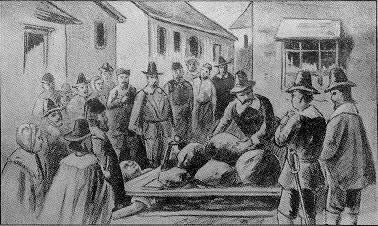
Three hundred and twenty years ago, Giles Corey was accused of being a wizard, or warlock, during the infamous Salem Witch Trials. Among the accusations were that he had been seen serving sacrament at a gathering of witches and his “spectre” had been witnessed harassing supposedly innocent citizens. Corey refused to admit guilt or proclaim innocence, an act that was required in order for him to stand trial.

In order to force a plea from him, Corey was forced to undergo “pressing.” He was stripped naked and staked to the ground with a large sheet of wood over his torso. Large boulders, some so heavy it took six men to move, were then placed on the board. Over the course of two days, more and more boulders were added, crushing his chest. Steadfastly refusing to answer the court’s accusations, Corey died from the pressing.

Ever feel like you are being pressed to death?

Everyone feels stressed or even somewhat overwhelmed from time to time. But I’m talking about the kind of pressure that weighs down on you so heavily that you can’t move. You can’t think straight. You find yourself immobilized, unable to take action because your mind keeps worrying about the various issues on your plate.

Left unchecked, this kind of pressure can impact your job, your family, your relationships with friends, and even your health.

I don’t claim to be an expert in stress-management, but I’d like to share some of the strategies I use to help relieve the pressure when I feel the weight of the world pressing down on me.

1. I write it out. I’m a list person. I need to see just how big the mountain is before I can tackle it. So I try to keep a master list of projects updated at all times. It’s nothing fancy, just a legal pad where I write down each project and the major steps that need to take place in order to get it completed. Writing things down helps me to organize the chaos in my head that leads to stress and worry.

2. I eliminate it. Sometimes the best answer to relieving stress is to remove the root cause, literally. I can’t tell you how many pet projects I’ve had languishing on my list, causing me angst every time I see how much I haven’t worked on them. Each time I’ve made the decision to cross one off as “not worthy of my stress right now” have been liberating. Some things just aren’t worth the price tag.

3. I delegate it. Sometimes it can be hard to let go of certain projects. For my own sanity, though, I’ve learned to hand off various tasks to other equally or more capable people. This involves a degree of trust and the ability to live with results that may not be quite like you’d prefer, but the sense of relief I gain from getting certain things off of my plate is usually worth it.

4. I build some momentum. Now I’m down to those things that are both worth pursuing and require my personal attention. Some of these are big projects with many steps. It can be intimidating to see just how long that list still is. To help me get started on the things that really matter, I cheat a little. I add a few smaller items to my to-do list – things I’ve already accomplished – and then cross them off. This visual sense of accomplishment often helps give me the mental boost I need to tackle a few of the others.

Unlike Giles Corey, you and I have a choice when it comes to stress. When it feels like a ton of rocks are piled on your chest, you can choose to remove a few. Obviously, my tips apply to work-related stress. There are other, more serious, types of pressure out there and many more ways to alleviate or cope.

Got a great stress-reduction technique? Shoot me an email. I’d love to hear it.