Walking the Tightrope

Karl WallendaLast week, I wrote about Jean Francois Blondin, the first person to walk a tightrope across Niagara Falls. As I thought about his story this week, I was reminded of another famous tightrope artist – Karl Wallenda. He and his family, known as the “Flying Wallendas,” were famous for their trapeze and tightrope routines. Their signature act was walking the tightrope as a team – stacked on top of each other in a pyramid.

Karl was not only the leader of the Wallenda clan; he was a daring individual tightrope walker as well. He was known for performing high above the ground without a safety net. He felt the net gave him an excuse to be less than perfect. He knew that the key to a successful walk lay in keeping his focus on his goal at the other end of the rope, not on what could happen if he fell. Falling was simply not an option for Karl Wallenda.

Wallenda used to perform shows where he’d walk across a tightrope stretched between two buildings. His last stunt occurred in Puerto Rico and involved a walk between the city’s two tallest buildings. But something was different this time. Wallenda overheard some people talking about another tightrope walker who had recently fallen and he began to focus on that. He began to worry about what could go wrong and on the day of the stunt was preoccupied with checking the ropes.

Halfway across the rope, Wallenda lost his balance and fell to his death.

When leaders start focusing on what they have to lose versus what they have to gain, the only direction they can go is down. The result may not be physically deadly, but the consequences are still dire. Projects stagnate, innovation dies, and communication stops. Forward progress comes to a halt as everyone either adopts the leader’s myopic focus or opts out.

To move forward, you have to look ahead, not down. You can’t blaze new ground if you’re busy building fences. You can’t WOW your customers or employees if you’re worried about the potential downside.

I’m not saying you should be reckless. You can’t ignore obvious dangers. But there’s a balance that needs to be achieved. No great achievement is without risk. But nothing great is ever achieved without it.

The Power of Mission

On July 21st 1969, Neil Armstrong became the first human being to walk on the moon. Most of the people reading to this weren’t even born when this happened and don’t understand the significance of the event. They don’t remember the grainy TV pictures or the excitement in the air as people around the world listened to Armstrong declare “That’s one small step for a man, one giant leap for mankind.”

And it was a giant leap. Just eight years earlier, President Kennedy had presented the challenge of placing a man on the moon by the end of the decade. Almost before the words had escaped his lips the skeptics appeared. It’s a waste of time. It’s too expensive. It’s too dangerous. It’s impossible.

But for those who believed, the challenge became a mission. They dedicated themselves to seeing the dream become a reality. Some made the ultimate sacrifice for the mission; men like Ed White, the first American to walk in space who later died in a launch pad fire along with fellow astronauts Virgil Grissom and Roger Chaffee.

However, most of those involved were mission specialists and controllers, men and women operating behind the scenes, each playing some small part in accomplishing the mission even though they themselves would never personally experience gazing back at the planet Earth from the surface of the moon. It was the combination of hundreds and thousands of contributions that led ultimately to Armstrong’s moonwalk. Without everyone playing their part, it never would have happened.

Sometimes it’s hard for people to see how their small contribution fits into the overall mission. It’s the job of the leader to help them see it. Leaders have to “connect the dots” so that everyone understands how important they are to achieving the larger goal. It’s not enough to just delegate tasks. You have to paint the “big picture” in order to draw people in.

Does everyone on your team understand the mission?
Do they each understand their role in achieving that goal?
What will you do today to help connect the dots?

Redefining Excellence

Excellence is a term that gets thrown around a lot today. I hear people talking about service excellence, sales excellence, leadership excellence and even operational excellence. The problem is that too many of these people have the wrong idea regarding what excellence really is. More often than not, when someone uses the word “excellence,” they’re really talking about “perfection.” The idea of excellence is used to refer to the epitome of achievement – the highest state of performance.

There’s a problem with that definition of excellence. If you aspire to perfection, you will never reach your goal. You’ll always be frustrated, and so will your employees.

Don’t get me wrong. I’m a firm believer in having goals. But in order for goals to be effective, they have to be attainable. They need to provide a stretch, but they have to be within reach. Attaining such a goal provides a sense of accomplishment and the energy to stretch for the next one.

So I’d like to propose a new definition for “excellence.” Here it is;

“True excellence is rising above what you ‘should’ be to become what you ‘could’ be.”

You see, excellence is not perfection. Excellence is growth. Excellence is reaching a level of performance that’s eluded you in the past. Excellence is accomplishing something that you never have before.

This new definition of excellence says that while perfection is impossible – and we all know it is – the status quo isn’t acceptable. The idea of excellence requires that I move beyond my current state of performance even though it might be acceptable. The organization may say that a certain level of performance is expected – it’s what I should be doing. But a quest for excellence says perhaps I could be doing more than that. Striving for excellence allows me to set goals for improvement, celebrate that success, and then push the boundaries once more. And I’d much rather be excellent than acceptable.

What defines excellence for you?

What defines excellence for your team, department or business?

And what will you do today to achieve true excellence?

Pressed to Death

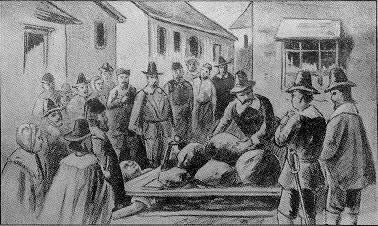
Three hundred and twenty years ago, Giles Corey was accused of being a wizard, or warlock, during the infamous Salem Witch Trials. Among the accusations were that he had been seen serving sacrament at a gathering of witches and his “spectre” had been witnessed harassing supposedly innocent citizens. Corey refused to admit guilt or proclaim innocence, an act that was required in order for him to stand trial.

In order to force a plea from him, Corey was forced to undergo “pressing.” He was stripped naked and staked to the ground with a large sheet of wood over his torso. Large boulders, some so heavy it took six men to move, were then placed on the board. Over the course of two days, more and more boulders were added, crushing his chest. Steadfastly refusing to answer the court’s accusations, Corey died from the pressing.

Ever feel like you are being pressed to death?

Everyone feels stressed or even somewhat overwhelmed from time to time. But I’m talking about the kind of pressure that weighs down on you so heavily that you can’t move. You can’t think straight. You find yourself immobilized, unable to take action because your mind keeps worrying about the various issues on your plate.

Left unchecked, this kind of pressure can impact your job, your family, your relationships with friends, and even your health.

I don’t claim to be an expert in stress-management, but I’d like to share some of the strategies I use to help relieve the pressure when I feel the weight of the world pressing down on me.

1. I write it out. I’m a list person. I need to see just how big the mountain is before I can tackle it. So I try to keep a master list of projects updated at all times. It’s nothing fancy, just a legal pad where I write down each project and the major steps that need to take place in order to get it completed. Writing things down helps me to organize the chaos in my head that leads to stress and worry.

2. I eliminate it. Sometimes the best answer to relieving stress is to remove the root cause, literally. I can’t tell you how many pet projects I’ve had languishing on my list, causing me angst every time I see how much I haven’t worked on them. Each time I’ve made the decision to cross one off as “not worthy of my stress right now” have been liberating. Some things just aren’t worth the price tag.

3. I delegate it. Sometimes it can be hard to let go of certain projects. For my own sanity, though, I’ve learned to hand off various tasks to other equally or more capable people. This involves a degree of trust and the ability to live with results that may not be quite like you’d prefer, but the sense of relief I gain from getting certain things off of my plate is usually worth it.

4. I build some momentum. Now I’m down to those things that are both worth pursuing and require my personal attention. Some of these are big projects with many steps. It can be intimidating to see just how long that list still is. To help me get started on the things that really matter, I cheat a little. I add a few smaller items to my to-do list – things I’ve already accomplished – and then cross them off. This visual sense of accomplishment often helps give me the mental boost I need to tackle a few of the others.

Unlike Giles Corey, you and I have a choice when it comes to stress. When it feels like a ton of rocks are piled on your chest, you can choose to remove a few. Obviously, my tips apply to work-related stress. There are other, more serious, types of pressure out there and many more ways to alleviate or cope.

Got a great stress-reduction technique? Shoot me an email. I’d love to hear it.

Olympic-sized Inspiration

The Olympic games are always a big deal in the Voland household. We each have our favorite sports and we love learning the back stories on each of the athletes. And while we cheer heartily for the American competitors, we have such a multicultural household that it’s easy to appreciate any outcome.

The Olympics may be over, but the competition in London is just heating up. The 2012 Paralympics started this past week and run through Sunday the 9th. I’m always inspired by the stories of sacrifice and dedication that are so prevalent during the Olympics. But for real inspiration, nothing beats the Paralympics.

Sometimes I get to feeling sorry for myself. Things don’t go the way I planned. Someone I trust lets me down. Circumstances beyond my control set me back in ways I never anticipated.

I feel myself feeling inadequate, unprepared, even handicapped.

Then I watch some of these people in action. And I feel ashamed. Here are people who have overcome setbacks I can’t begin to imagine in order to achieve a level of excellence that’s incredible. They could sure kick my butt! How dare I allow any of my lame excuses keep me from reaching my full potential.

If you haven’t had a chance to see some of these amazing athletes in action, you are definitely missing out. Unfortunately, the Paralympic games aren’t being broadcast on TV here in the states, but you can watch events, both recorded and streamed live, on the internet.

For a little preview, and a lot of inspiration, watch this:

Once In A Blue Moon

Tonight’s full moon is a Blue Moon – not because it’s blue, but because it’s the second full moon in a given month. Because blue moons only occur once every 2.7 years or so, they are relatively rare. Even rarer are full moons that actually appear to have a bluish tint. This typically occurs when dust or smoke refracts light in such a way that the blue spectrum is most prominent.

The phrase “once in a blue moon” entered the English lexicon as a way of describing an event which happens rarely. While some events are prized because they are rare, some things need to happen more frequently to be truly valued. Exercising frequently is obviously more beneficial than occasional spurts of exertion. Ongoing home maintenance is less costly than massive repair projects.

And certain leadership actions have greater impact when performed regularly. Here are 10 easy things you can do as a leader that will have a tremendous effect on those around you.

1. Challenge someone with a project outside of their comfort zone.
2. Encourage someone who’s feeling discouraged after a letdown.
3. Coach someone who’s struggling to improve an aspect of their performance.
4. Recognize someone for their recent achievement.
5. Thank someone who’s helped you out of a bind.
6. Tell someone how important their job is to the team and your customers.
7. Apologize for something you messed up.
8. Ask someone about their professional goal and how you can help them achieve it.
9. Share an article, book or other resource related to someone’s area of responsibility.
10. Spend time brainstorming with people about possibilities that don’t exist yet.

Effective leadership involves building relationships. And you can’t build relationships if your interactions with other people are superficial and random. I promise that if you make an effort to engage with people on a deeper level as indicated by these suggestions you’ll find yourself connecting – and leading – in ways you never thought possible.

The next blue moon will take place on July 31, 2015. Where will you have taken your leadership skills by then?

Coaching Styles, Part 2 – The Visionary

I enjoy watching home improvement shows. In particular, I like the shows about landscaping. My favorites are those where the host and his/her team of experts descends on an unsuspecting homeowner and offer to remake their entire back yard. I wish that would happen to me.

Toward the beginning of the show, there’s always a point where the host reveals the master plan. They make a big deal out of unrolling an architectural drawing of their plan for the yard. This is always met with an air of excitement and anticipation by the homeowners. But if you watch carefully, you’ll see something interesting happen when they first see the drawing.

For just a second – before they remember that their reaction is being recorded for national television and they start jumping up and down – their eyes glaze over. They don’t get it. They lack the knowledge of a landscaper and can’t make the connection between the lines on the paper and the potential utopia in their back yard.

And so the host begins to describe it for them. He points out where the hot tub will go. He explains that the big cloud-like circle in the corner is a new tree. See this rectangle here? That’s a new grill for your outdoor kitchen over there.

As the host explains the plan, you sense a change. You can feel the confusion melt away and the excitement build as the picture crystalizes in the minds of the homeowners. Now that they can visualize the end result, they’re ready to get dirty.

To be an effective coach, you have to be like that host. You have to understand that not everyone sees things the way you do. You have to “connect the dots” so that the members of your team see how their individual contributions come together to create the larger picture. This is the job of The Visionary.

The role of the Visionary is often the most difficult. Many mid-level leaders don’t understand the big picture themselves and therefore have a hard time conveying it to their team. Others don’t see the importance of communicating a larger vision feeling it just distracts from the job at hand. And others simply avoid sharing too much information, preferring to keep employees in the dark for fear they will be perceived as unimportant once the masses know what’s going on.

But common sense (and a lot of research) indicates that employees who understand the big picture, and how their job contributes to it, are more engaged. Employees who see their individual role as important to the overall success of the organization are more likely to do their job well than those who feel their work has little meaning. Fundamental to the human condition is the need to feel like we’re part of something bigger than ourselves. Knowing my work means something to someone else makes it mean something more to me.

The day I realized this, my approach to coaching changed. I started talking about the big picture and how our team factors into it. I told them how their individual jobs were critical in order for the organization to achieve success. And as we talked, I could see the change in their eyes. The fog lifted and a spark was lit. They began to make better decisions. They began to identify opportunities for improvement. Now that they see the big picture, they are on fire. And I don’t dare let that fire go out. So I spend more time talking with my team about our vision than anything else.

What vision do you need to share with your team? How do each of them factor into the big picture? How can you help paint the picture for them? Answer those questions and then let’s talk about my back yard.

Why Managers Don’t Coach, Part 5

For the past several weeks, I’ve been discussing some of the most common reasons given by managers when asked why they aren’t coaching. Along the way, I’ve shared my thoughts on the relationship between coaching and training, coaching the high performer, the importance of regular coaching and time management. In this final post of the series, I’ll address the issue of coaching skill.

Excuse #5: “I don’t know how to coach.”

Typically, this excuse stems from a lack of understanding. Managers who don’t understand what a coach is, will have a hard time figuring out what a coach does. So let’s begin with some definitions. Simply put, coaching is anything you do to help someone improve their level of performance. Therefore, a coach is someone engaged in activities that help another person improve their level of performance.

Many corporate coaching programs have complicated the concept. Attend a typical class on frontline coaching and you will be inundated with complex forms, charts and processes that require any number of acronyms in order to remember them all. Back at the office, you spread out all of the materials only to find that the idea of coaching, as it was presented, is way too cumbersome. Frustration leads to procrastination and, ultimately, the idea of coaching is abandoned.

But it doesn’t have to be this way. Look at that definition of coaching again – anything you do to help someone improve their level of performance. When you think of coaching this way, as the process of helping someone vs. a complex set of activities, it frees you to act. Coaching should focus on providing a service rather than following a particular system. So with this new definition in mind, let’s look at some of the activities effective coaches engage in.

Observation: The act of observing an employee in the act of performing their job to identify patterns of behavior. During an observation, the coach makes notes regarding specific strengths and deficiencies in order to address them with the employee.

Goal-setting: The act of defining specific expectations regarding an employee’s performance. Effective goal-setting involves communicating exactly what is expected of the employee with regard to technique and results.

Role clarification: The act of communicating the importance of an employee’s particular job role in the achievement of the organization’s objectives. Role clarification helps the employee understand how the specific tasks they are charged with contribute to the big picture.

Skill drill: The act of repeating a specific behavior over and over in order to develop mastery. The goal of a skill drill is to create an automatic response to a particular set of circumstances.

Role play: The act of practicing a series of skills in preparation for performing on the job. Think of role playing as a dress rehearsal. The goal is to work out any kinks prior to going on stage. Employees who can perform as desired in repeated practice scenarios are more likely to perform when it counts.

Modeling: The act of demonstrating a set of specific behaviors so that employees can form a picture of the ideal performance. Modeling the behavior you want employees to demonstrate provides them with a visual reference to draw upon while they work to improve.

Praise: The act of recognizing when an employee performs as desired and letting them know about it. Effective praise communicates specifically what you noticed, why you liked it and how important it is to continue the desired behavior. Praise should be delivered as soon as possible after the desired behavior occurs so that the employee makes a strong connection between what they did and the positive feelings associated with your praise. Because of the positive emotions it evokes, praise should be used frequently.

Correction: The act of recognizing when an employee fails to perform as desired and letting them know about it. Effective correction communicates specifically what you noticed, why it is undesirable and how to correct the behavior. By nature, correction evokes negative emotions and should be used sparingly. The goal is to inspire improvement, not fear of failure.

These are just a few of the activities commonly associated with effective coaching. I’ll bet you already do some of these. You may be a great coach and don’t even know it. If this all seems new, start small. Get up right now and go catch someone doing something right. And praise them for it. When you come back to your office, schedule an hour within the next week to perform some observations. Remember that coaching is action oriented. So let’s go coach!

Traits Of High Performing Teams

The fantastic group of top performers that make up my team live and work in a variety of locations. As a result, a lot of our team interaction takes place over the phone or via email. So its always a pleasure when we have the opportunity to work on the same project, in the same place, at the same time. You know, as a team.

Last week the group came together to facilitate a series of workshops designed to guide a group of managers through the process of setting annual goals for their staff members. Watching them work was phenomenal. After the final session was over, and every one had gone their separate ways, I had a chance to reflect on the three days we’d spent together. I thought about the things I had just witnessed and jotted down a few observations. Here are some of the things I feel contributed to an incredible team effort.

– They each perform well as individuals. Each member of the team is a superstar in their own right. You can’t have a winning team without talent, and I’m fortunate that the men and women I work with on a regular basis are each very good at what they do. They each strive to be the best at what they do, so I know that when it’s their turn to perform, I’ll get the best possible result.

– They work well together. You don’t have to look far (try the world of pro sports) to find examples of teams loaded with individual superstars, but no teamwork. A team is more than a collection of people. A team has an identity, a rhythm. This doesn’t happen overnight. It takes time and practice. But once you’ve been part of a team that works well together, you’ll spend the rest of your career trying to recapture that feeling. I have a great team. And I love it when they have the chance to work together. They do too.

– They share a common goal. Take a group of top performers, get them working together well, and you have a team. Instill a passion for excellence and focus them on the same goal, and you have something magical. We had many meetings and planning sessions before our project came about last week. Going in, everyone knew what the end result needed to be. And everyone was committed to making that result a reality.

– They “get it.” ‘Nuff said.

– They are committed to team success and that of their teammates. Top performers like to be recognized for their accomplishments. Members of high performing teams understand that their success is tied to that of the team and, by extension, the success of their teammates. As a result, they work just as hard when their role is a backseat one. They understand that when the team looks good, they look good. When a teammate is recognized, their stock rises because of their association with another top performer.

– They know their strengths and limitations (and those of their teammates). You know that guy who knows everything, already has all the skills, and can do anything? Yeah, neither do I. But too many people believe they have to be that person in order to be successful. Great teams happen when each member willingly takes the lead in their area of expertise and hands over the reins when the task at hand in best handled by someone else.

– They’re not afraid to disagree. Great teams have some great arguments. They stem from passion, from a desire to produce a superior result. If your team argues about petty issues or suffers from personality attacks, they’ll have difficulty in putting it aside to present a unified front. Healthy disagreements revolve around the project at hand, around the issues.

Over the past few days, I’ve received several complimentary emails from managers who attended our goal-setting workshops. We hit a home run on this project. But I know that wouldn’t have been possible without a great team. As I share each comment with the team, and see them complimenting each other in turn, I’m reminded of how truly blessed I am to work with such a great group.

Achieving the Impossible

May 6, 1954 began like most other spring days in southern England. A morning rain shower left the air cold and a stiff wind blew for most of the day. At the Iffley Road Track in Oxford, spectators began arriving for the University’s annual track meet against the Amateur Athletic Association. As he began his stretching routine, Roger Bannister , a young medical student, contemplated the goal he had set for himself. Bannister was set to run in the one-mile event. In defiance of history, Bannister planned to not only win the race, but to do so in less than four minutes.

Others had attempted the break the four minute barrier. The closest was Gunder Hagg, a Swede who posted a time of 4:01.4 in 1945. In the eight years since, no one else had come close. Sporting experts had decided that the four minute mark could only be passed under ideal conditions – the right weather, the right track, the right training regimen. But as Bannister approached the starting line on the track (still damp from the morning shower), he took note of the chill in the air. At least the wind had died down.

At 6:00 pm, the starting gun was fired and the race began. Trailing for most of the race, Bannister pulled out all the stops during the last 300 yards. Crossing the finish line, he collapsed onto the track, unable to stand. The noisy crowd fell silent waiting for the race results. Finally, the announcer broke the silence. Bannister had won the race and achieved his goal – a new world record time for the one-mile event – 3:59.4.

Advice on setting and achieving goals is commonplace. Ever heard of S.M.A.R.T. goals? That’s all well and good, but what does it take to achieve the kind of breakthrough performance that Roger Bannister experienced? How does one go about achieving what everyone says can’t be done?

Here are three lessons from Roger Bannister’s experience that I think answer that question:

He set an impossible goal.
I think one of the reasons people often fail to reach a particular goal is because their aim is set too low. Goals that are too vague or only require a little stretch are easily forgotten. Impossible goals get your attention. They command your daily focus if they stand any chance of becoming reality. Coming off of a huge defeat in the 1951 Olympics, Bannister knew he needed a new approach to training if he were to remain competitive. Winning the next race wasn’t a big enough goal to push him out of his comfort zone. But breaking the four minute barrier forced him to rethink his motivation, his priorities, and his approach to training.

He believed it was possible.
Contrary to popular opinion and scientific evidence, Bannister believed – no, he knew – that a sub-four minute mile run was achievable. Others before him had come close, but failed because they didn’t believe. Their disbelief guaranteed their failure. One of Bannister’s biggest rivals, John Landy, had given up his quest to break the four minute barrier saying “It is a brick wall. I shall not attempt it again.”

He focused on the possible.
How do you eat an elephant? One bite at a time. While impossible goals get your attention, they can also easily overwhelm you. The key is to break the goal into smaller, more achievable steps. This helps you to keep a positive focus and celebrate successes along the way. Bannister didn’t focus on the mile. He spent his training time perfecting his quarter mile run, eventually reaching a point where he could consistently run the quarter mile in under one minute. Once he reached this point he knew he could put them together and achieve his goal.

By the way, it’s funny how once someone achieves the impossible, it suddenly becomes possible. The unattainable becomes the benchmark. Forty-six days after Roger Bannister’s amazing run, John Landy set a new world record for the mile with a time of 3:58. Today, a sub-four minute mile run is commonplace. The current world record is 3:43.13.