
You’ve Been Asking Yourself the Wrong Questions

woman-687560_640John O’Leary was a typical kid growing up in St. Louis, Missouri. But his life took a dramatic turn one day in 1987 when he accidentally triggered an explosion while playing with fire. Just nine years old, burns covered his entire body. He was rushed to the hospital where doctors gave him less than a one percent chance of making it through the night. He survived, only to endure months of pain and multiple surgeries, including the amputation of his fingers. Today O’Leary is a successful businessman, husband and, father.

I recently listened to an interview with O’Leary in which he shared insights into his ordeal and the mental shift he had to make in order to adjust to a new way of life. In particular, I was stuck by a series of questions he posed – questions that we all ask ourselves when faced with significant change or adversity.

Why me? According to O’Leary, the first question we ask when confronted with unwelcome change is “Why me?” We place ourselves into the role of a victim and look for reasons to distance ourselves from what’s happening. By adopting the victim mentality, we place responsibility for what’s happening on to someone else and we give ourselves permission to disengage.

Who cares? The second question we ask is “Who cares?” Because we feel alone and out of control, it’s easy to feel as if no one else is concerned about our feelings. “No one asked for my opinion. No one checked with me to see if this was a good idea.” When we perceive change as something that’s happening to us, we give ourselves permission to resist.

What’s the point? The third question, O’Leary says, is “What’s the point?” When we’re not the driving force behind change, it can be difficult to identify a reason. If we don’t agree with the change, and feel like we have no control over it, we give ourselves permission to not act.

O’Leary stated that he went through all of these questions multiple times during his period of recovery. Over time, he began to realize that he was asking himself the wrong questions. The secret to successfully navigating change is to ask yourself the right questions. So he started to train his mind to focus on a different line of thinking.

Why me? Why have I been given this opportunity? What is it that makes me particularly suited to excel in this environment and at this time? What unique talents and skills do I possess that set me up for success where others tend to fail?

Who cares? Who is depending on me right now? Who needs me to be successful in order to better their situation? Who else is out there struggling and looking for someone to show them the way? Who is looking to me for leadership and inspiration?

What’s the point? What’s the end game here? What larger purpose is being served by my journey through this trial? How will the greater good be served by my engagement and involvement?

Over the past few weeks, I’ve written about different aspects of navigating change. We can categorize the need for change. We can understand why accepting change is so difficult. We can even alter our approach to guiding others through the process of change. But as O’Leary learned, the biggest thing we can do to make significant change easier is start with our own attitude toward it.

Sometimes change is difficult; sometimes it’s painful. Occasionally, change is absolutely excruciating. I think that the toughest change to manage is the shift that has to occur in our own heads. Once we change the way we think, there’s nothing we can’t overcome.


JOIN THE CONVERSATION:

What keeps you motivated? Share your tips on our facebook page.

The Physics of Change

inertia-e1455505796605It’s called inertia.

That force that keeps us from doing things differently, even though we know it’s in our best interest, is called inertia. Isaac Newton first wrote about it back in 1687. While studying the physics of motion, he discovered that “an object that is at rest will stay at rest unless a force acts upon it.” Likewise, he observed that “an object that is in motion will not change its velocity unless a force acts upon it.”

Of course, while developing his First Law of Motion, Newton referenced primarily inanimate objects – things like apples and planets. He wasn’t really interested in understanding why people acted the way they did. However, the same principle that explains why the pen on my desk doesn’t move unless I pick it up points toward some realizations about how and why we respond to potential change.

In terms of human behavior, inertia represents the tendency to continue in whatever course of action we are presently engaged in. Sometimes, that means no action. Think about physical fitness, for example. It’s very difficult for a couch potato to change their behavior and suddenly start working out. But for individuals who do work out (or run, bike, etc.), asking them skip a session could earn you a dirty look. Why is it that a body at rest tends to stay at rest, while a body in motion tends to stay in motion?

We’re creatures of habit. The human brain is full of neural pathways – connections that link specific behaviors and consequences. Every new behavior creates a neural pathway. Subsequent repetitions of the same behavior reinforce that pathway. Over time, that pathway becomes well-defined, almost like a rut in a dirt road. When we go to perform an action, the brain looks for established patterns of behavior and follows the path of least resistance – the rut. Eventually, certain activities become so ingrained we don’t even have to concentrate on what we’re doing. Muscle memory takes over and we act without thinking.

Subtle shifts in behavior are often just as hard to make as drastic ones. When I go mountain biking, I’m often faced with trails that are riddled with ruts left by other bikers. Sometimes I’ll try to ride just to the side of existing ruts in order to provide for a smoother ride without causing significant further impact to the trail. However, I almost always find this method of riding difficult to sustain. Try as I might to ride the edge, I just keep sliding back into the rut. Carving an entirely new route can actually be easier. Without the convenience of an established path to fall back on, I have no choice but to embrace something new.

Breaking one habit requires creating another one. Even though I’ve begun the process of creating a new pathway, my next trip down the trail presents me with the same challenge. Until I’ve traveled the new path enough times for it to become established, I’ll have to fight the tendency to follow the old one – the rut. It takes time for my mind and body to see the new pathway as the obvious choice. Old habits die hard. It takes focus and determination to kill them.

So what does this mean for effectively implementing significant change, either personally, or in our teams? How do we approach change in a way that helps people accept it, embrace it, and stick with it?

1. Accept that significant change takes effort. Like pulling out of a rut on the bike trail, shifting behavior requires concentrated effort. It’s not easy. Just because someone has a tough time adjusting to a new process doesn’t necessarily mean they don’t agree with it. Even the easiest, most desirable change can take its toll on people. Recognize the effort that’s required.

2. Accept that significant change takes time. Meaningful change doesn’t occur overnight. Allow ample time for people to process what’s being asked of them and to come to terms with their own feelings about it. Set your expectations in such a way that, as an agent of change, you don’t become frustrated with what appears to be a failure to accept new processes.

3. Accept that significant change takes repetition. Understand that I order for a new process to become routine, old habits have to fade. For that to happen, new habits – new neural pathways – have to be created. Until the new route is firmly established, people will occasionally fall back into the rut.

As Newton discovered so long ago, change doesn’t just happen. With the right kind of approach, though, effective change can be realized. Using the right combination of focused effort, repetition, and time will allow you to overcome inertia.


JOIN THE CONVERSATION:

What keeps you motivated? Share your tips on our facebook page.

The History of Cake Mix & Resistance to Change

cakemix-e1454724283655Prior to 1930, every cake baked in the United States was made from scratch. Cooks hand-sifted their own flour, carefully measured out the ingredients, and lovingly slaved over their delicious creations. But the P. Duff & Sons company changed all of that by introducing a pre-made cake mix. Thanks to shifting consumer habits, the company found itself with an overabundance of molasses. To avoid wasting this resource, they found a way to dehydrate it and combine it with other pre-measured ingredients to produce a cake mix. Marketed as a convenience, the product was an instant hit.

But not everyone flocked to buy this new creation.

For serious cooks, using a pre-made mix could not be considered baking. Housewives especially felt guilty for taking shortcuts with their family’s food. Still, the idea caught on and other companies began perfecting their own brands of mix. As women began entering the work force during the Second World War, the time saved using pre-packaged food helped cake mixes become mainstream.

But following the war, as families once again turned to the dinner table, sales of cake mixes flattened.  Research revealed that cakes baked from a box just didn’t taste as fresh as those made from scratch. In search of better tasting fare, consumers were abandoning the mixes. The culprit, it turned out, was the dehydrated eggs. Using fresh eggs helped give a cake texture while the powdered version in the mix left them flat.

Removing the dehydrated eggs and changing the recipe to have the cook add their own fresh ones solved that issue, but the struggle wasn’t over. In the 1950’s, the cake mix industry faced another decline in sales. A wave of individual expression left cooks desiring a personalized approach to baking. Cakes from a mix all looked the same – and that was boring. Luckily, some smart advertising helped provide consumers with tips for turning the basic cake mix product into one-of-a-kind creations.

Regardless of the nature of change, there will likely be opposition. For most of us, it’s hard to imagine passing over the convenience of a pre-packaged cake mix. However, the challenges faced by this one product line illustrate why just about any change can be difficult to implement. While the outward symptoms appear to be different (rejection of a new process, taste preferences, and a desire for individual expression), at the core lies a single cause for resistance to change – loss of control.

Like gravity, the need for control is a constant pull. Every decision is affected by that pull. Any change in behavior either gives us more control or takes some away. Changes that result in more control tend to be accepted readily – we like making those adjustments. But changes that force us to relinquish control are harder to accept. The desire to be in control is so strong that, even if we know the change is ultimately for the better, we tend to first consider what we have to lose.

This is a key concept to keep in mind when rolling out any new process. Despite the benefits of a change to product features, what will your customers believe they are being forced to give up as a result? What about your employees? What control will they perceive is being taken from them as part of the latest procedure change?

It’s easy to view organizational change as a simple project when you’re the one calling the shots. As with any communication effort, the key to success is considering how others will interpret your words, your actions, and ultimately, your intent.


JOIN THE CONVERSATION:

What keeps you motivated? Share your tips on our facebook page.

The Matrix of Change

sign-94966_640It’s often said that “the more things change, the more they stay the same.” In many ways, this appears to be the case. Change is all around us. And whether it’s technological, social, economic, political, or otherwise, the volume of speed at which change takes place is constantly on the rise.
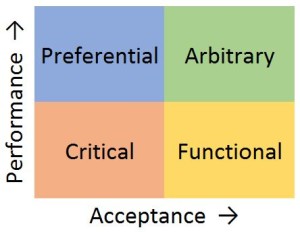
Even when it’s good for them, people tend to resist change – not because they don’t want things to be better, but because it takes energy to change. It’s not change itself we fight, but transition; the act of moving from one state to another. That’s where the energy is required. So we balk at those changes that we perceive will take the most out of us.
I believe there are two factors behind the impulse to change. The degree to which they impact the status quo determines how strongly the desire to change manifests itself.

The first factor is the performance of a current process. Another phrase you may be familiar with, “if it ain’t broke, don’t fix it,” comes to mind. If the existing course of action is producing the desired result, then it’s difficult to justify changing it. The more “broken” a process appears to be, however, the more change becomes necessary.

The second factor is the acceptance of the current process by the people affected by it. If people are comfortable with the status quo, then it will be difficult to affect a change in their behavior. The more accepted a process is, the more difficult it is to get people to change – regardless of the process’ performance.

Based on the interplay of these two factors, I suggest that there are four types of change. Understanding these types can help us identify how strongly a change needs to be made as well as potential barriers we may face in implementing a change.

Critical Change
Changes made to functions low in performance and low in acceptance are considered critical. Not only is the desired result not being achieved, but the current process is not being accepted by those affected by it. When both performance and acceptance are low, something needs to change quickly.

Functional Change
Changes made to functions low in performance and high in acceptance are considered functional. While the desired result is not being achieved, people are comfortable with things the way they are. Changing things up may be necessary, but resistance can be anticipated due to the comfort level people have with the status quo.

change-matrix-300x232

Preferential Change
Changes made to functions low in acceptance and high in performance are deemed preferential. Even though results are being achieved through this current process, those involved in it may have reservations about it. They may perceive it as too difficult or time consuming. Change may be required in order to maintain employee engagement.

Arbitrary Change
Finally, changes made to functions high in both performance and acceptance may be considered arbitrary. No good reason for the change is apparent and potentially high levels of resistance can be expected.

How a proposed change is categorized depends on your perspective. We are human beings, after all, and our individual beliefs, goals, and preferences come into play when evaluating the need to change. For example, your wife may decide it’s time to paint the living room. She sees it as a preferential change as she has simply become bored with the color. For you, though, this may be perceived as an arbitrary change. The paint is in acceptable shape and you are perfectly happy with the existing color scheme. With differences of opinion such as this, conflict over the potential change can be expected.

When considering any change, it is important to take individual perspectives into account. Few of us like being subject to decisions affecting our lives if we see them as arbitrary. Communication and even compromise become important considerations in navigating change.

Change may indeed be the only constant. There is no progress without it. But how we – and others – view any given potential change has huge implications for effectively implementing it. Over the next couple of weeks, I’ll explore some of the specific reasons people have for resisting change and how we can work together to make change easier to implement and assimilate.

Consider a recent change you have been asked to make. How has your perception of the change impacted your reaction to it? What could have been done differently to make the transition easier?


JOIN THE CONVERSATION:

When do you find change most difficult? Share your thoughts on our facebook page.

Flip or Flop?

ihighju001p1Richard had two bad feet, a bad back, and a dream of being a star track & field athlete. His chosen sport was the high-jump; but he struggled to clear the minimum distance – five feet- required to make the high school track team. No amount of coaching or practice seemed to help. The proven techniques utilized by his teammates and world-class competitors didn’t work for him. He just couldn’t get himself over the bar.

So Richard began to experiment. Over several months he altered each aspect of his performance. He started by adjusting his approach. While every other athlete ran straight at the bar, he began to run at a diagonal. This gave him more speed in the final few steps.

He changed his takeoff, starting further and further from the bar. He worked at it until he found the launching point that would position him over the bar at the highest point of the jump. As the height increased, he found he needed more room to achieve apogee.

Traditional jumpers utilized a scissor kick to clear the bar, stretching out one leg and then the other before landing on their stomach. Richard started twisting his body in the air so that he cleared the bar headfirst and landed on his back. This allowed him to arch his back and kick his legs up simultaneously, creating precious space between himself and the bar.

Richard’s track coaches were worried. The methods he was using were unheard of. They feared his deviation from standard procedures would damage his ability to compete and possible lead to serious injury. But during his junior year he broke the high school record. Suddenly the critics became supporters.

After winning a series of competitions in college, Richard Douglas “Dick” Fosbury began to catch the eye of the press. They dubbed his technique the “Fosbury Flop.” During the 1968 Olympics, he won the gold medal by clearing 7 ft. 4.25 in., setting a new Olympic record in the process. Today, the flop is the most popular high-jump technique in use.

Its easy to get stuck in a rut. People do it and so do organizations. We get used to doing things a certain way and rarely question why. Most people fail to realize that greatness lies just a few tweaks away from the norm. Innovation is rarely about huge, radical changes; although even small change is typically met with strong resistance.

Innovation is a critical aspect of any thriving business. If you aren’t constantly looking for ways to improve, you’re doomed to stagnate. Those who are willing to change thrive – they can even flip an industry upside down. Those who aren’t fall into obsolescence – they flop. And anyone can be a catalyst for change.

Could your business benefit from a little innovation? Could your performance use some tweaking? What small change would make a huge difference in your success?