80% of Your Growth Opportunity Lies Behind This Door

door-e1456723457887A few years ago, there was a reality show that featured emergency personnel competing against each other in a variety of events designed to challenge their strength, speed, and ingenuity. One episode in particular stands out in my mind. A group of firefighters went head-to-head until only three were left to face the final test. The contestants had to navigate an obstacle course. The man who finished in the shortest amount of time would be crowned the winner.

The final obstacle on the course was a trio of doors the firemen had to get through in order to cross the finish line. The first contestant sped through the course, lowered his shoulder, and attempted to smash through the first door. It held. He then tried to kick his way through. Again it held. Finally, using an axe, the burly man was able to hack his way through that first door. Then, already exhausted, he slowly chopped his way through the second and third doors while the clock ran.

Contestant number two, having watched all of this from the sidelines, didn’t waste any time trying to muscle the doors open. He immediately picked up the axe and began swinging. His time was much better than his predecessor, but he too slowed considerably as the physical effort took its toll.

The last firefighter confidently made his way through the course, posting a similar time as the first two until he reached the first of the doors. He picked up the axe, drew back to deliver his first blow, and then paused. He let the axe slide to ground, reached out his hand, and turned the knob of the unlocked door before walking through it. The next two doors proved to be unlocked as well and he won the competition easily, having barely broken a sweat.

I don’t know about you, but I often wrack my brain looking for the best solution to a problem, only to realize the answer is right in front of my face. While my focus has been on crafting a complex, often taxing strategy, a much simpler solution has been available all along. I just didn’t know where to look.

This is the route many of us take when looking to grow our business. We instinctively focus on difficult, time consuming, expensive strategies. Too many times, these efforts offer a horribly low return.

What if I told you that there’s an easier path to growth – one that’s been sitting in front of you all along? What if there’s a group of buyers just waiting to respond to your offer if you’d only recognize them and extend your hand?

The group I’m taking about is your existing customer base. Studies show that, for a great number of industries, up to 80% of your growth opportunity lies with existing customers. Instead of fighting for outside prospects, look inside to find your reward. Your most promising audience is comprised of those you’ve already done business with.

Think about it. Your customers have already made the decision to do business with you. They don’t have to be alerted to your existence or convinced to give you a try. They already know you possess a certain amount of expertise. Your customers already know who you are and how you work. The learning curve is short and trust is high, otherwise they’d have left for a competitor by now.

What your existing customer base may not know is how you can help them beyond the initial transaction. You can’t assume that because they bought one product from you they automatically know that you have additional solutions to offer. And if your original interaction took the form of a transaction rather than the start of a relationship, you probably didn’t do much to help them see beyond that particular transaction.

The onus is on you then to reach out, identify other potential needs, and then educate those who already trust you on the additional skills, expertise, and products you bring to the table. Remember, you are the expert. You have to be the one to make the effort. But since the hard part – establishing that initial trust – has already been done, the effort to extend the relationship doesn’t have to be taxing.

Over the next couple of weeks, I’ll share a few strategies for reaching out to this gold mine of potential. I’ll explore the concept of customer cues and clues – bits of insight that indicate opportunity is knocking. And just like the winning firefighter from my opening story, we’ll see just how easy it can be to open the door to those opportunities.


JOIN THE CONVERSATION:

What keeps you motivated? Share your tips on our facebook page.

You’ve Been Asking Yourself the Wrong Questions

woman-687560_640John O’Leary was a typical kid growing up in St. Louis, Missouri. But his life took a dramatic turn one day in 1987 when he accidentally triggered an explosion while playing with fire. Just nine years old, burns covered his entire body. He was rushed to the hospital where doctors gave him less than a one percent chance of making it through the night. He survived, only to endure months of pain and multiple surgeries, including the amputation of his fingers. Today O’Leary is a successful businessman, husband and, father.

I recently listened to an interview with O’Leary in which he shared insights into his ordeal and the mental shift he had to make in order to adjust to a new way of life. In particular, I was stuck by a series of questions he posed – questions that we all ask ourselves when faced with significant change or adversity.

Why me? According to O’Leary, the first question we ask when confronted with unwelcome change is “Why me?” We place ourselves into the role of a victim and look for reasons to distance ourselves from what’s happening. By adopting the victim mentality, we place responsibility for what’s happening on to someone else and we give ourselves permission to disengage.

Who cares? The second question we ask is “Who cares?” Because we feel alone and out of control, it’s easy to feel as if no one else is concerned about our feelings. “No one asked for my opinion. No one checked with me to see if this was a good idea.” When we perceive change as something that’s happening to us, we give ourselves permission to resist.

What’s the point? The third question, O’Leary says, is “What’s the point?” When we’re not the driving force behind change, it can be difficult to identify a reason. If we don’t agree with the change, and feel like we have no control over it, we give ourselves permission to not act.

O’Leary stated that he went through all of these questions multiple times during his period of recovery. Over time, he began to realize that he was asking himself the wrong questions. The secret to successfully navigating change is to ask yourself the right questions. So he started to train his mind to focus on a different line of thinking.

Why me? Why have I been given this opportunity? What is it that makes me particularly suited to excel in this environment and at this time? What unique talents and skills do I possess that set me up for success where others tend to fail?

Who cares? Who is depending on me right now? Who needs me to be successful in order to better their situation? Who else is out there struggling and looking for someone to show them the way? Who is looking to me for leadership and inspiration?

What’s the point? What’s the end game here? What larger purpose is being served by my journey through this trial? How will the greater good be served by my engagement and involvement?

Over the past few weeks, I’ve written about different aspects of navigating change. We can categorize the need for change. We can understand why accepting change is so difficult. We can even alter our approach to guiding others through the process of change. But as O’Leary learned, the biggest thing we can do to make significant change easier is start with our own attitude toward it.

Sometimes change is difficult; sometimes it’s painful. Occasionally, change is absolutely excruciating. I think that the toughest change to manage is the shift that has to occur in our own heads. Once we change the way we think, there’s nothing we can’t overcome.


JOIN THE CONVERSATION:

What keeps you motivated? Share your tips on our facebook page.

The Physics of Change

inertia-e1455505796605It’s called inertia.

That force that keeps us from doing things differently, even though we know it’s in our best interest, is called inertia. Isaac Newton first wrote about it back in 1687. While studying the physics of motion, he discovered that “an object that is at rest will stay at rest unless a force acts upon it.” Likewise, he observed that “an object that is in motion will not change its velocity unless a force acts upon it.”

Of course, while developing his First Law of Motion, Newton referenced primarily inanimate objects – things like apples and planets. He wasn’t really interested in understanding why people acted the way they did. However, the same principle that explains why the pen on my desk doesn’t move unless I pick it up points toward some realizations about how and why we respond to potential change.

In terms of human behavior, inertia represents the tendency to continue in whatever course of action we are presently engaged in. Sometimes, that means no action. Think about physical fitness, for example. It’s very difficult for a couch potato to change their behavior and suddenly start working out. But for individuals who do work out (or run, bike, etc.), asking them skip a session could earn you a dirty look. Why is it that a body at rest tends to stay at rest, while a body in motion tends to stay in motion?

We’re creatures of habit. The human brain is full of neural pathways – connections that link specific behaviors and consequences. Every new behavior creates a neural pathway. Subsequent repetitions of the same behavior reinforce that pathway. Over time, that pathway becomes well-defined, almost like a rut in a dirt road. When we go to perform an action, the brain looks for established patterns of behavior and follows the path of least resistance – the rut. Eventually, certain activities become so ingrained we don’t even have to concentrate on what we’re doing. Muscle memory takes over and we act without thinking.

Subtle shifts in behavior are often just as hard to make as drastic ones. When I go mountain biking, I’m often faced with trails that are riddled with ruts left by other bikers. Sometimes I’ll try to ride just to the side of existing ruts in order to provide for a smoother ride without causing significant further impact to the trail. However, I almost always find this method of riding difficult to sustain. Try as I might to ride the edge, I just keep sliding back into the rut. Carving an entirely new route can actually be easier. Without the convenience of an established path to fall back on, I have no choice but to embrace something new.

Breaking one habit requires creating another one. Even though I’ve begun the process of creating a new pathway, my next trip down the trail presents me with the same challenge. Until I’ve traveled the new path enough times for it to become established, I’ll have to fight the tendency to follow the old one – the rut. It takes time for my mind and body to see the new pathway as the obvious choice. Old habits die hard. It takes focus and determination to kill them.

So what does this mean for effectively implementing significant change, either personally, or in our teams? How do we approach change in a way that helps people accept it, embrace it, and stick with it?

1. Accept that significant change takes effort. Like pulling out of a rut on the bike trail, shifting behavior requires concentrated effort. It’s not easy. Just because someone has a tough time adjusting to a new process doesn’t necessarily mean they don’t agree with it. Even the easiest, most desirable change can take its toll on people. Recognize the effort that’s required.

2. Accept that significant change takes time. Meaningful change doesn’t occur overnight. Allow ample time for people to process what’s being asked of them and to come to terms with their own feelings about it. Set your expectations in such a way that, as an agent of change, you don’t become frustrated with what appears to be a failure to accept new processes.

3. Accept that significant change takes repetition. Understand that I order for a new process to become routine, old habits have to fade. For that to happen, new habits – new neural pathways – have to be created. Until the new route is firmly established, people will occasionally fall back into the rut.

As Newton discovered so long ago, change doesn’t just happen. With the right kind of approach, though, effective change can be realized. Using the right combination of focused effort, repetition, and time will allow you to overcome inertia.


JOIN THE CONVERSATION:

What keeps you motivated? Share your tips on our facebook page.

The History of Cake Mix & Resistance to Change

cakemix-e1454724283655Prior to 1930, every cake baked in the United States was made from scratch. Cooks hand-sifted their own flour, carefully measured out the ingredients, and lovingly slaved over their delicious creations. But the P. Duff & Sons company changed all of that by introducing a pre-made cake mix. Thanks to shifting consumer habits, the company found itself with an overabundance of molasses. To avoid wasting this resource, they found a way to dehydrate it and combine it with other pre-measured ingredients to produce a cake mix. Marketed as a convenience, the product was an instant hit.

But not everyone flocked to buy this new creation.

For serious cooks, using a pre-made mix could not be considered baking. Housewives especially felt guilty for taking shortcuts with their family’s food. Still, the idea caught on and other companies began perfecting their own brands of mix. As women began entering the work force during the Second World War, the time saved using pre-packaged food helped cake mixes become mainstream.

But following the war, as families once again turned to the dinner table, sales of cake mixes flattened.  Research revealed that cakes baked from a box just didn’t taste as fresh as those made from scratch. In search of better tasting fare, consumers were abandoning the mixes. The culprit, it turned out, was the dehydrated eggs. Using fresh eggs helped give a cake texture while the powdered version in the mix left them flat.

Removing the dehydrated eggs and changing the recipe to have the cook add their own fresh ones solved that issue, but the struggle wasn’t over. In the 1950’s, the cake mix industry faced another decline in sales. A wave of individual expression left cooks desiring a personalized approach to baking. Cakes from a mix all looked the same – and that was boring. Luckily, some smart advertising helped provide consumers with tips for turning the basic cake mix product into one-of-a-kind creations.

Regardless of the nature of change, there will likely be opposition. For most of us, it’s hard to imagine passing over the convenience of a pre-packaged cake mix. However, the challenges faced by this one product line illustrate why just about any change can be difficult to implement. While the outward symptoms appear to be different (rejection of a new process, taste preferences, and a desire for individual expression), at the core lies a single cause for resistance to change – loss of control.

Like gravity, the need for control is a constant pull. Every decision is affected by that pull. Any change in behavior either gives us more control or takes some away. Changes that result in more control tend to be accepted readily – we like making those adjustments. But changes that force us to relinquish control are harder to accept. The desire to be in control is so strong that, even if we know the change is ultimately for the better, we tend to first consider what we have to lose.

This is a key concept to keep in mind when rolling out any new process. Despite the benefits of a change to product features, what will your customers believe they are being forced to give up as a result? What about your employees? What control will they perceive is being taken from them as part of the latest procedure change?

It’s easy to view organizational change as a simple project when you’re the one calling the shots. As with any communication effort, the key to success is considering how others will interpret your words, your actions, and ultimately, your intent.


JOIN THE CONVERSATION:

What keeps you motivated? Share your tips on our facebook page.

The Matrix of Change

sign-94966_640It’s often said that “the more things change, the more they stay the same.” In many ways, this appears to be the case. Change is all around us. And whether it’s technological, social, economic, political, or otherwise, the volume of speed at which change takes place is constantly on the rise.
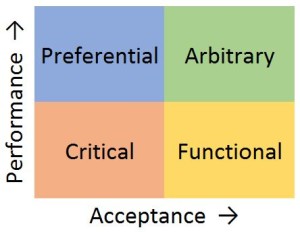

Even when it’s good for them, people tend to resist change – not because they don’t want things to be better, but because it takes energy to change. It’s not change itself we fight, but transition; the act of moving from one state to another. That’s where the energy is required. So we balk at those changes that we perceive will take the most out of us.
I believe there are two factors behind the impulse to change. The degree to which they impact the status quo determines how strongly the desire to change manifests itself.

The first factor is the performance of a current process. Another phrase you may be familiar with, “if it ain’t broke, don’t fix it,” comes to mind. If the existing course of action is producing the desired result, then it’s difficult to justify changing it. The more “broken” a process appears to be, however, the more change becomes necessary.

The second factor is the acceptance of the current process by the people affected by it. If people are comfortable with the status quo, then it will be difficult to affect a change in their behavior. The more accepted a process is, the more difficult it is to get people to change – regardless of the process’ performance.

Based on the interplay of these two factors, I suggest that there are four types of change. Understanding these types can help us identify how strongly a change needs to be made as well as potential barriers we may face in implementing a change.

Critical Change
Changes made to functions low in performance and low in acceptance are considered critical. Not only is the desired result not being achieved, but the current process is not being accepted by those affected by it. When both performance and acceptance are low, something needs to change quickly.

Functional Change
Changes made to functions low in performance and high in acceptance are considered functional. While the desired result is not being achieved, people are comfortable with things the way they are. Changing things up may be necessary, but resistance can be anticipated due to the comfort level people have with the status quo.

change-matrix-300x232

Preferential Change
Changes made to functions low in acceptance and high in performance are deemed preferential. Even though results are being achieved through this current process, those involved in it may have reservations about it. They may perceive it as too difficult or time consuming. Change may be required in order to maintain employee engagement.

Arbitrary Change
Finally, changes made to functions high in both performance and acceptance may be considered arbitrary. No good reason for the change is apparent and potentially high levels of resistance can be expected.

How a proposed change is categorized depends on your perspective. We are human beings, after all, and our individual beliefs, goals, and preferences come into play when evaluating the need to change. For example, your wife may decide it’s time to paint the living room. She sees it as a preferential change as she has simply become bored with the color. For you, though, this may be perceived as an arbitrary change. The paint is in acceptable shape and you are perfectly happy with the existing color scheme. With differences of opinion such as this, conflict over the potential change can be expected.

When considering any change, it is important to take individual perspectives into account. Few of us like being subject to decisions affecting our lives if we see them as arbitrary. Communication and even compromise become important considerations in navigating change.

Change may indeed be the only constant. There is no progress without it. But how we – and others – view any given potential change has huge implications for effectively implementing it. Over the next couple of weeks, I’ll explore some of the specific reasons people have for resisting change and how we can work together to make change easier to implement and assimilate.

Consider a recent change you have been asked to make. How has your perception of the change impacted your reaction to it? What could have been done differently to make the transition easier?


JOIN THE CONVERSATION:

When do you find change most difficult? Share your thoughts on our facebook page.

5 Tricks to Regain Your Motivation

smiley-1041796_640I’d lost it. My mojo, my desire to achieve, my motivation to move forward… was gone.

I had started running in May, a natural progression of the workout routine I’d started a month earlier. I had caught the bug and was going for a run at least every other day. Things were going well – I’d lost some weight and felt better than I had in a long time.

But while out for a run during the last week of July, I somehow managed to injure my left foot. Within an hour of completing my run, I was barely able to stand, a stabbing pain pierced my heel. A quick internet search revealed the most likely diagnosis was plantar fasciitis. Recovery, however, would not be quick. The recommended course of action was rest and reduced activity while the condition resolved itself; but that could take six months to a year.

I tried to convince myself that the pain was temporary, but a couple of test runs proved otherwise. I was grounded. Unable to participate in my new favorite activity, my motivation to exercise plummeted. I started gaining weight again and found myself spending more and more time on the couch.

From time to time, we all suffer from a lack of motivation. Things are clicking along and suddenly, without warning, we hit a wall. Sometimes, all it takes is some sort of setback – a disappointing performance, lack of positive feedback, or even an injury. In other instances, a drop in motivation might result from boredom. Without variation, even the most worthwhile jobs lose their excitement.

Last week I wrote about personal accountability, suggesting ways to keep yourself focused on achieving the goals you set for yourself this year. Accountability is important, but motivation is critical. Think of accountability as external pressure to perform. Motivation, on the other hand, is the internal drive to achieve. Accountability can be avoided and suppressed, but once motivation kicks in it will not be denied.

When motivation ebbs, it can be difficult to regain. I have found there are five things I can do to rekindle the internal fire and boost my motivation.

  1. Listen to motivating music. There are certain songs that instantly boost my energy level. When I started running, I developed a playlist that never failed to keep me moving. Listening to those songs caused a shift in my mentality. I would instantly envision myself succeeding and my body responded. I enjoyed the sensation so much that I started listening to the playlist at other times. No matter what I’m doing, it inspires me to up my game just a bit. Do you have some go-to motivational music?

  2. Look at motivating images. Zig Ziglar used to tell the story of his own weight loss journey by describing how he once tore an ad from a magazine. The ad featured a fit male model, and he taped it to his mirror. Every morning Ziglar would look at the ad and ask himself “Zig, do you want to look like you or do you want to look like the guy in the magazine ad?” Similarly, my son has pictures and videos of successful musicians saved on his phone. He wants to be a musician and looking at them motivates him to practice. Looking at images of successful people can help boost my motivation because I imagine myself in their place and feel compelled to take the next step to achieve that goal. Do you have some go-to motivational images?

  3. Read motivating words. I love quotes. The right combination of words often cuts through the clutter and speaks to my soul so clearly that I cannot help but be motivated to act. For quite a while now, my favorite one has come from Karen Lamb. “A year from now you will wish you had started to day.” Every time I think about that quote, I imagine myself a year in the future and am motivated to get moving. Do you have some go-to motivational words?

  4. Talk to motivating people. Some people drag you down. Some lift you up. Avoid the former. Be the latter. Talking to people who whine and complain does nothing to help me get better. Talking to people who encourage and challenge me does. I’ve found that the best way to find motivators is to be one yourself. In fact, I can turn my own day around simply by encouraging someone else. As I speak uplifting words to them, I hear and internalize those same words. It’s a sure-fire way to remind myself of the goals I committed to achieve. Do you have some go-to motivational people?

  5. Do motivating things. They say the journey of a thousand miles begins with a single step. That first step might be difficult, but the second one is easier. Each subsequent step is easier still. The key is to take that first step – no matter how small you have to make it. Lost your motivation to work out? Go for a short walk. Lost your motivation to clean the house? Start by making the bed. One small victory provides the motivation necessary to move me just a bit further down the path. Do you have some go-to motivational activities?

I’m happy to report that I’m back on the exercise wagon. I’m still not running again, but I am walking daily. As of yesterday, I’ve hit my 10,000 step goal for 24 consecutive days. Of course, seeing the visual representation of my success displayed on my fitness tracker motivates me to keep the streak going.

I hope that, as we near the end of January, you are still on track with your personal improvement goals. If you’ve hit a speedbump – if something has caused you to lose motivation – try some of these tactics to regain it. There’s a lot to accomplish this year. You need to stay fired up.


JOIN THE CONVERSATION:

What keeps you motivated? Share your tips on our facebook page.

Feet to the Fire: Keys to Personal Accountability

andrew-mirror-e1452990922179By now, close to a third of all New Year’s resolutions have been abandoned. Think about that. Millions of people announced an intention to make some kind of significant change in 2016; and less than three weeks later have walked away from that commitment. Is it any wonder that more and more people have decided to stop making resolutions altogether?

I guess some figure it’s just too hard to keep their resolutions. Losing weight sounds like a great idea, but when you really think about it, losing weight is not easy. It requires changing the way you think. It requires changing the way you act. It requires developing new habits. And change is very, very difficult.

But isn’t that the point? Aren’t resolutions supposed to be hard? Shouldn’t meaningful change come at a cost? After all, if it was really that easy to make significant changes to your daily life, you’d have already done it, right? There’d be no need to set some kind of goal for improvement.

We make resolutions in good faith. We set goals for ourselves with the most sincere of intentions. So many attempts at change fail though because we just don’t hold ourselves accountable. Starting a new routine tomorrow sounds great, but when tomorrow comes – with all of its unexpected twists and turns – the road isn’t as easy as we thought it would be and we give ourselves permission to back off. How can we hold our feet to the fire so that the meaningful change we desire takes root?

Renew your commitment to yourself.

  • Remind yourself why you set the goal in the first place. There’s a reason you identified this goal. Something happened that caused you to decide things had to be different. Hold on to that thought. Hold on to the emotions that welled up inside you and led you to declare that, going forward, your life would be different. Let those feelings propel you through the toughest parts of your transformation.
  • Give yourself permission to let other things take a back seat. One of the most common reasons for abandoning new routines in our life is lack of time. Guess what? That’s an excuse – nothing more, nothing less. We all have the same amount of time every day. We just choose to allocate it differently. Someone once said “I don’t have time” is another way of saying “That’s not important.” If you want something bad enough, you won’t have to find time for it. You’ll make time. Learn to let lesser things slide in pursuit of your identified priorities.
  • Write it down. Post it. Look at it. Commit to your goal in writing. Tape it to the bathroom mirror, the refrigerator, or the television. Make sure you can’t go a single day without being reminded of the commitment you made to yourself.

Create systems to hold yourself accountable.

  • Schedule it. Remember the SMART Goal filter? Conducted properly, that exercise will provide you with specific action steps to accomplish your goal. Now take those steps and identify exactly when and where you are going to take them. Write them on your desk calendar. Enter them into your smartphone. What gets scheduled gets done.
  • Create reminders. Now go back and set reminders to yourself so appointments don’t sneak up on you and catch you off guard. Set an alarm each night to remind you to pack the gym bag. Put a post-it note on the door to remind you to grab your lunch. Use texts and emails to stay on top off your new commitments.
  • Partner with others. One of the best ways to hold yourself accountable is to hold someone else accountable at the same time. Find someone who shares the same goal and work together. They say misery loves company. I say success is better when shared, and a little competition is good for the soul. Anyone want a Fitbit buddy?

Ask for accountability.

  • Tell others what you are doing. This time next year, people are going to expect Mark Zuckerberg to have delivered on his personal challenge to build an artificial intelligence system for his home. He publicly announced his intentions, essentially asking others to hold him accountable. A goal kept secret is easy to walk away from, but a public declaration invites accountability.
  • Give others permission to ask for updates. Having announced your goal to others, ask them to challenge you. Beg them to do it now, while your resolve is firmest. Share with them why this is important to you and request that they periodically check on your progress.
  • Welcome consequences. I define accountability as the application of both truth and consequences. Define some milestones and associate rewards (positive consequences) with reaching them. Identify some negative consequences with failure. We are naturally drawn to things we want and move away from things we don’t want. Use this basic instinct to your advantage and ask friends to help keep you honest.

Personal accountability is easy when the task is easy. Persevering in the face of obstacles requires discipline. Ultimately, you have to decide how you want to perceive yourself. Are you a champion, or an also-ran? Champions hold themselves accountable. They do what has to be done. If you want to be a champion, then be one. Don’t think about it. Don’t hope for it. Don’t wait for it to happen to you. Just be a champion. Do the things champions do – every day.


JOIN THE CONVERSATION:

How do you hold yourself accountable? Share your tips on our facebook page.

Five Steps to Take Your Resolutions from Dream to Reality

goal-list-e1452481764282Last Sunday, Facebook CEO Mark Zuckerberg announced his 2016 personal challenge. He plans to build an artificial intelligence system to run his house. In past years, he’s challenged himself to learn Mandarin, read a new book every two weeks, and to meet a new person face-to-face, every day.

While most of us don’t have the resources available to set a goal as aggressive as building a robot butler, it does make sense to set some type of personal goals for improvement. Whether you call them New Year’s resolutions or personal challenges is irrelevant. What matters is that you identify a goal to improve yourself and set out to accomplish it.

Of course, setting a goal isn’t all that difficult. You just pick some aspect of your life that you want to be better and decide to work on it. The hard part comes when the rubber meets the road – that is, when you actually have to make some kind of change in order to achieve your goal. You can’t just set a goal. You have to create a plan for success.

Last week, I presented seven different areas of your life that Career Coach Dan Miller suggests setting goals for. I also promised to share with you my personal goals/resolutions and some of my plans to achieve them. After considering all the categories and paring the list down, here’s what I came up with:

  • Get in better shape physically.
  • Spend more time on spiritual and mental growth.
  • Get more organized and manage my time better.

Now these statements probably look a lot like the resolutions most people make every year. That’s understandable. The problem is that resolutions like these just don’t work. Did you know that 25% of resolutions are abandoned after just one week? By July 1st, six months into the year, 60% of the people who made resolutions will have quit. That’s because making a resolution isn’t good enough. You have to have a plan to accomplish the goal. A New Year’s resolution without a plan is just a wish. It’s a pipe-dream. But a resolution with a well-thought out plan of action becomes a mission.

Here are five things I’ve done to give my resolutions a more-than-fair shot at actually becoming reality.

I wrote my goals down. On reason most resolutions fail is that they never make it past the stage of conception. Simply voicing a desire to improve does little to change your mindset. But there’s magic in writing down your goals. Seeing your goals in writing gives them weight. It makes them real.

I actually wrote down several versions of my 2016. What you see above is just the initial, vague concept behind those I settled on. Keep reading to see how I refined my thoughts into concrete strategies.

I thought small. Another reason resolutions fail is because people bite off more than they can chew. They set too many goals. They shoot for too much improvement too quickly. As a result, they reach too far, wind up falling short, and give up. The secret to making change stick is actually small moves. Small moves are easier to accomplish, allowing you to complete more of them and giving you the confidence to attempt something just a bit harder.

Knowing how full my plate is, and how difficult it is for me to stick to any particular routine, I first decided to whittle my list of resolutions to three. Furthermore, I chose to approach each goal using small, easy-to-accomplish steps. For instance, I know (from experience) that a gym membership is a waste of time for me. I simply don’t have the discipline or time to travel in order to work out. So I decided to focus on bodyweight exercises that I can complete at home in just a few minutes a day.

I got very specific. In order for a goal to be actionable, it has to be specific. The best way to ensure a goal is a good one, is to use the SMART Goal filter. SMART Goals are specific, measureable, attainable, time-based, and realistic. If your goal can pass this simple test, you now have a strategy. Rewrite your goals, getting more and more specific, until you can pass each of the five parts to the SMART Goal filter.

There are two parts to my fitness goal. Part one involves taking 10,000 steps daily. That number is generally regarded as a minimum target for adults. I bought a Fitbit tracker last year that keeps tabs on my progress and experience shows that with just a little extra effort, I can reach that number each day. I also found a free 90-day exercise plan that features short bodyweight movements. I created a tracking sheet and have been marking my progress as I complete each day’s routine. Now I have two fitness strategies that, based on what I know about myself, meet the SMART Goal criteria.

I’m working smarter, not harder. Change is difficult. Huge changes, such as starting a daily routine that hasn’t existed before, are even harder. In order to make it stick, you have to make it as easy as possible to engage in the new behavior. Take steps to make it almost impossible to fail by designing systems that use your natural inclinations to propel you forward.

I moved my elliptical machine into my bedroom. It doesn’t fit with my wife’s decorating, but it’s an in-my-face reminder of my goal – and it removes my excuse for walking when inclement weather keeps me inside. I also identified a series of business and spiritual audio podcasts that I can listen to while walking. This allows me to tackle two goals at the same time. I don’t have to find extra time or expend extra effort to accomplish that goal, so it becomes almost automatic for me.

I started immediately. Your biggest enemy is tomorrow, and there are a thousand reasons to wait. Ignore them. Start now. Inertia is a powerful enemy, but it can also be a powerful friend. Get moving and get inertia on your side.

One of my favorite quotes is from Karen Lamb. “A year from now, you’ll wish you had started today.” Make the commitment and get moving. Taking the first step is usually the hardest part of any new project for me. Once I take that first step, though, the next one becomes easier. Each successive step becomes easier still. The sooner you get started, the better. As of last night, I’ve got 1 days under my belt. According to my tracking sheet, I’ve hit my target each day. Some days I barely made it, but I did it. Had I waited until this week to get going, odds are I’d just keep waiting.

Obviously, I didn’t share everything about my 2016 plan – this article is already longer than I intended. If you’re interested in more details about my goals and strategies, feel free t ask. That will help keep me accountable – a topic I’ll cover next week.

Have you given up on your resolutions already, or are you still committed? It’s not too late to take charge of 2016. All you have to do is settle on a few small changes and then massage those goals into workable strategies. Let’s make this our best year so far!

What Will You Do Differently This Year?

fitness-957115_640The New Year has arrived. Are you ready for it? Are you energized and excited? Are your goals set? I’m not talking about your business goals; things like revenue and customer growth. I’m talking about your goals – the things you want to accomplish this year. Do you have them written down?

A lot of people start January with a list of New Year’s resolutions; things they want to either start or change in order to improve their quality of life. Memberships to gyms and dieting plans are skyrocketing right now. Of course, by February, most resolutions will be forgotten or abandoned. I think that’s sad, because self-improvement is not something to be taken lightly. We should honor those commitments and work hard to succeed at them.

One of my favorite business and motivational speakers, Zig Ziglar, once said “With definite goals you release your own power, and things start happening.” I believe that is true. Without personal goals, I feel like I am just meandering my way through life. Maybe good things happen, maybe they don’t; but without goals I feel like I’m subject to the whims of fate.

Setting well-defined goals is like having a GPS for life. It creates not just a target to reach for, but a set of guidelines by which to get there. Once I’ve decided where I want to go and the route I want to take, the trip becomes easier and much more enjoyable.

Career Coach Dan Miller suggests seven different areas of life in which you should set personal goals. That may be a bit much for some people; especially if you’re like me. I’m not very disciplined, so having too many goals to achieve lessens my chance of accomplishing any of them. But let’s start with his list. See what goals you come up with for each of these categories.

  1. Financial. How much do you want to be earning this time next year? How much do you want to have saved or invested? How will improving your financial well-being impact your quality of life?
  2. Physical. What bad habits do you want to shed this year? What good ones do you want to pick up? What does your physically fit self look like? How will a change in your physical well-being impact your quality of life?
  3. Personal Development: What new skills would you like to learn this year? What gifts do you have that aren’t being utilized? How will spending time on your own development impact your quality of life?
  4. Family. What changes need to be made with regard to those closest to you? What does a healthy relationship with your significant other look like? What about the relationship with your children? How will more meaningful relationships with your family impact your quality of life?
  5. Spiritual. What do you feel is God’s purpose for your life? What changes do you need to make in order to grow in your faith? How will a deeper spiritual walk impact your quality of life?
  6. Social. Are you comfortable with the number and types of people that make up your social circles? What changes do you need to make in order to be a better friend? How will richer social relationships impact your quality of life?
  7. Career. Are you utilizing your unique skills, abilities, and passions at work? What would it look like to do your best work? What would it look like if your team was operating at their best? What changes need to take place in order for this to happen? How will doing your best work impact your quality of life?

Like I said, that’s a lot to consider. I can easily conceive of at least two goals for each category; but 14 goals is just too much to carry. The list needs to be trimmed down. Personally, anything over 5 is out of the question; and even that is pushing it. So the next step is to cull the list. Look at the last question I added to each category. Prioritize your list based on the level of impact you feel each goal will have on your life. Decide how many you think you can reasonably work on and put the others aside. Those can be saved for later on, after we’ve made significant progress on the most important ones.

Of course, just having goals identified isn’t enough. We need to have a plan to help us achieve them. Next week, I’ll share the goals I’ve set for myself and the strategies I’m putting in place to achieve them. Until then, I’d love to hear what you come up with.

Winning When You’re Not Ready

Jim-Thorpe
Agence Rol [Public domain] , via Wikimedia Commons
The 1912 Summer Olympics, held in Stockholm, Sweden, proved to be a busy one for American Jim Thorpe. An accomplished athlete, Thorpe was scheduled to participate in four events – the long jump, the high jump, the pentathlon, and the first-ever decathlon. Combined, he was set to compete in 17 different contests, each with potentially multiple heats, over two days.

Born in 1887, Thorpe was a natural athlete. He started playing football in high school; but soon added baseball and lacrosse (along with ballroom dancing) to his resume’. However, it was his performance on the football field that made him a household name. He earned collegiate All-Star honors in both 1911 and 1912. Carlisle Indian Industrial College won the 1912 national championship largely due to his involvement – he scored 25 touchdowns and 198 points during that season.

It wasn’t until the spring of 1912 that Thorpe turned his thoughts to competing in the Olympics and began training. Just a few months later, he now reached for his shoes in anticipation for his first event. There was just one problem, though.

His shoes were gone.

Thorpe’s track shoes – his most valuable pieces of equipment – had been stolen. But there was no time to track them down. The first event was about to start. If Thorpe didn’t report to the starting line quickly, he would be disqualified. The starting gun simply would not wait.

While few of us can relate to the pressure of competing in an Olympic event, most of us can understand feeling ill-prepared for the starting gun. Maybe it’s a big work presentation, an important client meeting, or the start of the next sales cycle – despite your best efforts, you can find yourself feeling not quite ready for the clock to move forward. Numerous times over my career, I’ve found myself feeling like I need a time-out in order to gather myself before launching into something big.

Perhaps one or more of these scenarios seems familiar to you.

  • You’re feeling swamped. Sometimes the pressure of too many things on your plate can make you want to call for a time-out. When the calendar is full and deadlines start getting close, the pressure can be overwhelming.
  • You’re feeling thrown off guard: Sometimes you think you’re ready, but factors outside of your control move against you at the last minute. Family issues pop up, market conditions change, and coworkers let you down. All can leave you feeling off-balance.
  • You’re feeling ill-equipped. Equipment can fail. Supplies can prove to be inadequate. Help can be out of reach. Finding yourself without key resources can be a significant setback to even the best of us.

Eventually, you’ll find yourself between a rock and a hard place; between the need for more time to prepare and an unmovable deadline. Maybe it’s now, at the end of the year with less than a week to the end of one year and the start of the next.

What do you do?

Try following Jim Thorpe’s lead.

  1. He didn’t give up. As tempting as it must have been to throw in the towel, Thorpe didn’t. He didn’t forfeit. And he didn’t spend time worrying about what had happened to his shoes. Don’t waste precious time dwelling on things outside of your control. Focus on what you can do.
  2. He found an alternate solution. Thorpe pulled two mismatched shoes from a garbage can. He put extra socks on his left foot to compensate for that shoe being too big. Don’t let the absence of a perfect solution hold you back. Find a way to move forward.
  3. He ran like a champion. Thorpe shook off any self-doubt he had and resolved to get the job done. More than that, he resolved to win. Don’t just participate. Compete to win; no matter what it takes.

Thorpe won four of the five pentathlon events wearing mismatched shoes and earned the gold medal. That same day, he qualified for the high jump final and took seventh in the long jump. The next day, he placed no lower than fourth in all ten events of the decathlon and received that gold medal as well.

The New Year is upon us. The starting gun is raised. Like it or not, the game is about to start. What do you say champ? Ready to race?

“Jim Thorpe, 1912 Summer Olympics” by Agence Rol is licensed under PD-1923.