
What’s Your Plan?

We really are creatures of habit, aren’t we?

We humans have become extremely proficient at developing routines. We find comfort in the expected, so much so that we rely on it. We become dependent on it. Our expectations start to revolve around systematic events over which we have no control. We fall into a rut and set ourselves up for disaster.

Because, what happens when the routine breaks down? What happens when that email we’ve come to expect every Monday morning doesn’t arrive on time? How do we respond when the friend or coworker that’s been so reliable suddenly isn’t there for us anymore? What are we to do when the customer we were counting on to make our monthly numbers takes their business elsewhere?

I don’t mind a good surprise now and then, but there are some things I like to have control over. When it comes to running (and growing) my business, I don’t want to be so dependent on things outside of my control that a surprise break in the routine can cause chaos. That’s where a good strategic plan comes in.

I’ve said before that “hope is not a strategy.” However, that’s exactly how many leaders run their business. They sit back and hope enough new business will walk through the door to make their numbers. Others rely on assumptions. They assume the same customers will always come through. They assume market conditions will remain favorable. Things have always worked out in the past, so they just assume things always will.

Hope and assumptions are not sound business strategies. Having a plan is. A strategic plan outlines the results you want and the steps you and your team must take in order to achieve those results. There is no hope or assumption involved. There is action – specific, measurable action that, when executed properly, virtually guarantees your success.

A lot of leaders will say they have a strategic plan in place. Few actually do. Oh, some may have a few ideas written down on a piece of paper somewhere – typically because they’ve been forced to by someone up the food chain; but I rarely meet teams who have proper strategic plan.

A simple strategic plan includes three components.

1. Goals. What is it the team is trying to achieve?

2. Actions. What has to happen in order for the goal to be achieved?

3. Accountabilities. Who is responsible for executing the identified actions?

Over the next couple of weeks, I’m going to walk through the process of putting together a strategic plan. I’ll give you some tips for writing your first plan, or for plugging some holes that might exist in an existing one. You can follow along and have a basic strategic plan for the rest of the year completed by the end of August.

It’s not too late to take control of your year. It’s not too late to break away from the routines that might be holding you back. Now is the time to stop hoping, stop assuming, and lead your team across the finish line in championship fashion.

Now is the time to make success a habit.

Change the Way You Act

weary-traveler-1631369_640Welcome back! I hope you had a merry Christmas full of family, friends, and good cheer. I’m actually enjoying a second round of Christmas this week. My parents flew into town last night and are spending the week with us. I anticipate a week of much needed rest before hitting the New Year in stride.

Speaking of the New Year, I promised to share my three personal challenges for 2017. I’ve already laid out the first two – changing the way I think and changing the way I talk, having provided specific ways in which I plan to address each of these goals. Today, I want to explain the third challenge I’ve decided to take on for 2017. It’s to change the way I act.

It’s easy to say you will change the way you think. After all, no one can read your mind and see the actual thoughts swirling around your brain. And it’s only slightly less difficult to change the way you talk. Despite the occasional slip of the tongue, choosing to say “the right thing” comes easy for a lot of us. After all, words are cheap, right?

But changing the way you act is something altogether different. It is through our actions that we are defined. I’ve known plenty of people who acted in ways that seemed remarkably different than the way they spoke. Many of us act in ways that run counter even to what we believe to be best. Actions can betray not only our words, but our thoughts as well. So I’ve chosen some specific ways in which to try and tame my own behavior.

I’m going to try and act with intention. I’m one of those people that like to say “yes.” I like being viewed as a go-to resource, someone who can get the job done. But saying “yes” too often gets a lot of people in trouble. Taking on too much can put you in a position where you’re running behind and trying to please a lot of others people while still trying to get your own work done. In the end, you wind up short-changing everything. No one project gets your best effort and no one, including yourself, is blown away by the result.

To combat this trend, I’m challenging myself to be more purposeful about my actions. When I take something on, I want it to be intentional. It needs to be something I believe in and will commit to owning. I want to execute. It may upset a few people that I have to say “no” to, but then they wouldn’t be happy with a lackluster effort anyway. I’ll be happier with myself having committed to only those projects I believe in.

I’m going to try and act with passion. Having ideally pared down the number of commitments I’ve made, I should be able to approach each one with a lot more gusto. You know that feeling you get when you’re working on something and just know deep down that you’re doing your best work? Time seems to slip away because you get caught up in doing the very best job you can. That’s the feeling I’m going to shoot for. I want work I can be proud of. That means I can’t allow myself to “dial it in.” If I’m in it, I’m in it to win it.

I’m going to try and act with focus. I can’t do my best work with a lot of distraction. Multi-tasking has been scientifically proven to reduce productivity, and I know it’s been killing me. So that’s got to stop. Likewise, interruptions pull me out of “the zone” and make it that much harder to get back in the swing of things. So I’m going to have to block out chunks of time to focus my energy on specific tasks knowing that the end result will be better having done so.

Now, I’ve shared my three personal challenges with you for a couple of reasons. Obviously, I feel this is a good practice and I want to encourage you to identify a couple of challenges for yourself. If I’ve hit a chord with my challenges, feel free to adopt them and join me on this quest. Regardless, write down specific things you want to improve on in 2017. I write mine on sticky notes and post them on my bathroom mirror as a daily reminder.

I also invite you to hold me accountable. Accountability is something of a lost art these days. People didn’t always feel so free to make promises knowing they could ignore them or weasel their way out at some point. I thinks that’s a shame. So, ask me from time to time how I’m holding up against my personal challenges. If you feel so bold, share your 2017 goals with me. I’ll be your accountability partner if you’ll be mine.

Let’s make 2017 the very best it can be. The New Year is blank canvas, just waiting for us to make our mark. What do you say we make it a great one?


JOIN THE CONVERSATION:

Have an opinion on this post? Share your thoughts on our facebook page.

Learn to Be Flexible

ropes-993425_640Twelve seconds. That’s how long it took for Julia Gunthel to set a new world record. It happened in Cologne, Germany on November 23, 2007. In only twelve seconds, Gunthel popped three balloons with her back. While I have trouble bending forward to touch my toes, she can do it bending backward.

That’s because Gunthel is extremely flexible. Doctors say she has the ligaments of an infant, allowing her to twist and contort herself into all manner of strange positions. She discovered her amazing ability when she was four years old and now performs all around the world – wrapping her legs around her head and folding herself into boxes the size of a carry-on suitcase.[Tweet “You don’t have to be a professional contortionist to be flexible.”]

Of course you don’t have to be a professional contortionist to be flexible. Given the ever-changing nature of today’s workplace, flexibility is a skill we should all be developing. Those who learn to bend without breaking will always have the advantage over more rigid competitors. Here are three ways being flexible provides a leg-up.

Flexibility allows you to adjust quickly in the face of new information. Inflexible people and organizations have a difficult time adjusting to an ever-changing world. They create policies, procedures, and plans based on a particular set of circumstances and find themselves at a loss when those circumstances change. Those who are flexible understand from the outset that today’s plan might not work tomorrow. Because they haven’t adopted too many sacred cows, they can more easily tweak plans as needed to stay ahead.

Flexibility allows you to recover faster from unforeseen setbacks. Everyone gets blindsided occasionally. Just today, I found myself called in to an unanticipated meeting that threw off the schedule I’d laid out. When this happens, inflexible people find themselves under the gun – behind schedule, scrambling to make up time, and stressed. Those who are flexible know not to paint themselves into corners. They leave enough wiggle room to shift priorities around in a way that ensures setbacks don’t derail their entire plan.

Flexibility allows you to take advantage of short-term opportunities. When someone knocks on the door of opportunity, you want to answer it. This is really hard for some people to do because they’re hands are already tied. They’ve created such a rigid system around them that they can’t move on a new opportunity for fear of dropping something from their already crowded plate. Flexible people know some great could lie around the next corner, and they want to be ready for it.

So, how do you become more flexible? It all starts with your mindset. Consider these mental approaches to change. In general where do you fall on this continuum? Challenge yourself to adopt a more willing attitude toward change with the ultimate goal being to reach level five.

Level I – I am resistant to change. I hate it. Change is typically bad, so I fight it.

Level II – I tolerate change. I don’t like it. There’s no need for it. If it has to happen, get it over with.

Level III – I embrace change. I am ok with it. Change is typically good, so bring it on. I’ll go along.

Level IV – I assist change. I like it. Change is needed. I want to play a part in making change go smoothly.

Level V – I lead change. I love it. If it’s not broken, let’s break it and make it better. Follow me.

Julia Gunthel has inspired a wave of potential performers. Thanks to her example, others are flexing their muscles and trying out new, often uncomfortable, positions so that they too can enjoy her level of success. Add a spirit of flexibility to your workplace toolkit and see who you can inspire.


JOIN THE CONVERSATION:

Have an opinion on this post? Share your thoughts on our facebook page.

What Are You Afraid Of?

fear-1172407_640In the 1991 film Defending Your Life, Albert Brooks plays a man named Daniel Miller. Daniel dies in a car accident and finds himself in Judgement City, a way-station for the recently departed. It is here that souls are assigned a defender and, through a series of interviews, must demonstrate they have overcome the fears that govern most human behavior in order to be granted access into heaven. Those found to still be struggling with fear are sent back to earth, reincarnated so they can try again. Daniel is forced to relive several incidents from his life, played back on a large video screen, and attempts to justify his often less than heroic actions.

I don’t know what the afterlife might hold for us, but I am convinced that fear is one of our most formidable opponents here on earth. While motivation drives us forward, fear is what holds us back. The most exciting goals and meaningful activities can be easily thwarted by fear. It’s only by overcoming our fears that we can break through the barriers keeping us from realizing our fullest potential.[Tweet “It’s only by overcoming our fears that we can realize our fullest potential.”]

Some people have a fear of rejection. They fear their ideas will be deemed insignificant, insufficient, or even laughable. They worry about not fitting in. Rather than seeking to stand out, they seek to blend in. Their desire for acceptance overshadows their desire to grow and achieve.

Some people have a fear of failure. They fear falling short of the goal and ultimately decide it is better not to tempt fate. After all, if you never make the attempt, you don’t have to worry about losing. And for them, the potential pain of losing overrides the potential benefits of winning.

Still others have a fear of success. They fear actually achieving the goal. They’ll never admit it, but successfully attaining their goal is causes great anxiety. Reaching a new level of performance brings on a lot of pressure. You might be expected to continue performing at a high level. You might find yourself with a new set of challenges and responsibilities you don’t necessarily want. Pursuing a goal is often more comforting than actually reaching it.

These fears manifest themselves in various ways. Worry, anxiety, timidity, disengagement, lack of communication, procrastination, low performance, missed opportunities, decreased trust. Any of these sound familiar?

As leaders, it’s critical that we help team members overcome the fears that are holding them back; but that process has to start with facing our own. Those in leadership positions are often the most susceptible to fear. Their position adds a different dimension to the motivation vs. fear equation. It can be difficult to help someone else move forward when I’m being held back myself.

Overcoming fear is a process. It occurs to me that there are three key steps to mastering the fears that hold us back.

  1. Name it. When you feel yourself reluctant to take that next step, it’s important to identify exactly what’s causing that hesitation.
    • Why am I reluctant to take the next necessary step?
    • What negative consequences do I feel might result?
    • Why do I feel these negative consequences are likely to occur?
  2. Quantify it. Once you’ve named your fear, identify its impact on your progress.
    • What’s the cost to me should the negative consequences come to pass?
    • What’s the cost to me of not moving forward? What positive outcomes am I giving up?
    • What’s the worst case scenario? Do the benefits of moving forward outweigh the consequences?
  3. Address it. Assuming the potential benefits outweigh the potential negative consequences, identify the best way forward.
    • What steps should/could be taken to minimize the potential negative consequences?
    • Who can I confide in/work with to help me make the most of this opportunity?
    • How can I use this experience to propel my performance forward and lay the groundwork for even more success in the future?

Overcoming fear is a very real component of motivation. Without addressing the internal reservations that hold us back, we can’t fully embrace the challenges ahead. Without confronting that part of us that creates doubt, we’ll never realize our full potential. Ultimately, you may find that overcoming fear is the most motivating move of all.


JOIN THE CONVERSATION:

How has fear held you back? Share your thoughts on our facebook page.

You’ve Been Asking Yourself the Wrong Questions

woman-687560_640John O’Leary was a typical kid growing up in St. Louis, Missouri. But his life took a dramatic turn one day in 1987 when he accidentally triggered an explosion while playing with fire. Just nine years old, burns covered his entire body. He was rushed to the hospital where doctors gave him less than a one percent chance of making it through the night. He survived, only to endure months of pain and multiple surgeries, including the amputation of his fingers. Today O’Leary is a successful businessman, husband and, father.
I recently listened to an interview with O’Leary in which he shared insights into his ordeal and the mental shift he had to make in order to adjust to a new way of life. In particular, I was stuck by a series of questions he posed – questions that we all ask ourselves when faced with significant change or adversity.

Why me? According to O’Leary, the first question we ask when confronted with unwelcome change is “Why me?” We place ourselves into the role of a victim and look for reasons to distance ourselves from what’s happening. By adopting the victim mentality, we place responsibility for what’s happening on to someone else and we give ourselves permission to disengage.

Who cares? The second question we ask is “Who cares?” Because we feel alone and out of control, it’s easy to feel as if no one else is concerned about our feelings. “No one asked for my opinion. No one checked with me to see if this was a good idea.” When we perceive change as something that’s happening to us, we give ourselves permission to resist.

What’s the point? The third question, O’Leary says, is “What’s the point?” When we’re not the driving force behind change, it can be difficult to identify a reason. If we don’t agree with the change, and feel like we have no control over it, we give ourselves permission to not act.

O’Leary stated that he went through all of these questions multiple times during his period of recovery. Over time, he began to realize that he was asking himself the wrong questions. The secret to successfully navigating change is to ask yourself the right questions. So he started to train his mind to focus on a different line of thinking.

Why me? Why have I been given this opportunity? What is it that makes me particularly suited to excel in this environment and at this time? What unique talents and skills do I possess that set me up for success where others tend to fail?

Who cares? Who is depending on me right now? Who needs me to be successful in order to better their situation? Who else is out there struggling and looking for someone to show them the way? Who is looking to me for leadership and inspiration?

What’s the point? What’s the end game here? What larger purpose is being served by my journey through this trial? How will the greater good be served by my engagement and involvement?

Over the past few weeks, I’ve written about different aspects of navigating change. We can categorize the need for change. We can understand why accepting change is so difficult. We can even alter our approach to guiding others through the process of change. But as O’Leary learned, the biggest thing we can do to make significant change easier is start with our own attitude toward it.

Sometimes change is difficult; sometimes it’s painful. Occasionally, change is absolutely excruciating. I think that the toughest change to manage is the shift that has to occur in our own heads. Once we change the way we think, there’s nothing we can’t overcome.


JOIN THE CONVERSATION:

What keeps you motivated? Share your tips on our facebook page.

The Physics of Change

inertia-e1455505796605It’s called inertia.

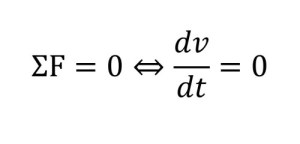
That force that keeps us from doing things differently, even though we know it’s in our best interest, is called inertia. Isaac Newton first wrote about it back in 1687. While studying the physics of motion, he discovered that “an object that is at rest will stay at rest unless a force acts upon it.” Likewise, he observed that “an object that is in motion will not change its velocity unless a force acts upon it.”

Of course, while developing his First Law of Motion, Newton referenced primarily inanimate objects – things like apples and planets. He wasn’t really interested in understanding why people acted the way they did. However, the same principle that explains why the pen on my desk doesn’t move unless I pick it up points toward some realizations about how and why we respond to potential change.

In terms of human behavior, inertia represents the tendency to continue in whatever course of action we are presently engaged in. Sometimes, that means no action. Think about physical fitness, for example. It’s very difficult for a couch potato to change their behavior and suddenly start working out. But for individuals who do work out (or run, bike, etc.), asking them skip a session could earn you a dirty look. Why is it that a body at rest tends to stay at rest, while a body in motion tends to stay in motion?

We’re creatures of habit. The human brain is full of neural pathways – connections that link specific behaviors and consequences. Every new behavior creates a neural pathway. Subsequent repetitions of the same behavior reinforce that pathway. Over time, that pathway becomes well-defined, almost like a rut in a dirt road. When we go to perform an action, the brain looks for established patterns of behavior and follows the path of least resistance – the rut. Eventually, certain activities become so ingrained we don’t even have to concentrate on what we’re doing. Muscle memory takes over and we act without thinking.

Subtle shifts in behavior are often just as hard to make as drastic ones. When I go mountain biking, I’m often faced with trails that are riddled with ruts left by other bikers. Sometimes I’ll try to ride just to the side of existing ruts in order to provide for a smoother ride without causing significant further impact to the trail. However, I almost always find this method of riding difficult to sustain. Try as I might to ride the edge, I just keep sliding back into the rut. Carving an entirely new route can actually be easier. Without the convenience of an established path to fall back on, I have no choice but to embrace something new.

Breaking one habit requires creating another one. Even though I’ve begun the process of creating a new pathway, my next trip down the trail presents me with the same challenge. Until I’ve traveled the new path enough times for it to become established, I’ll have to fight the tendency to follow the old one – the rut. It takes time for my mind and body to see the new pathway as the obvious choice. Old habits die hard. It takes focus and determination to kill them.

So what does this mean for effectively implementing significant change, either personally, or in our teams? How do we approach change in a way that helps people accept it, embrace it, and stick with it?

1. Accept that significant change takes effort. Like pulling out of a rut on the bike trail, shifting behavior requires concentrated effort. It’s not easy. Just because someone has a tough time adjusting to a new process doesn’t necessarily mean they don’t agree with it. Even the easiest, most desirable change can take its toll on people. Recognize the effort that’s required.

2. Accept that significant change takes time. Meaningful change doesn’t occur overnight. Allow ample time for people to process what’s being asked of them and to come to terms with their own feelings about it. Set your expectations in such a way that, as an agent of change, you don’t become frustrated with what appears to be a failure to accept new processes.

3. Accept that significant change takes repetition. Understand that I order for a new process to become routine, old habits have to fade. For that to happen, new habits – new neural pathways – have to be created. Until the new route is firmly established, people will occasionally fall back into the rut.

As Newton discovered so long ago, change doesn’t just happen. With the right kind of approach, though, effective change can be realized. Using the right combination of focused effort, repetition, and time will allow you to overcome inertia.


JOIN THE CONVERSATION:

What keeps you motivated? Share your tips on our facebook page.

The History of Cake Mix & Resistance to Change

cakemix-e1454724283655Prior to 1930, every cake baked in the United States was made from scratch. Cooks hand-sifted their own flour, carefully measured out the ingredients, and lovingly slaved over their delicious creations. But the P. Duff & Sons company changed all of that by introducing a pre-made cake mix. Thanks to shifting consumer habits, the company found itself with an overabundance of molasses. To avoid wasting this resource, they found a way to dehydrate it and combine it with other pre-measured ingredients to produce a cake mix. Marketed as a convenience, the product was an instant hit.

But not everyone flocked to buy this new creation.

For serious cooks, using a pre-made mix could not be considered baking. Housewives especially felt guilty for taking shortcuts with their family’s food. Still, the idea caught on and other companies began perfecting their own brands of mix. As women began entering the work force during the Second World War, the time saved using pre-packaged food helped cake mixes become mainstream.

But following the war, as families once again turned to the dinner table, sales of cake mixes flattened.  Research revealed that cakes baked from a box just didn’t taste as fresh as those made from scratch. In search of better tasting fare, consumers were abandoning the mixes. The culprit, it turned out, was the dehydrated eggs. Using fresh eggs helped give a cake texture while the powdered version in the mix left them flat.

Removing the dehydrated eggs and changing the recipe to have the cook add their own fresh ones solved that issue, but the struggle wasn’t over. In the 1950’s, the cake mix industry faced another decline in sales. A wave of individual expression left cooks desiring a personalized approach to baking. Cakes from a mix all looked the same – and that was boring. Luckily, some smart advertising helped provide consumers with tips for turning the basic cake mix product into one-of-a-kind creations.

Regardless of the nature of change, there will likely be opposition. For most of us, it’s hard to imagine passing over the convenience of a pre-packaged cake mix. However, the challenges faced by this one product line illustrate why just about any change can be difficult to implement. While the outward symptoms appear to be different (rejection of a new process, taste preferences, and a desire for individual expression), at the core lies a single cause for resistance to change – loss of control.

Like gravity, the need for control is a constant pull. Every decision is affected by that pull. Any change in behavior either gives us more control or takes some away. Changes that result in more control tend to be accepted readily – we like making those adjustments. But changes that force us to relinquish control are harder to accept. The desire to be in control is so strong that, even if we know the change is ultimately for the better, we tend to first consider what we have to lose.

This is a key concept to keep in mind when rolling out any new process. Despite the benefits of a change to product features, what will your customers believe they are being forced to give up as a result? What about your employees? What control will they perceive is being taken from them as part of the latest procedure change?

It’s easy to view organizational change as a simple project when you’re the one calling the shots. As with any communication effort, the key to success is considering how others will interpret your words, your actions, and ultimately, your intent.


JOIN THE CONVERSATION:

What keeps you motivated? Share your tips on our facebook page.

The Matrix of Change

sign-94966_640It’s often said that “the more things change, the more they stay the same.” In many ways, this appears to be the case. Change is all around us. And whether it’s technological, social, economic, political, or otherwise, the volume of speed at which change takes place is constantly on the rise.
Even when it’s good for them, people tend to resist change – not because they don’t want things to be better, but because it takes energy to change. It’s not change itself we fight, but transition; the act of moving from one state to another. That’s where the energy is required. So we balk at those changes that we perceive will take the most out of us.
I believe there are two factors behind the impulse to change. The degree to which they impact the status quo determines how strongly the desire to change manifests itself.

The first factor is the performance of a current process. Another phrase you may be familiar with, “if it ain’t broke, don’t fix it,” comes to mind. If the existing course of action is producing the desired result, then it’s difficult to justify changing it. The more “broken” a process appears to be, however, the more change becomes necessary.

The second factor is the acceptance of the current process by the people affected by it. If people are comfortable with the status quo, then it will be difficult to affect a change in their behavior. The more accepted a process is, the more difficult it is to get people to change – regardless of the process’ performance.

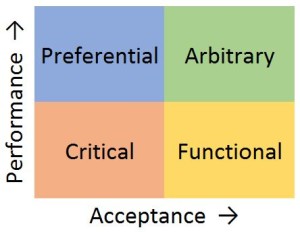
Based on the interplay of these two factors, I suggest that there are four types of change. Understanding these types can help us identify how strongly a change needs to be made as well as potential barriers we may face in implementing a change.

Critical Change
Changes made to functions low in performance and low in acceptance are considered critical. Not only is the desired result not being achieved, but the current process is not being accepted by those affected by it. When both performance and acceptance are low, something needs to change quickly.

Functional Change
Changes made to functions low in performance and high in acceptance are considered functional. While the desired result is not being achieved, people are comfortable with things the way they are. Changing things up may be necessary, but resistance can be anticipated due to the comfort level people have with the status quo.

change-matrix-300x232

Preferential Change
Changes made to functions low in acceptance and high in performance are deemed preferential. Even though results are being achieved through this current process, those involved in it may have reservations about it. They may perceive it as too difficult or time consuming. Change may be required in order to maintain employee engagement.

Arbitrary Change
Finally, changes made to functions high in both performance and acceptance may be considered arbitrary. No good reason for the change is apparent and potentially high levels of resistance can be expected.

How a proposed change is categorized depends on your perspective. We are human beings, after all, and our individual beliefs, goals, and preferences come into play when evaluating the need to change. For example, your wife may decide it’s time to paint the living room. She sees it as a preferential change as she has simply become bored with the color. For you, though, this may be perceived as an arbitrary change. The paint is in acceptable shape and you are perfectly happy with the existing color scheme. With differences of opinion such as this, conflict over the potential change can be expected.

When considering any change, it is important to take individual perspectives into account. Few of us like being subject to decisions affecting our lives if we see them as arbitrary. Communication and even compromise become important considerations in navigating change.

Change may indeed be the only constant. There is no progress without it. But how we – and others – view any given potential change has huge implications for effectively implementing it. Over the next couple of weeks, I’ll explore some of the specific reasons people have for resisting change and how we can work together to make change easier to implement and assimilate.

Consider a recent change you have been asked to make. How has your perception of the change impacted your reaction to it? What could have been done differently to make the transition easier?


JOIN THE CONVERSATION:

When do you find change most difficult? Share your thoughts on our facebook page.