
The Incredible Power of Tradition

ornamentWhen Susan and I got married (November of 1991), we knew Christmas was just around the corner. There wasn’t a lot of time to set up a joint household and figure out how we were going to decorate our new place for the holidays. It was stressful enough thinking about how we were going to navigate all of the family, work, and other gatherings; let alone establish some kind of celebration of our own. We knew that our own traditions would evolve over time, particularly once we added children to the mix. But there was one tradition we decided to start right from the beginning, and I’m so glad that we did.

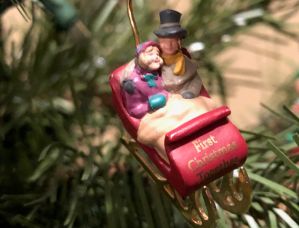
We bought a small, table-top tree and an ornament commemorating our first Christmas as a married couple. The ornament is from the Hallmark Miniature series and features a Victorian-era couple in a sleigh. It has the words “First Christmas” and the year printed on it. The idea was that each year, we’d find a new ornament to celebrate our new family and place only those items on this particular tree.

As you can imagine, the tree looked pretty bare at first. That single ornament looked rather sad floating in the sea of pine needles. But a short year later it was joined by a second one. Then came a third and a fourth and so on. The tree began to fill out with ornaments and memories. Now, twenty-seven years and twenty-eight Christmases later, we’ve got a nice little collection assembled. It’s gotten harder to find the miniature ornaments, and we’ve had to hand-write the dates on a few; but even those elements add something to our shared story.

Traditions are important, as they serve as markers for us to orient ourselves to. Each time we engage in meaningful traditions, we reinforce values that define who we are and what we stand for. As Susan and I look at our marriage tree, and either put the ornaments on or remove them for storage, our commitment to each other is strengthened in a variety of ways.

Obviously, there’s the connection to the past. Each ornament signifies a chapter in our life as a couple. We can pick up an ornament and recall significant events that happened during the 12-month period it represents. Recalling the good times (and yes, the bad ones as well) helps to cement our history and what our family stands for.

There’s the anticipation of searching for and selecting each new season’s ornament. Participation in the tradition brings us together in a time when our schedules pull us apart more often than not. As we look for the next addition to the tree, we engage with each other and rediscover what it is that we have in common.

And there’s also the joy of sharing the tradition with others. Back in 1991, I envisioned a future where our children would open each ornament; counting the years to ensure all were accounted for and identifying the year when they first entered the story. That came to pass. Just this weekend, my daughter Abby sat down and decorated the tree, strategically placing each ornament for maximum effect.

I’m sure you have traditions of your own. Some may be heartfelt while others are corny and cause eyes to roll. But know that each of them are meaningful. Each of them are important.

Don’t let this season disappear in a blur. Rather, grab hold of your traditions, and create new ones, so that you and those you care about have a reason to come together. Make a point to celebrate, anticipate, and engage this Christmas.

Not So Different After All

gratitudeLast week I quietly posted a Gratitude Survey on the home page of my company’s intranet. Being Thanksgiving week, I thought it might be interesting to invite people to share what they were especially appreciative of (besides some extra time off from work). As the days went by, more and more coworkers encountered the survey and the list of entries grew. Some were funny, some were poignant; all were obviously heartfelt.

Expressing gratitude has been found to improve your quality of life in several ways. Here are seven scientifically proven benefits of cultivating a sense of gratitude.

  1. Gratitude opens the door to more relationships.
  2. Gratitude improves physical health.
  3. Gratitude improves psychological health.
  4. Gratitude enhances empathy and reduces aggression.
  5. Grateful people sleep better.
  6. Gratitude improves self-esteem.
  7. Gratitude increases mental strength.

As I read through the responses to my survey, often several times a day, it was impossible to ignore the common threads weaving throughout the entries. The same words and phrases kept popping up. A creative coworker put together this word cloud for me to illustrate the frequency with which certain ideas were expressed. The larger the word appears, the more often it was found in the survey responses.

It doesn’t matter what our differences are. It doesn’t matter that we have different jobs, backgrounds, belief systems, life objectives, or political affiliations. We can disagree on any number of practical and ideological matters. Yet, through it all, we still have so much in common. When we take time to think about what’s really important, we tend to agree. We are so much more alike than any of us tend to realize.

I hope you had a fantastic Thanksgiving filled with warmth and laughter. I hope you took time to express your gratitude to all those who bring joy and happiness to your life. And I hope we’ll keep that spirit of gratitude front and center long after the specifics of this holiday season have faded from our memories.

It’s not too late to express your gratitude. It never is. Any time is the right time to say “thank you” to a coworker, a customer, a member of your family, or even a stranger. Let’s ignore the things that pull us apart and grab hold of those that bring us together. Because, as you see, there’s always something to be thankful for.

Service That Shocks

shockI recently paid a visit to Walmart, one of my favorite people-watching locations. Proceeding to the checkout with an armful of items, I was shocked to find myself behind only one other customer. It was a young woman accompanied by what I assumed to be her mother and her young daughter. They had a cart full of groceries but, fortunately for me, the clerk had scanned just about all of them by the time I walked up. It looked like my wait would short.
Placing the last items into a bag, the clerk announced the total and the customer swiped the card in her hand – a Walmart gift card. “How lucky,” I thought. “Wish I had a gift card to cover my purchases.” But the color drained from her face when the clerk announced there was just over $23 left to pay. The gift card didn’t cover everything this family had picked up.

The two women searched their purses for a minute, but it was obvious they didn’t have any cash or other method of payment. So began the humiliating ritual of identifying items to put back so they could reduce the total bill. I watched for a few seconds as they removed some of their basic grocery items, trying hard to avoid looking at me. They hadn’t been spending frivolously; from my vantage point, everything they had bought belonged in the typical pantry or refrigerator.

I pulled out my wallet and told the cashier I’d like to cover the remainder of their bill, including what they had pulled out to return. Please understand, I’m not writing about this to brag on myself. I’m blessed beyond measure and could afford to pay the $23 they owed in addition to my own purchases. I didn’t do this for attention or for any other of self-serving reason. I only decided to write about this because of the looks on the faces of the ladies in line with me that day.

Everyone seemed absolutely shocked by by what I had done.

The adult customers fell over themselves thanking me. Their gratitude was almost embarrassing. They obviously did not expect anyone to bail them out in that moment. Remember, when I walked up they were almost finished; there was no apparent rescuer in sight. They thanked me again and again. They apologized for not having another card or cash to cover their own expenses.

The young girl just stared at me in awe. Perhaps she’d never witnessed an act of service like this before. Maybe later she would ask her mother what happened and learn how sometimes people help each other out simply because it’s the right thing to do. I hope she is inspired to do the same when the opportunity presents itself.

It was the cashier’s face that has stuck with me though. When I offered to pay for someone else’s groceries, her face took on a mask of disbelief. I bet she’s encountered many a customer who couldn’t pay for all of their purchases and had to sheepishly return some items. She’s probably seen that so many times that she’s become desensitized to it. I imagine she stands by, dispassionately watching as the customer scrambles to escape their embarrassment. I imagine she rarely witnesses someone else stepping in to help out.

It occurs to me that this should be our service mission – to shock those who witness us in action. Talk about a competitive advantage. What if our acts of service were so powerful that they left people in a state of profound gratitude, wonder, or disbelief? Imagine providing a service experience that completely upends someone’s paradigm. What does it take to do that? Not much apparently; maybe $23. Probably a lot less.

So why aren’t we doing it?

Toe-tally On Board

socks-1322489_640I’ll understand if you’ve never heard of Alan ‘Nasty’ Nash. Until just a few days ago, I didn’t know the name myself. The 59 year old from Staffordshire, England is a 15 time world champion in the sport of toe wrestling. Yeah, I’d never heard of that either.

Toe wrestling is a sport in which two competitors lock toes, the flats of their feet against each other, and then each attempts to twist their opponent’s foot to the ground. Just picture arm wrestling with a different part. There’s just as much grunting and sweat, but a lot more odor.

Recently, Nash tried to insure his big toe for £1 million. He’s broken the other nine before and had two of them surgically removed due to injuries suffered during matches. It was his unusual insurance coverage request that caught my eye, but it’s his approach to his sport that piqued my interest. I think we can learn a few things from his journey to the top of the toe wrestling world.

Zero In
Nash has always had a lot of nervous energy. For many years, he drifted from one interest to another in order to occupy his time. He’s always been attracted to the new… the different… even the weird (he was voted Britain’s 2nd most eccentric man in 2002). He’s tried all manner of strange pastimes, including chicken whispering and egg breaking, for which he holds the world record. But while working for band at a toe wrestling competition, he signed up to kill time. He won and immediately knew he’d found his niche. Everything else gave way to his pursuit of toe wrestling dominance. He considers it his calling. What’s your calling, the one thing you want your team to pursue above all else?

Double Down
There are only so many toe wrestling competitions one can enter each year, and only one world championship. When show time comes around, Nash goes all out to earn his nickname. However, he takes his time outside the ring, officially called a “toe-dium,” just as seriously. In addition to his toe-strengthening exercises, he works to train his legs, back, and shoulders. He performs around two hundred squats a day to keep himself in shape. While most matches last seconds, he once locked up with an opponent for an hour, so trains for endurance as well. In other words, winning is always on his mind. What’s your strategy, the plan your team follows all year long to ensure success?

Have Fun
With 23 awards in his trophy case, Nash has a lot to brag about, but it’s other aspects of the experience that brings him the most joy. He’s traveled the world and established friendships with other who share the same passion. He said “I’ve enjoyed every minute of this. I’ve got to go on shows and do all kinds of things I would have never had the chance to do. I like to think of myself as an ambassador of the sport.” Nash has introduced his step-daughter to tow wrestling and applied to have toe wrestling added as an Olympic sport. His enthusiasm is unmistakable. What’s your spark, that aspect of your job that excites you and makes the effort worthwhile?

‘Nasty’ Nash is set to retire soon; I guess toe wrestling is a young man’s game.  Yet, to the end, he retains the mindset of a champion. “I don’t believe anyone can beat me,” he said. “It gives me a psychological edge. I would say I have the world’s strongest toe. I won’t lose.” I can honestly say I believe him.

Now That’s Refreshing!

soft-drink-2741251_640When Ray Kroc bought McDonald’s, he knew he had stumbled onto something big. The brothers he’d purchased the restaurant from had a great formula, but no designs of expansion. Kroc dreamed of a chain of restaurants, scattered across the country. The burgers, he thought, would draw people in. All he needed was a beverage partner.

Kroc approached Coca-Cola, another enterprise looking to grow. After a fortuitous meeting with the head of Coke’s fountain division, an agreement was reached and the final piece to the McDonald’s puzzle fell into place. Today, customers have their choice of over 37,000 McDonald’s locations around the globe. And coke is still their beverage partner.

In fact, consumers visit the golden arches as much for the fountain drinks as for the food. That’s because of the meticulous was in which Coca-Cola products are served at McDonald’s. The chain’s method for supplying soft drinks has many convinced that you simply can’t find a better tasting Coke anywhere. The way they address this one menu item is impressive.

The magic starts long before the syrup even gets to the restaurant. In their agreement, McDonald’s specifies that Coca-Cola syrup be delivered in stainless steel tanks. Other customers receive their syrup in plastic bags. The steel helps protect the syrup from outside elements – light, temperature, and even air – that can affect the taste.

Once in the store, the syrup is mixed with water that’s been filtered many times over. This allows them to provide a consistent product despite the differences in water supplies around the world. These two steps help remove any variation from outside influences and ensures you get the same flavor experience every time.

What steps does your team take to prepare before the customer even arrives?

McDonald’s pre-chills their syrup and water separately. Most other restaurants flash-chill the mixture of syrup and water as its being dispensed. In a McDonald’s restaurant though, insulated tubes deliver water that’s stored at just above freezing; at a temperature optimized to retain the carbon dioxide that’s infused. Colder temps keep the CO² from escaping and makes your drink crisper and more refreshing.

What steps does your team take to deliver a superior customer experience?

A drink from McDonald’s seems to hold its flavor longer than one purchased from other restaurants. That’s because the syrup/water mixture is designed with melting ice taken into consideration. The last sip should deliver just as much flavor as the first. Of course, you may not notice this because you’ve slurped your McDonald’s Coke down faster. You can thank the straw for that; McDonald’s uses wider straws to allow as much flavor as possible to hit your taste buds. The goal is to provide that consistent experience long after you’ve left the building.

What steps does your team take to ensure satisfaction after the sale?

This may seem like a lot of steps to go through simply to deliver a beverage; but this attention to detail has paid off significantly for McDonald’s. They sell a lot – they remain Coca-Cola’s largest single customer; the only one with an entire division dedicated to them. And when people come in to purchase a soft drink, they usually buy something else too; fries, a pie, or even a burger. It strikes me that the effort is worth it.

Choosing the Right [K]not

rope-1333314_640As a Boy Scout, you learn many useful things. From day one, you are taught a variety of skills from first aid, to cooking, to outdoor survival. With over 100 merit badges available, the amount of knowledge you can acquire is overwhelming. And a common thread through many of these pursuits is the use of knots.

Knot tying is a core scout skill. Whether it’s setting up a tent, or securing a load to your backpack, understanding how knots work (and what they’re used for) goes a long way toward making life easier and more productive. Of course knots are extremely helpful in non-scouting pursuits as well. Still, it’s important to understand which knots to use and which ones to avoid in a given scenario.

For instance, the square knot (or reef knot if you’re a sailor) is the most basic of knots. It’s used to tie the ends of a single rope together securely. It comes in handy when tying down a bundle of objects as it doesn’t slip.

The bowline is a knot that creates a fixed loop in one end of a rope. It is also easy to tie and can be used in a number of situations. One of the most common uses is in first aid recovery scenarios. The loop can be positioned under an injured party’s arms and used to pull them out of a hairy situation. The bowline is perfect for this application because the knot won’t slip and tighten uncomfortably around the person’s chest.

The taught-line hitch is slightly more complicated, but just as useful. This is an adjustable loop knot designed to maintain tension. When you need to set up an awning or tent, this knot can be slid up or down to increase or decrease tension on the rope in order to keep your structure upright and in place.

There are many other useful knots available to use, and any of them could be perfect under the right circumstances. However, there are two nots that I feel should be avoided at all costs. These nots provide little, if any, value and can actually be counterproductive if used. Unfortunately, most of us tend to fall back on them far too often.

The first of these is the “cannot.” I hear this one pretty often. Unfortunately, I also use this one quite bit myself. That’s because it’s such a readily available option. When a task appears difficult, it’s easy to say “I can’t do that.” When policies or procedures present obstacles, “I cannot” quickly slips past our lips. But relying on “cannot” represents a victim mentality. It means we’ve accepted a lack of control and initiative. That’s not the scouting way, and it shouldn’t be ours either.

The “cannot” is often used as a cover for the “will not.” We often rely on “will nots” when personal preferences and biases get in the way. You also see them used when pride and resentment are part of the mix. When I don’t like something or someone, the tendency is to let “will not” be my default response. When I feel like I’ve been wronged, left out, or ignored then “will nots” start dominating my approach to other people.

It’s easy to see how overuse of these two nots can be detrimental. There are times when saying “I cannot” or “I will not” is the right move; but if these become our go-to tools, we’re probably not very successful. Those who “cannot” or “will not,” typically “do not.”

There’s another not that I’d like to suggest using in place of “cannots” and “will nots.” It’s called the “why not.” Why not try something you don’t think you can accomplish? Why not look for a way around that obstacle? Why not prove the naysayers wrong? Why not risk looking foolish? Why not go for the win? Why not practice the “why not” today?

Don’t Give Up

kops-lake-1610739_640In 2009, three friends from Karawara, Western Australia started a YouTube Channel. They called it “How Ridiculous.” Derek, Brett, and Scott began posting videos of trick shots using basketballs and footballs; a hobby they developed as a way to avoid schoolwork. Over time, the shots became more and more, well ridiculous. Props got bigger, distances grew longer, and heights increased. Each successful stunt caused them to think up ever more creative and entertaining tricks to attempt.

You may think that watching someone shoot a basketball into a hoop from the roof of a building seems like a complete waste of time. That’s what I thought as well, at least until one of their recent videos showed up in my feed. I clicked it, watched it, and instantly thought “you know, there’s a lesson to be learned here.” Allow me to explain.

In the October 12th video, the team travels to Luzzone Dam in Ticino, Switzerland. As a follow-up to an earlier video, in which they’d dropped a bowling ball onto a trampoline from a 45 meter tower, they wanted to see if they could hit the same target from an even higher starting point. Luzzone Dam is 165 meters high. That’s almost four times as high and, as you can imagine, much more complex. To hit the target, they’d have to place the trampoline in the right spot, release the ball the right distance from the edge of the dam, and account for any other variables they might encounter. Here’s what I noticed about their approach.

  1. They had a simple, clearly defined goal. The team’s objective was to have the bowling ball bounce off of the trampoline. Despite the challenges and distractions they encountered, they kept returning to what they had defined as their goal. Other interesting things happened in over the course of the experiment, but even shattered bowling balls and craters in the ground didn’t deter them. These results made for spectacular video, but they didn’t allow themselves to deter from the original plan.
  2. They tried different approaches. When the first attempt missed the target entirely, and destroyed the bowling ball, they discussed what went wrong and made adjustments before moving on. They made note of what happened, including things they didn’t expect, and made subtle shifts to keep getting closer and closer to what they wanted to accomplish.
  3. They didn’t give up. The team arrived in Switzerland with two bowling balls. The first was destroyed during attempt number one. The second only made it through two drops before it was destroyed as well. Because the objective hadn’t been reached though, the team regrouped and came back the next day ready to try again. On the fifth drop of day two, another bowling ball was shattered against the side of the dam. Still, the team plunged ahead.

Finally, on the 12th drop, the team was successful. The 4th bowling, their last, hit the trampoline and rocketed back up into the air. It peaked and fell back onto the trampoline for a second bounce before veering off the side. The frustration expressed during earlier attempts gave way to huge smiles and shouts of joy.

Yes, this may be a frivolous exercise, but how many times have you been in the midst of working on a project only to encounter setback after setback. Rejection, delays, equipment failures, and any number of other impediments to success often make me feel like my efforts are a waste of time. Still, I’m encouraged by Brett’s thoughts as he summed up his team’s latest stunt. He said they were inspired by this victory to move on to even greater tricks and reminded us all to pause from time to time to enjoy the view from the top.

Sticks and Stones

information-3011747_640In the mid 1700’s, English physician Alexander Sutherland encountered a number of patients dissatisfied by what they perceived as his inability to treat their illnesses. In some cases, patients repeatedly insisted that Sutherland provide them a potion or salve to ease their suffering, despite his assurances that there was nothing more to be done. In a desperate attempt to help, and to stop the complaining, Sutherland began prescribing inert drugs – substances which held no medical benefit yet posed no threat to the patient.

Miraculously, many patients immediately displayed improvement. Their pain subsided. Their symptoms faded. Their mood and outlook changed for the better, as did their impression of Sutherland. Other physicians followed his lead. Soon the prescription of placebos became common practice, even though doctors could not explain how the application of sugar pills or ointments made from bread paste could possibly make a difference. Dispensing placebos eventually became a crucial part of the testing process for new drugs and the practice is still used today.

It’s called the placebo effect. Patients who believe that what they are given will have a positive effect tend to experience that effect, even though the placebo has no inherent medical benefit at all. The patient’s own mind takes over the healing process. Because the mind believes good things will follow, it causes the body to experience the benefits in the absence of the actual drug. And as more recent studies have shown, a placebo doesn’t have to be a drug to be effective.

Paul Dieppe of the Exeter Medical School says that “we all have the ability to self-heal in many conditions and that can be activated by our interactions with other people. Experiments have found that placebos provided by a doctor that talks and acts empathetically can be more effective than actual drugs given by one who seem unconcerned with their patient’s welfare. A doctor’s demeanor is as important as their medical competence.

But is the doctor’s office the only place where good bedside manner makes a difference? Don’t we desire improvement in the operation of our businesses? Don’t we long for better relationships with our customers and the members of our organization? If Dieppe and his fellow researchers are right, then the key lies in the way we approach those interactions. Our ability to solve organizational ailments depends as much, if not more, on the way we communicate with each other than on any business strategy.

Think about the last conversation you had with a coworker or supervisor. How did the way they spoke to you impact your feelings about the interaction? How did their behavior influence your desire to work with them further? Did their words and actions have a positive effect on your productivity for the rest of your day? More importantly, what impact do you fell your behavior had on them?

You see, there’s a dark side to the placebo effect. Patients in drug trials alerted to possible side effects have up to a 25% chance of experiencing the symptoms of those side effects, even when they’ve only ingested a sugar pill or other harmless substance. It seems that the mind, focused on negative inputs, can manifest ailments as easily as it can cure them. And the same doctors whose encouraging bedside manner aids in patient healing? Well, all they have to do is adopt a negative or apathetic outlook and patients begin taking a turn for the worse. It’s a phenomenon called the nocebo effect, and it’s just as real.

You may not have taken a Hippocratic Oath – a vow to “do no harm.” Yet, by taking on the mantle of leadership, you’ve promised to act for the good of the organization. You’ve taken on a responsibility to behave in ways that positively impact the minds and hearts of the people you serve and work with. When you fulfill that promise, you become more powerful than any drug.

What’s Your Plan?

document-3268750_640Just over a week ago, the Apple Store in Moscow opened to a massive throng. For more than a day, people had been lining up to purchase the new iPhone XS and XS Max. As employees prepared to unlock the doors, a huge cheer rose from the crowd.
Product launches like this have been occurring for years, and it’s considered a badge of honor to be the first in line to purchase the latest gadgets. Yet, the first man in this particular line wasn’t very excited. In fact, he tore up his ticket and walked away, despite having camped out in front of the store for days. He was soon joined by the next seven in line. All abandoned their highly-coveted spot and left without ever setting foot inside the store.

That left the ninth man, who said his name was Valery, at the top of the queue. He walked inside; waving to the employees and reporters who had gathered to cover the event. Then he suddenly covered his face with his cap and awkwardly left the building without making a purchase. Like the eight people before him, he’d never actually planned on buying anything in the first place.

Each of these individuals had secured their place in line hoping to sell it to another consumer – someone eager to among the first with a new iPhone. With asking prices of up to 500,000 rubles (just over $7,600), it seemed like an easy way to make a lot of money. When no one showed to take them up on the offer, however, they had no choice but to abandon the wait and their hopes of cashing in.

Hope is not a strategy. It’s actually strategy’s direct opposite. Consider these definitions:

Hope: a feeling of expectation and desire for a certain thing to happen.

Strategy: a plan of action or policy designed to achieve a major or overall aim.

The key to the difference lies in the first two words of each definition. Hope is a feeling. Strategy is a plan. Hope is guesswork. Often described as a hunch, it offers the promise of maximum payout with minimal effort. It’s the default move of those who are too lazy or inept to devise and execute a plan.

Leaders who crush their goals always have a strategy to do so. They analyze the circumstances, create a plan of action, and then execute it. They involve the team, partnering with those who offer complementary skill sets and resources. They track their progress, adjusting along the way so that steady progress continues to be made. In short, they work hard. They work their strategy knowing that their actions are what produce results. And because they have a strategy, hope isn’t necessary.

As the fourth quarter of 2018 gets underway, I hope you have a strategic plan in place. I hope you are prepared to execute that plan so that your goals are met. I hope you aren’t relying on hope. Don’t be like Valery and others like him who simply wait for things to happen only to risk walking away empty-handed.

How Should We Respond to Mistakes?

toaster
Photo: Uncanny Brands

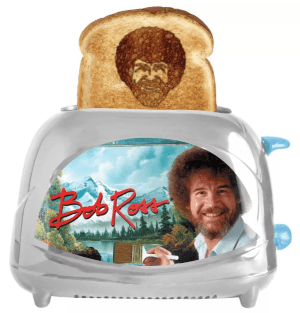
New York based Uncanny Brands produces a unique blend of pop-culture toys, artwork, and small appliances. Their Star Wars line alone is impressive, featuring items such as the Death Star Popcorn Maker, Lightsaber Salt & Pepper Mills, and the Millennium Falcon Waffle Maker. Sports fans can select from NHL and NBA themed merchandise, while KISS and WWE aficionados have plenty to choose from as well.

But if you’ve been thinking that your toast is a little plain, I suggest you check out their Bob Ross Toaster. Just pop in your bread, and out comes a fairly reasonable likeness of the famous painter burned into your breakfast bread. There’s even a full color portrait of Ross on the side of the toaster, so you don’t have to feel bad about biting into his fluffy afro.

For those of you who don’t know who Bob Ross is, you owe it to yourself to check out a video or two of his PBS show The Joy of Painting. It aired from 1983 to 1994 (Ross died of lymphoma in 1995) and each half-hour episode featured Ross offering painting instruction as he completed a new landscape in real time. Ross’ belief that everyone could paint, and his soothing commentary earned him rave reviews and three Emmy Awards during its run.

After his death, Ross’ popularity continued to grow, in large part because of his fun approach to painting and his encouraging witticisms. One of his most enduring quotes references the goof-ups that inevitably happen as we pursue any endeavor. After an errant stroke of the brush, he said “We don’t make mistakes, just happy little accidents.”

Ross believed that mistakes were valuable as a natural part of the learning process. We don’t seek to make mistakes, but we should take advantage of them to grow. How we respond to our mistakes determines the value we receive from them. In particular, I see three ways we can turn our own mistakes into “happy little accidents.”

  1. Perfect your technique. There’s no doubt that some people are born with a natural inclination for painting. I’m not one of those, but thankfully I have other natural talents. Yet even the most gifted in any area will address their mistakes and practice to improve their skill level. Writers become better writers by writing. Athletes get better by competing. In every case, mistakes can point you to valuable lessons that need to be learned in order to become more proficient.
  2. Learn something new. Mistakes can often lead us to discover different ways of completing a task. I’ve lost track of how many innovative woodworking skills I’ve picked up as a result of messing up some aspect of a project in my home shop. Nine times out of ten, my second or third attempt, using a different approach, uncovers a faster, cleaner, more satisfying result. Without mistakes, I’d still be using time-intensive, less effective methods to get things done.
  3. Build a relationship. Mistakes provide us with an opportunity to establish and build relationships with people that we otherwise wouldn’t. Seeking out advice after messing up can lead you to a coworker or colleague; someone with whom you can share your own wisdom with. And while we definitely wouldn’t invite mistakes concerning customer relationships, studies show that customers who encounter a problem – and have it resolved to their satisfaction – become even more loyal than those who never have an issue in the first place.

Bob Ross once dabbed the wrong color onto one of his paintings (I’m sure it happened more than once). Instead of losing his cool or starting over, he simply moved the blob of paint around to create a bird. He turned his mistake into the focal point of a masterpiece. I’ll be keeping that in mind the next time I enjoy a slice of toast.