

Connected

connected-1327191_640At the beginning of this school year, my daughter and I adopted the practice of picking up a doughnut on Friday mornings. It’s a way for us to celebrate her senior year of high school and makes our morning commute discussions just a little more lively. However, I’ve come to look forward to these Friday morning detours for an entirely different reason. I enjoy the feeling I get from the purchase transaction.

You see, my daughter and I are creatures of habit. We each get the same kind of doughnut every Friday. The first time we pulled up to the drive-thru window, a young woman took our order. We paid, she handed us the bag, and we drove away. The same thing happened the next week. The same woman took our same order, we paid and left with our purchase. It happened again a week later and the week after that.

But somewhere around week four or five, there was a shift. Our doughnut lady came to the window, and in her broken English asked “The same?” She repeated our standard order and waited for my confirmation. A new norm was established. We’d pull up, she asked if we wanted the same things, and the rest of the interaction would play out as expected. Until four or five more weeks had passed.

On this particular Friday morning, we pulled up to the window and I looked inside to see our friend finishing up with a customer at the counter. She turned, caught my eye, and immediately grabbed a bag. She picked out the two donuts we always ordered and then came to the window. With a big smile, she handed me the bag and said “Good morning, $4.65 please.”

This is a very busy little shop. I’d estimate a hundred vehicles conduct business through that window every Friday morning. That’s hundreds of different faces and different orders each week. Yet it only took a few weeks for her to recognize the two of us and learn our preferences. No doubt, it makes her job easier. Every second she saves allows her to serve the next customer that much faster. I doubt she realizes how good it makes me feel to be known.

We’re social animals. We all have a need to be known, accepted, and respected. It makes me feel good that this proprietor recognizes me and remembers my order. It communicates that I’ve made an impact, albeit in a small way, on her. And it opens the door to an enhanced relationship. Our interactions have become more than just a series of transactions.

In a recent exercise, employees were asked to focus on remembering and using customer names for a period of three weeks. In response to this challenge, the majority of employees reported improved interactions with the people they interacted with. Some were surprised to find they were remembered. They appreciated the attention and conversations were more pleasant. Customers talked more, sharing information that helped them receive better service.

Think about your own reactions to service providers you encounter. I bet you’re more open and friendly with those who remember and know you. When we’re treated as just a number, or a problem, or a task to be managed, we respond negatively. When a human connection is made though, it changes everything.

My daughter mentioned that as the school year draws to a close, she’s going to miss our regular stops on Friday morning. She wondered if we’ll be missed after graduation. When I suggested that she write a thank you card for our Friday morning friend, Abby jumped at the idea. “Yes,” she said. I think she’d appreciate that because she knows us.” I believe she’s right.

The Three-Legged Leader

shoes-2060519_640Some of my favorite memories from childhood revolve around Field Day. Each spring, as the weather began to warm up, officials at my elementary school would announce a date for the event and the entire student body would erupt in cheers. Field Day meant class was cancelled so that everyone could spend the day outside competing in a variety of games. There were individual events like the 50-yard dash and the egg race. I preferred the team competitions, though. I would scramble to find just the right partners in order to sign up for relays, the wheelbarrow race, and my favorite – the three-legged race.

The three-legged race always included a number of spectacular wipe outs. You’d think the most athletic kids would have a leg up in this event (pardon my pun), but they didn’t. Typically, it was their overconfidence that did them in. They would always get off to fast start, sneak a glance back at the rest of us, and then trip over their own feet. In an instant they went from front-runners to speed bumps.

Winning a three-legged race isn’t about physical prowess. It’s about strategy, teamwork, and leadership. Focusing on the same techniques can help us overcome stronger competitors in the world of business. You don’t have to be the biggest, the fastest, or the most experienced to be successful. You just need to be a three-legged leader.

Start by choosing the right partner and tying yourselves together tightly. In a three-legged race, you want someone who’s about the same height and weight as you so that your movements are coordinated. Too much of a mismatch and you’ll have a hard time finding a rhythm. Tie your legs together at the ankle and again just below the knee. Make sure your legs are together; avoid a loose connection because too much independent movement will quickly send you on different trajectories.

As a three-legged leader, choose teammates who share the same goals, instincts, and work ethic. Take time to get this right, and identify strategies that align people with in ways that complement each other. Teams win when teams work together.

Each three-legged race team needs a leader; someone who will dictate the strategy. Which leg do we start with – the tied one, or the free one? The leader is the one who monitors the competition and looks for obstacles. They may even call out a cadence to ensure both parties are operating at the same speed. The person who leads this particular race may be different than the leader for other competitions. It depends on who is best suited for the circumstance.

As a three-legged leader, identify the team member with the skills, experience, and drive necessary for a particular initiative. This means you will have to step back into a support role, following their lead in order to position the team for victory. The best leaders understand when it’s time to let someone else take point.

Communication plays a big part in a three-legged race. Any team-based effort does. If the pace is too fast or too slow for one, then both need to adjust. Encouragement is essential, as is a healthy dose of fun. No one likes being part of a team where the only communication is derision and blame.

Three-legged leaders understand that when a team is having fun, they’re more likely to succeed. They encourage team members to communicate freely. A healthy team involves plenty of debate, discovery, and evaluation. All of this is done within a culture that promotes team success above individual achievement. When the team wins, everyone wins.

Try a little three-legged leadership and see how far your team can go.

Alone

man-1246233_640I’m currently binge-watching season five of Alone. This History Channel program follows 10 survival experts as they each survive alone (that’s where the name comes from) in the wilderness. Separated from each other by several miles and with no contact with the outside world, they are left to carve out an existence using limited resources, their experience, and whatever internal fortitude they can muster. The participant who lasts the longest wins.

This season features a collection of prior contestants. Each failed to win their respective season and are now looking for redemption. It’s been very interesting to see what lessons were learned the first time around and how their approach changes given a second chance.

Take Randy Champagne from Boulder, Utah. In Season two the wilderness instructor lasted 21 days before tapping out. He handled every aspect of the challenge well, but ultimately grew lonely without human contact for three weeks. Obtaining food and creating shelter, what most would consider the core obstacles of the challenge, were handled masterfully. He simply starved from lack of community.

Coming into season five, Champagne recognized this would be the hurdle he’d need to overcome in order to win. His plan was to keep his mind busy with hunting and bush craft projects in order to ward off the loneliness. This time around he lasted 35 days.

Humans are inherently social animals. We’re geared to operate as part of a unit, not as individuals. In order to function properly, we require the give-and-take that comes with interaction. Each of us needs what others have to offer – and we need to provide them with what we bring to the table. Removing us from the social construct is like removing pieces from a machine. The parts simply don’t function on their own.

Science has proven this out through thousands of studies over decades of research. But you don’t need a PHD to understand the importance of community. The pull to be a part of something bigger is hard-wired into each of us from birth.

That’s why the social aspect of work is so crucial. The connections we make with coworkers and customers is necessary for the organization to function well. The more siloed we become – the more we retreat behind email and rely on policies to communicate for us – the more our work suffers. Work, just like any other endeavor, is improved by socialization. Despite all our technological advances, work works best within the context of community.

Even the hardiest among us fall victim to the hunger for companionship. The longer we attempt to operate in isolation, the stronger the pull becomes; and the harder it is to go on. Surrounded by other people, we can still find ourselves struggling to find real connection. Without it, we feel lost. Work continues, but the passion is gone. The desire to continue slowly evaporates. Or, as Randy Champagne explained after calling for rescue “It’s not being out here and surviving. It’s being out here and surviving alone.”

Nothing But Net

basket-801708_640Sports have always provided excellent metaphors for success, and at this time of year college basketball takes center stage. Here in Lubbock, we’re celebrating the new NCAA Division II Women’s National Champions (Lubbock Christian University’s Lady Chaparrals), and the first trip ever to the Division I Final Four for the Texas Tech Red Raiders. Obviously, basketball fever is running high in West Texas.

The road to any championship includes numerous stories of personal adversity and team achievement. It’s one of the reasons I enjoy playoff seasons and even the Olympics. There’s always someone who defies the odds. There’s always a team that shouldn’t be on the leaderboard. Underdogs make for compelling television; but when it comes to winning, they share many traits in common with the perennial top seeds.

It starts with strategy. Winning teams begin with a roster of talented players and a leader – a coach – who knows how to maximize their abilities. After building a team with the desired skill set, a strategy is formed. A style of play is developed and communicated. Assignments are given out and expectations are set. Goals are established and progress is measured. Does your team have a comprehensive, written strategy?

A strategy requires discipline. Every player accepts and embraces their role. Skills are honed and expanded. Teammates come to rely on each other and trust that each is doing their part for the team’s success. The coach promotes a culture of accountability. Mistakes are made, but every eye is on the prize and no one slacks off. Ability grows. Does each member of your team approach their role with discipline?

That discipline allows for flexibility. With the basics securely in place, teams gain the flexibility to change things up as necessary. They can adapt to different opponents and circumstances. They ramp up intensity when needed to overcome unforeseen obstacles they encounter. They begin experimenting with new strategies knowing that the fundamentals aren’t in question. Has your team developed the ability to shift as needed to address unexpected change?

In short order the 2019 NCAA championships will be over, but that doesn’t mean the work will end. Even now, most teams are analyzing the data from their season and revisiting their strategic plans. They’re looking to recruit new talent and identifying skills that need to be improved. There’s no time for looking back, because the future lies ahead. Winners are always moving forward, eyes focused on the next play.

A Slap in the Face

child-1099770_640With March Madness in full swing, much of the country has basketball fever. Television schedules have been adjusted to account for viewership pulled to the college games, and other sports take a back seat this time every year. For those who aren’t fans of basketball, it can be hard to find something other than reruns to watch.
Or maybe not.

I’ve stumbled across a new sport that offers a little bit of everything. There’s drama, suspense, and hard-hitting action…literally. The sport in question is competitive slapping. That’s right, grown men have made a sport out of slapping each other. Last weekend in the Russian town of Krasnoyarsk, Vasily Pelmen (a 370-pound walk-on competitor nicknamed “Dumpling”) decimated the competition as part of the Siberian Power Show. He walked away with a purse of 30,000 rubles – the equivalent of $470.

The rules of the contest are simple. Two men face each other across a small table. They take turns delivering an open-handed slap to the other’s face. The contest continues until one of them cannot continue or the judge calls the match out of safety. Even though they can clearly see the slap coming, many of the competitors I saw on video were knocked off their feet by a blow from their opponent. They clearly weren’t prepared for what was coming.

Workplace slaps to the face rarely come with physical contact, but they can still sting; and they usually involve communication issues. Last-minute demands, surprise assignments, and sudden changes to strategy – they hurt, but can be avoided with a little forethought. Here are some tips to help keep you and your teammates from getting knocked out.

Look across the table. Today’s businesses can’t succeed without teamwork. Individuals and business units alike must consider others who may be impacted by their work. Look beyond your role in the project. Who else plays a part in the process? Who will pick up where you leave off? Think in terms of all who will be affected, even far down the road, so that you avoid blindsiding someone.

Plan your strike. Before you communicate, think about how your words will be received. Ask others to help you anticipate reactions from those on the receiving end. Who will be excited by it? Who will be disappointed, or surprised? Take some time to choose your words so that teammates are set up for success, not reeling from shock.

Expect the unexpected. No amount of planning will eliminate the occasional surprise. How we respond to surprise news is important. Understand that you will occasionally be caught off guard. Do your best to stay connected with other parts of the organization to minimize surprises when they occur. Stay on top of your regularly-assigned work duties so that you can more easily absorb unexpected demands. And if you happen to be the one delivering the surprise, be ready for the inevitable reaction.

A slap to the face may be fun to watch; but nobody wants to be on the receiving end, even if it does come with a title and prize money. The real reward lies in being part of a smoothly operating team. Up your communication game and leave the red, stinging face to Dumpling and his buddies.

Layers

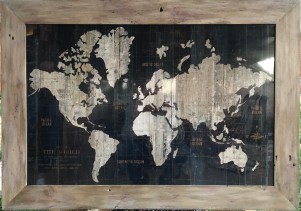
frameMy son Alex recently purchased a new piece of artwork for his room. It’s a picture of the world map, seemingly cut out of weathered boards. It has a very old word, rustic feel to it and he wanted a suitable frame for it – something that complemented the style rather than the sleek and modern options he found within his budget at retail outlets. So this weekend, we went out to the shop to build something custom together.

Finding the material was easy enough. I have a sizable stock of old wood from prior projects. He identified some old fence pickets that were straight and solid but with the right amount of character for his chosen aesthetic. After cleaning them up, milling them to accept the artwork, and cutting everything to size, it was time to address the look of the frame. Running the boards through my planer had revealed the fresh wood underneath the surface. They needed to be aged again.

I pulled out a variety of wood stains and we set to work. I’d lay down a color and Alex would follow behind me; blending each coat into the prior one to his liking. We repeated this process several times, mixing blues, reds, browns, and whites. Sometimes we used a brush, and sometimes a rag seemed like the appropriate tool to work with. Eventually, he felt like the right balance of colors was achieved and we left the pieces to dry overnight. Yesterday afternoon we assembled everything for the result you see in the picture above.

Note: It actually looks a lot better than this image represents. I need a photographer friend to give me pointers on taking pictures of artwork without getting reflections on the glass.

As we admired our handiwork last night and showed it off to the rest of the family, I couldn’t help but reflect on the process we went through… and how much it mirrors our journey through life. Each of us is a custom work of art. We are who we are as the result of a unique sequence of events. We’re just like this frame – made up of several colors, layered and blended repeatedly in a pattern of events that could never be replicated.

You have been exposed to circumstances and people that shaped who you are today. You’ve made innumerable decisions that have brought you to where you are right now. It’s the culmination of countless influences that now frame your world. And in turn, you have played a part in framing the world of those you’ve come in contact with.

Think about that last concept for just a minute. Everyone you have ever met is different because of your influence. In some way, you influence people. How you influence them is up to you. Will you provide a foundation; a basecoat upon which others will build? Will you be the splash of color that brightens up an otherwise dull corner? Or will you be the brush that helps blend various elements into a beautiful masterpiece?

Every person you meet is an opportunity to contribute to something special; to play a part in the creation of a masterpiece. No one else will ever create a piece of work like the one Alex now owns. He is extremely proud of it. And I’m proud to have played a part in helping it come to be.

More Than Just a Goal

bulls-eye-1044725_640By now, the vast majority of New Year’s resolutions made just a few weeks ago (remember those), have been forgotten. A study by U.S. News indicates that 80% of resolutions each year fail by the second week of February. Here we are in the second week of March and there’s probably no point in studying this topic anymore. Anyone who’s kept their resolutions this long is an anomaly – the exception that proves the rule.

The question is, “why do so many resolutions fail?” We make them in good faith, don’t we? I know that any time I come up with a personal goal it’s with the best of intentions. In the moment, I truly believe I have the power to change some aspect of my behavior, otherwise I wouldn’t go through the pretense of creating an expectation. What changes between the day I set a goal and the day I finally abandon it?

The answer for most of us is… nothing. Nothing changes. We’ve set a goal and allowed that to be the end of it. As humans we have a tendency to believe that a single decision invokes change. I want get in better shape and so I make the decision to join a gym. Having taken that step eases the internal tension I was feeling and I feel better about things. “I’m on my way,” I tell myself. “No turning back now.”

In reality though, I haven’t changed anything. That one decision, in and of itself, has no power. Having relived my mind of the initial conflict, I am free to return to my lazy routine. I’ll occasionally remind myself that I need to follow up on the initial commitment, but it’s never the right time to act. By mid-February, I’ll have either forgotten all about it, or decided to wait until next year. My behavior hasn’t changed.

Replace personal resolutions with work goals, and the pattern is the same. Team members will agree to adopt a new way of operating only to abandon it in fairly short order. It only takes a single, small slip-up to convince the entire group that changing isn’t possible.

To change the outcome, we have to change the way we approach the initial decision. We need to consider two factors that have enormous impact on our ability to actually achieve the goals we set. Those factors are specificity and commitment.

To start with, we’re rarely specific enough when setting goals. “I’m going to start going to the gym” or “We’re going to generate more referrals” are simply too vague to be meaningful. Real goal-setting involves developing a set of strategies to achieve the goal. We miss the mark because we haven’t thought about how we’re going to actually hit it.

Once our strategies are developed, few of us are actually committed enough to see them through. When the first unforeseen obstacle come along, we allow that to derail us. The plan is abandoned in favor of something easier to achieve. Only the strong-willed have what it takes to see things through when the going gets rough. Very few have the energy to win at the long game.

Motivational speaker Zig Ziglar used to ask his audiences “Are you a wandering generality, or a meaningful specific?” In other words, are you just bouncing from one vague goal to another, or do you have a plan to achieve what you’re after? Are you comfortable being at the mercy of your circumstances, or do have a clear picture of who you want to be that drives your actions each day?

I think I’d much prefer to be a meaningful specific. How about you?

Watch for Ice

road-587451_640The thermometer read 14 degrees when I left the house today. That’s a stark contrast to the balmy, 70 degree drive home I enjoyed on Friday afternoon. A cold front descended on West Texas this weekend. There wasn’t much precipitation; just enough to make things interesting and driving a little dangerous yesterday morning. Just enough to create patches of black ice.

While dry streets are obviously preferred, heavy rain or snow are much better for driving than the spotty conditions presented by black ice. With the really bad stuff, you know how to prepare, and you can be reasonably sure that other drivers will be just as cautious as you are. But black ice is different as it masquerades as dry pavement. The thin layer of ice allows the dark coloring of the road surface to show though, giving you a false sense of security. Often, you don’t know it’s there until it’s too late. Even if you do see it coming. It can be difficult to navigate.

We have patches of black ice at work too, don’t we? Again, I’m not talking about the “all hands on deck” type of emergencies. I’m talking about the random slick spots that we don’t see coming; the technical hiccups, the upset or demanding customer, the corporate demands that blindside us. Navigate them incorrectly, and you can spin out of control. Handled them properly though, and you can continue on to your original destination with little impact.

When you encounter one of these slick spots, the first thing you should do is put both hands on the wheel. Typical driving involves a lot of multitasking. We adjust the radio and climate controls. We drink our coffee and finish off a breakfast sandwich. But at the first sign that something is off, we need both hands on the wheel. This one act focuses our minds on the immediate situation. We can feel changes in road conditions through the steering wheel and react more quickly to changes that we sense. The simple decision to focus brings all of our resources to bear on navigating safely through the slick spot.

Next, we need to take our foot off of the gas. Make sure you read that correctly. Don’t step on the brakes and don’t accelerate. Either of those actions can make the problem worse. Hit the brakes, and you’ll create new problems as the car will quickly spin out of control. This endangers everyone around you. Trying to go faster will result in your spinning your wheels. You’ll waste a lot of effort with no result. The goal is to keep moving. Just ease off a little bit. Once the danger has passed, resume normal speed.

Finally, steer the vehicle in the right direction. A tendency is to over-correct. If the car starts sliding left, we want to jerk the wheel hard to the right. This is a recipe for disaster as once the immediate threat is over, you find yourself barreling in another wrong direction. Instead, we need to keep the wheel pointed in the direction we ultimately want to go. Keep your eyes on the desired destination and avoid the temptation to over-steer because of a single little unsteady patch.

Even when the road ahead looks to be clear, there are a million little decisions to make in order to reach our goal safely. And while it may be comfortable to set the cruise control and relax, we have to remain vigilant. When you’re behind the wheel, it’s important to make sure you are prepared to deal with the unexpected. Having the right plan ensures you can tackle whatever the road throws at you.

Turning a Blind Eye

telescope-971430_640During the Battle of Copenhagen in 1801, part of the French Revolutionary War, British Naval forces descended on Denmark. The intent was to prevent the Danish fleet from joining with ships from Russia, Sweden, and Denmark. Britain maintained a superior navy, but a newly formed alliance of these four countries, called the League of Armed Neutrality, would threaten that position and negatively impact Britain’s ability to negotiate favorable trade agreements. By decimating Denmark’s contingent of ships, Britain would stave off a potential threat.

The fleet arrived on March 30th under the command of Admiral Hyde Parker and his second-in-command Vice Admiral Horatio Nelson. Parker had a reputation as a cautious strategist and moved slowly, in stark contrast to Nelson; a man who preferred quick, decisive action. Nelson’s exploits had made him a war hero, and he remained a highly trusted officer, despite having been blinded in one eye during one of his earlier battles.

The British found the Danish fleet well prepared for their arrival thanks to Parker’s delay. They had moored their ships just off the cost, creating a defensive wall which would prevent any single ship from being targeted. The arrangement of ships in the harbor allowed their forts, armed with twice the guns of a typical ship, to join in the battle as well. In addition, this allowed for supplies and repairs to be coordinated from land without fear of attack.

It was decided that Nelson would lead the attack on April 2nd with 12 ships. These were smaller, and more maneuverable in the shallower water, but less heavily armed. Parker would command the heavier ships in deeper water preventing any Danish allies who might arrive from cutting off retreat. He would also engage the forts and other land defenses with his more formidable artillery.

Almost before the battle began though, three of Nelson’s ships ran aground. Without charts of the area, they had only last-minute soundings to gauge the depth of the channel. There was no time to regroup though as Danish forces began firing. Soon, Nelson’s ships were fully engaged and by 1 pm the battle was in raging all along the line.

Outside the channel, Admiral Parker could see little. The smoke made it difficult to tell what was going on, though he could see flag signals from the three grounded ships. Given Nelson’s depleted fleet, the lack of visibility to the front, and his inherently cautious nature, Parker ordered his flag captain to signal retreat at 1:30 pm.

However, retreating at this point in the battle would have exposed Nelson to heavy fire and would undoubtedly been disastrous. Informed of Parker’s order, Nelson turned to his own flag captain, Thomas Foley, and said “You know Foley, I only have one eye – I have the right to be blind sometimes.” He then raised his own telescope to his blind eye, saying “I really do not see the signal,” and continued the attack. By 2 pm, The Danish were defeated.

Nelson had triumphed, and in the process provided us with a commonly used idiom. Today, we use the phrase “turning a blind eye” when describing someone who ignores undesirable information.

Here I Am Starved

starvedLincoln’s Rock is a remote overlook nestled in the Blue Mountains of Australia. It lies at the end of a rough dirt pathway and involves a steep scramble over rocks and scraggly brush. The view, however, is well worth the detour from the main road. The ground drops away suddenly revealing a gorgeous valley of green. It truly takes your breath away.

Yet, carved in one of the rocks leading up to the cliff’s edge, I found this message: “HERE I AM STARVED” with a date too weathered by time to be readable. In the midst of such incredible beauty was a message from someone who, long ago, felt anything but inspired by their surroundings. Gazing at this image, I imagined an explorer – someone who’d set out on an adventure to accomplish great things – suddenly overwhelmed by isolation and loneliness…either literally or figuratively, they were starving.

Even in the midst of our excess employees can often feel this same sense of exasperation. Canadian researchers found that feelings of isolation at work are not only more common, but more damaging than workplace harassment. The social aspect of work is a critical component that shouldn’t be ignored, and yet the most distant of all relationships tends to be that between an employee and their manager.

In his book “What People Want,” author Terry Bacon shares the results of an interesting survey of United Stated employees. It paints a pretty clear picture of what workers are hungry for.

Honesty: 90% said they wanted more honesty and integrity from their manager.

Fairness: 89% want their manager to be fair and to hold all employees accountable to the same standards.

Trust: More than 86% want to trust, and be trusted by, their manager.

Respect: 84% want to respect, and be respected by, their manager.

Dependability: 81% wish they could count on their manager when needed.

Collaboration: 77% want to be part of their manager’s team and be asked to contribute ideas and solutions.

Genuineness: 76% wish their manager was a more genuine person.

Appreciation: 74% want to be appreciated for who they are and what they do.

Responsiveness: 74% want to be listened to, understood, and responded to.

These nine characteristics may seem fairly basic; and as the title of Bacon’s book illustrates, you don’t have to be an employee to desire these things. They’re traits that any person hungers for, and depends on those around them to provide.

We often think of work in terms of a journey. We’re climbing a mountain, running a race, or blazing a trail. We’re on a mission to reach our goals, or maybe just the weekend. Regardless, the journey is always easier when it’s shared with others who feed you along the way.

As we make our way through the twists and turns of 2019, let’s take time to make sure those around us are getting the nourishment they need to finish the journey with us.