
Be Prepared

Tres RitosI hope you had an enjoyable Labor Day weekend; full of either rest or excitement, depending on which of those you were hoping for. I spent mine camping in the Carson National Forest near Tres Ritos, New Mexico. From my campsite in a meadow next to a babbling brook, I had the most incredible view. I watched as thunderstorms moved across the mountains followed by mist rising up through the pine trees as the sun came back out. I had no internet or cell service, but it didn’t bother me at all. I had plenty to see and do in every direction.

I wasn’t alone, although I would have been just as happy. This was a scout camp out, and a chance for young men and women to test or acquire a number of skills in the great outdoors. Between the weather and the activity schedule, there were plenty of opportunities for them learn valuable lessons for the future.

The Scout motto is “Be Prepared.” We preach it from the time a young person first joins our troop. We do our best to model it for them and even end every meeting with those two words as a parting commitment to excellence. In fact, the entire scouting experience is really built around this principle. If one is prepared, one can succeed, at just about anything.

Before you strike a match to light a fire, you should be prepared with enough tinder, kindling, and fuel wood to maintain it. Otherwise, the flame will die and you’ll find yourself sitting in the cold. Before starting out on a hike, you should be prepared with proper attire, a defined route, and enough water for the journey. Otherwise, you may become lost, thirsty, or injured. Simply thinking through your activity or project before getting started can prepare you to tackle each step as it come up.

Launching a new product? The time to think about marketing, employee communication, and tracking mechanisms is before the technical development begins.

Bringing someone new onto the team? Think through the onboarding process (training, system setup, and physical resource needs) before their first day.

Heading into a meeting? Review the agenda, complete any assignments, and try to anticipate any questions that may come up regarding your area of responsibility.

When you make a habit out of being prepared, you not only become more organized, but you become more flexible as well. Having the known bases covered allows you the ability to more easily shift to handle the unanticipated. I planned for overnight temperatures in the mid 40’s, so I made sure to take along a good fleece jacket. I only wore it for an hour or so each morning and evening; but it became a second pillow at night, providing me with much more restful sleep. Being prepared allowed me to think creatively in the moment rather than bemoaning my lack of resources.

As always, we had a few scouts (and even some adults) who didn’t adequately prepare. Some didn’t have the proper clothing. Others didn’t bring a mess kit to eat form. But because so many others were prepared, we were able to step in and ensure an enjoyable weekend for all. The next time we go camping, everyone will have learned from this experience. Next time, even more will be prepared.

Tuned In

wild-865296_640In the wee hours of the morning on Sunday, August 11th, someone left an old television set on the front porch of a house in Henrico County, Virginia. In fact, according to Police Lieutenant Matt Pecka, the mystery deliveryman visited 50 different houses that night, leaving TV sets outside the door of each one. Nothing was stolen or disturbed, and no foul play is suspected.

Who made the late-night deliveries? Why did they come by? And why leave an old TV as a calling card? Some recipients took to their smart doorbells for answers, but found only more questions. Footage shows a man dressed in “a blue jumpsuit, brown boots, black gloves, and a big mask shaped like an old TV set.” He walks up to each house, sets a TV down, and leaves.

We can’t always explain why someone acts the way they do, and we’ve all witnessed behavior from a colleague that leaves us shaking our heads. But people are an inescapable part of any business. Without people, and their desirable behavioral traits, things simply wouldn’t get done. That’s why Forbes magazine recently published a list of 15 behaviors that make people virtually “irreplaceable in the workplace.

  1. They do more than asked.
  2. They have exceptional communication skills.
  3. They are one step ahead instead of behind.
  4. They are good listeners and observers.
  5. They are trustworthy, accountable, and reliable.
  6. They initiate.
  7. They fill the room with good energy.
  8. They are adaptable.
  9. They are problem solvers, not complainers.
  10. They are self-motivated and can motivate others.
  11. They don’t need to be micromanaged.
  12. They embrace new challenges.
  13. They are fast learners and fast thinkers.
  14. They love their job.
  15. They are well organized and efficient.

Think about the members of your team. Are they tuned in? How many of these behaviors do they exhibit on a regular basis? Odds are, the ones you most want to be around have a lot of check marks on this list. These are all traits I want to see from the people I work with.

Behavior is the outward manifestation of character. Despite what people say and all the good intentions in the world, behavior is what other people see. It’s what determines real outcomes. It’s what matters.

Now look at the list again. If a coworker was asked to describe you, how many of these sentences would they use? Or are there other, less desirable traits that would make your list? Perhaps we all have a little work to do.

Lieutenant Pecka said authorities determined that Henrico County’s TV Santa Claus posed no credible threat. While confusing and inconvenient, the television deliveries aren’t something law enforcement is concerned about. Some residents aren’t so sure about the motives behind the act; though unless the mystery man comes forward, there will likely be no explanation for his strange and unwelcome behavior. County officials plan to collect and recycle the unexpected gifts.

The Key to Change

bridge-2062748_640Think about it.

Nothing great is ever achieved without change. If I want to lose weight, I need to change the way I eat. If I want to get stronger, I need to change the way I exercise. And if I want to improve just about anything in my life, I need to change the way I think.

You see, our lives are determined by our actions, and our actions are determined by the way we think. Our perspective on things is what drives the words we use, the steps we take, and ultimately the outcomes we realize. Change the way you think about your circumstances, your skill set, your family, your coworkers … you name it … and you start to see real change.

For example, take the thought process we go through when asked a question we don’t know the answer to. Most people think “I don’t know,” and that’s exactly what comes out of their mouth. What if instead of “I don’t know,” your mental response was “I don’t know…yet?” How would that impact your verbal response and your subsequent behavior?

I bet several things would change. You’d be more likely to follow up and learn something new. You’d probably have a more meaningful conversation with your customer. And you’d probably enjoy a stronger relationship with them going forward – all from simply changing your perspective on the situation.

Here are a few other mind shifts to try out:

Instead of “I give up,” think “I will try a different strategy.”
Instead of I can’t do this,” think “I’m going to train my brain.”
Instead of “This is too hard,” think “This might take a little time and effort.”
Instead of “I’m not good at this,” think “What am I missing?”
Instead of “I messed up,” think “Mistakes help me learn.”

As with any significant change, shifting the way you think isn’t easy. It takes a while. You have to be intentional about it. You have to target the change you want to see and practice it diligently until it becomes a habit. Identify systems and resources that help guide your mind in the direction you want it to go.

If you change the way you look at things, the things you look at change.” Wayne Dyer

Better Together

I talk about the concept of partnership a lot, usually within the context of customer service. We want our customers to view us as a partner as opposed to a vendor, or even a service provider. The idea of having a partner moves the relationship past the point of transactional interactions. When customers see us as their partner, the relationship changes. It becomes stronger, more intimate, and ultimately more rewarding. The time we spend with customers, and they with us, is greatly enhanced when viewed as a partnership.

Just as important though, is the time we enjoy with our coworkers. In order to maximize the benefits of working with others, this relationship too should be something more than just a series of transactions. Too often, the people we should be closest to seem to be the farthest away. Silos develop as priorities diverge. Agendas begin to conflict and attitudes begin to sour. Those who should be the closest of partners become adversaries.

Just like customer service though, this is an easy fix. All it takes is an adjustment to the way we view others. True partners have a unique relationship – one that’s defined by the way they choose to interact.

Partners see each other as equals.There can be no true partnership when one person feels they are above, or better than, or in charge of the other. Job roles are different and titles vary, but partners actively position themselves as equal contributors. Whatever the desired outcome, both sides have to work just as hard for a partnership to exist. Imbalance creates tension and resentment. Put aside personal agendas, focus on the goal, and share the load.

Partners solve problems together. It’s easy to spot a partnership. When problems happen, both sides get down to business trying to find a solution. In the absence of partnership, placing blame takes priority.  Partners aren’t interested in who messed up, saving face, or protecting territory. True partners are interested in fixing what’s broken, learning from mistakes, and improving processes so that everyone moves forward faster.

Partners celebrate mutual success.There’s no chest-thumping in a partnership, but there is a lot of finger-pointing. “See my partner over there? That’s the hero, not me.” When you truly partner with others, it becomes difficult to tell who made the biggest contribution. Everyone’s sleeves are rolled up. Everyone’s hands are dirty. And everyone sees what they’ve brought to the table as just something a partner would do. When you look to celebrate what your partner brings to the table, there’s a whole lot to get excited about.

We want our customers to partner with us. We want them to stick around for a long time and get just as much benefit from the relationship as we do. Perhaps the first step though, lies in examining the health of the existing partnership we’re asking them to join.

The Abby Influence

AbbySenior-127This Saturday afternoon, my daughter Abby will graduate high school. It’s an interesting road that she’s traveled, with plenty of twists and turns along the way. She left an orphanage in Ternopil, Ukraine for the wide open skies of Lubbock Texas. She battled the setbacks presented by her Autism to attain the confidence of an “A” student. She’s grown from a sweet child into beautiful young woman.

During the graduation ceremony, we’ll listen to prepared remarks from several speakers. Administrators and the top-ranked students will share their words of wisdom and offer advice the graduating class. I won’t remember a word of what they say. Instead my mind will wander to the lessons I’ve learned from watching my daughter. She’s taught me all I need to know about success.

Ask questions. Abby asks lots of questions. She’s innately curious. She wants to know how things work, what words mean, why some things exist and others don’t. She wants to know why people act the way that they do and questions her own behavioral motivations. In addition, she is keenly observant and pays attention to the answers to her questions. She remembers what she’s learned and uses it going forward.

Get comfortable asking questions. We should be curious about the world and people around us. There is so much to learn about our customers, our coworkers, and our business. We should read and watch and research those little questions we ask about others and ourselves instead of just letting them skip across our minds. And then we should remember. That’s how we grow.

Be excited. Abby goes all-in, just about all the time. She loves holidays and wants to experience every aspect of them she can. She loves music and television and soaks up her favorite actors and musicians. She enjoys working with me in the shop and willingly dives into whatever project we’re working on together. She loves school and diligently completes her work. As that experience comes to a close, she’s excited about the prospect of working and taking on new challenges.

Get excited about whatever it is that you’re doing. Mundane task or fantastic adventure; both can be exciting if we make them so. It’s our attitude that determines our effort, nothing else. It’s our perspective that matters, not our circumstance. When we choose to be excited, we will be; and others will be too.

Seek improvement. Abby is a hard worker. She wants to do well and be told “good job!” She gives just about everything she does her best effort, sometimes going back and revisiting a project she’s already completed in order to make it better. She’s rarely satisfied with the status quo.

Get better. There’s always a next level. There’s always something that can be done to perfect your craft, no matter what it is. Let perfection be your goal and excellence your calling card. Push “good enough” to the side and seek to break new ground.

Build relationships. Abby doesn’t know a stranger. If she’s met you, she knows you – and you know her. Because she asks questions, gets excited about things, and is always trying to improve herself, she’s a magnet for others. We’ve been blessed to have teachers and friends and a host of others who have rallied around her over the years. Because she makes an effort to reach out, people respond to her and both lives are enriched.

Get involved. Building relationships can be messy. Learning about other people and bearing your own soul a little bit can reveal some things you’d prefer to leave uncovered. However, the reward of developing strong, long-term relationships with others is well worth the effort.

My little girl has grown a lot since I first laid eyes on her, but she’s not finished growing yet. On Saturday I’ll proudly watch her walk across the stage, accept her diploma, and enter into a new phase of exploration and discovery. I’m somewhat anxious for her, but confident that she has the tools she needs to tackle anything that comes her way.

Connected

connected-1327191_640At the beginning of this school year, my daughter and I adopted the practice of picking up a doughnut on Friday mornings. It’s a way for us to celebrate her senior year of high school and makes our morning commute discussions just a little more lively. However, I’ve come to look forward to these Friday morning detours for an entirely different reason. I enjoy the feeling I get from the purchase transaction.

You see, my daughter and I are creatures of habit. We each get the same kind of doughnut every Friday. The first time we pulled up to the drive-thru window, a young woman took our order. We paid, she handed us the bag, and we drove away. The same thing happened the next week. The same woman took our same order, we paid and left with our purchase. It happened again a week later and the week after that.

But somewhere around week four or five, there was a shift. Our doughnut lady came to the window, and in her broken English asked “The same?” She repeated our standard order and waited for my confirmation. A new norm was established. We’d pull up, she asked if we wanted the same things, and the rest of the interaction would play out as expected. Until four or five more weeks had passed.

On this particular Friday morning, we pulled up to the window and I looked inside to see our friend finishing up with a customer at the counter. She turned, caught my eye, and immediately grabbed a bag. She picked out the two donuts we always ordered and then came to the window. With a big smile, she handed me the bag and said “Good morning, $4.65 please.”

This is a very busy little shop. I’d estimate a hundred vehicles conduct business through that window every Friday morning. That’s hundreds of different faces and different orders each week. Yet it only took a few weeks for her to recognize the two of us and learn our preferences. No doubt, it makes her job easier. Every second she saves allows her to serve the next customer that much faster. I doubt she realizes how good it makes me feel to be known.

We’re social animals. We all have a need to be known, accepted, and respected. It makes me feel good that this proprietor recognizes me and remembers my order. It communicates that I’ve made an impact, albeit in a small way, on her. And it opens the door to an enhanced relationship. Our interactions have become more than just a series of transactions.

In a recent exercise, employees were asked to focus on remembering and using customer names for a period of three weeks. In response to this challenge, the majority of employees reported improved interactions with the people they interacted with. Some were surprised to find they were remembered. They appreciated the attention and conversations were more pleasant. Customers talked more, sharing information that helped them receive better service.

Think about your own reactions to service providers you encounter. I bet you’re more open and friendly with those who remember and know you. When we’re treated as just a number, or a problem, or a task to be managed, we respond negatively. When a human connection is made though, it changes everything.

My daughter mentioned that as the school year draws to a close, she’s going to miss our regular stops on Friday morning. She wondered if we’ll be missed after graduation. When I suggested that she write a thank you card for our Friday morning friend, Abby jumped at the idea. “Yes,” she said. I think she’d appreciate that because she knows us.” I believe she’s right.

At First Blush

skin-3358873_640While traveling last week, I popped into Dairy Queen for a post-meeting milkshake. As I approached the counter, the cashier looked up and asked “How can I help you?” Before I could answer however, he spoke again. “You know, I can give you the senior discount.”

At first I was surprised, then amused, and finally more than a little bit offended. Yes, I have gray hair. That, combined with the suit I was wearing no doubt signaled “old guy” to the young man standing before me. I don’t feel old; at least I didn’t until this encounter.

In the days since, my mind keeps going back to that interaction. I’ve been wondering how often I make snap judgments about people based on split-second observations. We all do it. Research shows that first impressions are formed within the first three seconds. One study from Princeton conducted in 2006 found that 100 milliseconds (one tenth of a second) is all it takes – a single glance is enough to form an opinion. It happens so quickly that neither party realizes it.

As soon as you see someone, your mind forms an opinion based on their appearance: their body language, demeanor, mannerisms, and the way they are dressed. Before a single word is exchanged, the impression is created. And that impressions colors the behaviors that follow.

How we treat someone depends more on our initial impression of them than anything else that follows.

What’s truly frightening is just how strong first impressions can be. Time doesn’t necessarily make much difference. Even when confronted with contradictory evidence, first impressions form our dominant opinion about someone for months after the initial encounter. That fraction of a second sets the stage for the entire relationship.

Look for information on impacting first impressions and you’ll find plenty of tips on how to dress, act, and speak. But all of these suggestions put the responsibility for managing first impressions on the wrong person. I believe the real challenge isn’t to work harder at creating better first impressions, but to change the way we look at people.

When a customer or coworker approaches, what do I see? An interruption, a nuisance, a problem? An opportunity, a challenge, a possibility?

Looking back, I can see that I too formed a split-second opinion about the cashier. His youthful appearance and casual demeanor instantaneously created an image of a disrespectful, uncaring employee. Maybe I was wrong. Maybe he was just trying to be friendly and helpful by offering what he thought was a kind gesture.

Is it possible to train our minds to remain open for longer than a fraction of a second? Could we choose to ignore the initial mental image that’s formed in order to pursue something more meaningful? I’d like to think so. The answer lies in challenging our first impressions; in believing there’s more to the story than can be revealed in a single glance.

Perhaps a second opinion is needed.

Not So Different After All

gratitudeLast week I quietly posted a Gratitude Survey on the home page of my company’s intranet. Being Thanksgiving week, I thought it might be interesting to invite people to share what they were especially appreciative of (besides some extra time off from work). As the days went by, more and more coworkers encountered the survey and the list of entries grew. Some were funny, some were poignant; all were obviously heartfelt.

Expressing gratitude has been found to improve your quality of life in several ways. Here are seven scientifically proven benefits of cultivating a sense of gratitude.

  1. Gratitude opens the door to more relationships.
  2. Gratitude improves physical health.
  3. Gratitude improves psychological health.
  4. Gratitude enhances empathy and reduces aggression.
  5. Grateful people sleep better.
  6. Gratitude improves self-esteem.
  7. Gratitude increases mental strength.

As I read through the responses to my survey, often several times a day, it was impossible to ignore the common threads weaving throughout the entries. The same words and phrases kept popping up. A creative coworker put together this word cloud for me to illustrate the frequency with which certain ideas were expressed. The larger the word appears, the more often it was found in the survey responses.

It doesn’t matter what our differences are. It doesn’t matter that we have different jobs, backgrounds, belief systems, life objectives, or political affiliations. We can disagree on any number of practical and ideological matters. Yet, through it all, we still have so much in common. When we take time to think about what’s really important, we tend to agree. We are so much more alike than any of us tend to realize.

I hope you had a fantastic Thanksgiving filled with warmth and laughter. I hope you took time to express your gratitude to all those who bring joy and happiness to your life. And I hope we’ll keep that spirit of gratitude front and center long after the specifics of this holiday season have faded from our memories.

It’s not too late to express your gratitude. It never is. Any time is the right time to say “thank you” to a coworker, a customer, a member of your family, or even a stranger. Let’s ignore the things that pull us apart and grab hold of those that bring us together. Because, as you see, there’s always something to be thankful for.

Choosing the Right [K]not

rope-1333314_640As a Boy Scout, you learn many useful things. From day one, you are taught a variety of skills from first aid, to cooking, to outdoor survival. With over 100 merit badges available, the amount of knowledge you can acquire is overwhelming. And a common thread through many of these pursuits is the use of knots.
Knot tying is a core scout skill. Whether it’s setting up a tent, or securing a load to your backpack, understanding how knots work (and what they’re used for) goes a long way toward making life easier and more productive. Of course knots are extremely helpful in non-scouting pursuits as well. Still, it’s important to understand which knots to use and which ones to avoid in a given scenario.

For instance, the square knot (or reef knot if you’re a sailor) is the most basic of knots. It’s used to tie the ends of a single rope together securely. It comes in handy when tying down a bundle of objects as it doesn’t slip.

The bowline is a knot that creates a fixed loop in one end of a rope. It is also easy to tie and can be used in a number of situations. One of the most common uses is in first aid recovery scenarios. The loop can be positioned under an injured party’s arms and used to pull them out of a hairy situation. The bowline is perfect for this application because the knot won’t slip and tighten uncomfortably around the person’s chest.

The taught-line hitch is slightly more complicated, but just as useful. This is an adjustable loop knot designed to maintain tension. When you need to set up an awning or tent, this knot can be slid up or down to increase or decrease tension on the rope in order to keep your structure upright and in place.

There are many other useful knots available to use, and any of them could be perfect under the right circumstances. However, there are two nots that I feel should be avoided at all costs. These nots provide little, if any, value and can actually be counterproductive if used. Unfortunately, most of us tend to fall back on them far too often.

The first of these is the “cannot.” I hear this one pretty often. Unfortunately, I also use this one quite bit myself. That’s because it’s such a readily available option. When a task appears difficult, it’s easy to say “I can’t do that.” When policies or procedures present obstacles, “I cannot” quickly slips past our lips. But relying on “cannot” represents a victim mentality. It means we’ve accepted a lack of control and initiative. That’s not the scouting way, and it shouldn’t be ours either.

The “cannot” is often used as a cover for the “will not.” We often rely on “will nots” when personal preferences and biases get in the way. You also see them used when pride and resentment are part of the mix. When I don’t like something or someone, the tendency is to let “will not” be my default response. When I feel like I’ve been wronged, left out, or ignored then “will nots” start dominating my approach to other people.

It’s easy to see how overuse of these two nots can be detrimental. There are times when saying “I cannot” or “I will not” is the right move; but if these become our go-to tools, we’re probably not very successful. Those who “cannot” or “will not,” typically “do not.”

There’s another not that I’d like to suggest using in place of “cannots” and “will nots.” It’s called the “why not.” Why not try something you don’t think you can accomplish? Why not look for a way around that obstacle? Why not prove the naysayers wrong? Why not risk looking foolish? Why not go for the win? Why not practice the “why not” today?

How Should We Respond to Mistakes?

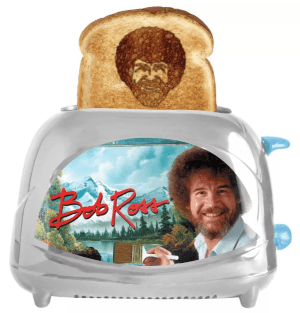
toaster
Photo: Uncanny Brands

New York based Uncanny Brands produces a unique blend of pop-culture toys, artwork, and small appliances. Their Star Wars line alone is impressive, featuring items such as the Death Star Popcorn Maker, Lightsaber Salt & Pepper Mills, and the Millennium Falcon Waffle Maker. Sports fans can select from NHL and NBA themed merchandise, while KISS and WWE aficionados have plenty to choose from as well.

But if you’ve been thinking that your toast is a little plain, I suggest you check out their Bob Ross Toaster. Just pop in your bread, and out comes a fairly reasonable likeness of the famous painter burned into your breakfast bread. There’s even a full color portrait of Ross on the side of the toaster, so you don’t have to feel bad about biting into his fluffy afro.

For those of you who don’t know who Bob Ross is, you owe it to yourself to check out a video or two of his PBS show The Joy of Painting. It aired from 1983 to 1994 (Ross died of lymphoma in 1995) and each half-hour episode featured Ross offering painting instruction as he completed a new landscape in real time. Ross’ belief that everyone could paint, and his soothing commentary earned him rave reviews and three Emmy Awards during its run.

After his death, Ross’ popularity continued to grow, in large part because of his fun approach to painting and his encouraging witticisms. One of his most enduring quotes references the goof-ups that inevitably happen as we pursue any endeavor. After an errant stroke of the brush, he said “We don’t make mistakes, just happy little accidents.”

Ross believed that mistakes were valuable as a natural part of the learning process. We don’t seek to make mistakes, but we should take advantage of them to grow. How we respond to our mistakes determines the value we receive from them. In particular, I see three ways we can turn our own mistakes into “happy little accidents.”

  1. Perfect your technique. There’s no doubt that some people are born with a natural inclination for painting. I’m not one of those, but thankfully I have other natural talents. Yet even the most gifted in any area will address their mistakes and practice to improve their skill level. Writers become better writers by writing. Athletes get better by competing. In every case, mistakes can point you to valuable lessons that need to be learned in order to become more proficient.
  2. Learn something new. Mistakes can often lead us to discover different ways of completing a task. I’ve lost track of how many innovative woodworking skills I’ve picked up as a result of messing up some aspect of a project in my home shop. Nine times out of ten, my second or third attempt, using a different approach, uncovers a faster, cleaner, more satisfying result. Without mistakes, I’d still be using time-intensive, less effective methods to get things done.
  3. Build a relationship. Mistakes provide us with an opportunity to establish and build relationships with people that we otherwise wouldn’t. Seeking out advice after messing up can lead you to a coworker or colleague; someone with whom you can share your own wisdom with. And while we definitely wouldn’t invite mistakes concerning customer relationships, studies show that customers who encounter a problem – and have it resolved to their satisfaction – become even more loyal than those who never have an issue in the first place.

Bob Ross once dabbed the wrong color onto one of his paintings (I’m sure it happened more than once). Instead of losing his cool or starting over, he simply moved the blob of paint around to create a bird. He turned his mistake into the focal point of a masterpiece. I’ll be keeping that in mind the next time I enjoy a slice of toast.