
Desirable DNA

dna-1811955_640Last year, scientists in Seoul, South Korea, approached Vanesa Semler of Dorado, Puerto Rico with an odd request. They wanted to know if they could clone her dog.

Semler’s furry friend Milly is very small, even for a Chihuahua. In fact, “Miracle Milly” holds the distinction of being the world’s smallest dog by height. According to the Guinness Book of World Records, Milly stands 3.8 inches tall and weighs about one pound. Using 50-year-old cloning technology, nuclear transfer, technicians from the Sooam Biotech Research Foundation planned to compare Milly’s original DNA to that of her clone in order to determine what causes her small size.

By focusing on a single, distinctive characteristic the scientists hope to learn better how to identify the causes of other genetic markers. The lessons they learn from Milly and her clones could pave the way to one day preventing various birth defects and genetic predisposition to disease.

Despite how you feel about the idea of cloning, I’ll bet there are attributes of certain people you know that you wish you could duplicate. Managers will often tell me how they would love to transfer the skills and personality traits of one employee to some of the others. And as a customer, there have been many times when, after interacting with a service provider, I’ve thought “I wish everyone who worked here was like this.”

I think these scientists may have a lesson to teach us about replicating desirable traits. Consider how they’re going about it.

  1. They zeroed in. The cloning experiment is focused on just one of Milly’s traits – her size. Eye color doesn’t matter. Neither does the texture of her fur or the sound of her growl. By identifying a single attribute, scientists are able to devote all of their energy to the same issue, and they are much more likely to succeed.

    What’s the single most important trait you wish you could multiply in your team?

  2. They dug in. Initially, the South Korean scientists asked for a 10 clones; nine to research and one for the owner. They quickly expanded the request, producing an initial litter of 12 puppies. To date, 49 clones have been produced; allowing them to study multiple sources for the same DNA markers and to see whether small differences impact the result. In the end, they hope to crack the code and be able apply their findings to other animals.

    How much time and effort do you devote to understanding the drivers behind team performance?

  3. They started with the best. When looking for a basis to compare their results to, the techs from Sooam didn’t pick just any dog, they decided to go with the record-holder. Milly represents an outlier in terms of dog height. They just don’t come any shorter than her. Choosing Milly ensures a strong benchmark for their tests.

    Who represents the absolute best in terms of the behavior you’re looking to duplicate?

The experiment is far from over. Specialists at the Beijing Genomics Institute have been called to collaborate on the next phase of the study. Milly’s clones all have the same eyes and markings on their coat, but they are all slightly different in height. Semler sees other similarities as well. The new dogs are “amazing to be around….they are all so smart, very playful. They are sweet and loving.” Maybe the experiment was a success after all.

A Matter of Commitment

result-3236280_1920This weekend I attended the wedding of one of one of my son’s best friends. It was a simple ceremony but there were a lot of emotions on display; as is the case with any wedding. And like all weddings there was a recitation of vows followed by the exchange of rings – the tangible reminders of those vows.
Outside of the marriage pact, you don’t see this kind of public commitment being made very often. Public servants (politicians, police officers, etc.) make a public vow to their new roles as they are sworn in; but the majority of us accept a job or promotion without much fanfare. In rare cases there may be an employment contract involved, but even those are typically confidential agreements. Most people simply accept a job after negotiating what they expect to receive rather than what they promise to give.

Nothing great is ever achieved without commitment. Until you commit yourself to a cause, participation is optional. Whether it’s a short-term goal, such as climbing a mountain, or a long term like marriage; it’s commitment that makes all the difference. Once you’ve committed yourself to the end game, then the path forward becomes clear. Decisions become easier to make. Every choice is determined by how it will impact the goal you have committed to.

Athletes committed to being number one are easy to spot. They follow the necessary training regimen, whether they feel like it or not. They avoid eating foods and engaging in activities that are extremely desirable because they would get in the way of achieving the goal. They fill their minds with information and imagery that propels them closer to achieving that which they are committed to.

Look around. Sales people, actors, chefs, musicians, service providers, medical professionals – the best of the best are those who have made a commitment to excellence. They are the ones who have identified what success looks like and refuse to settle for anything less. They are unwavering in their commitment, so they put in the effort. They go through the training, they put in the hours, they practice their craft to the point that they cannot fail.

The rest of us are merely bystanders. We’re Sunday drivers on a NASCAR speedway. We’re casual joggers on the Olympic sprint track, ready to bow out as soon as the going gets tough.

It’s so easy to bail on our commitments. It’s so easy to justify why we stop giving our all to the things we once felt were so important. The marriage hits a rough spot. The training gets tough. The job isn’t quite what we thought it would be. Maybe we made a mistake. Perhaps we should just coast for a bit.

Commitments are hard to keep. Vows are easy to break. Even those made in public often don’t stand the test of time. I guess that’s why there are so few people who ever reach the mountain top. Only one can stand at the top of the medal podium. So few know the joy of true success.

I’m convinced my life would be better if only I were more committed to certain aspects of it. Sadly, the list is far too short. Maybe I should fix that.

Who Do You Think You Are?

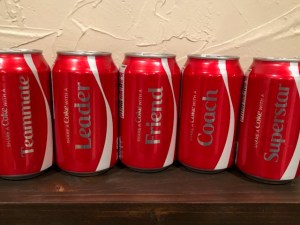
cokecansMy name is Scott Voland. It was given to me by my parents and forms the core of my identity. At the same time, I acquired other names – son, grandson, cousin. In time, I also became known as brother, schoolmate, and friend.

Over the years, I’ve added other names; other identities. Some were the result of external influences. Others were acquired by choice. Husband, father, employee, neighbor; these are identities I gave serious thought to before taking on. By accepting these roles, I’ve chosen to alter the course of my life and that of others as well.

Just like me, you have multiple names; identities that define who you are and how you act within certain situations and relationships. Many of these exist within the context of work. Think of the labels you operate under: associate, teammate, manager, leader; the list goes on. Each of these carries expectations for behavior, observable actions that indicate we have willing stepped into the role.

Hopefully, we take our identities seriously. We don’t take on roles lightly, ignoring the implications of our choices. That’s because the roles we identify with, and the way we behave within those roles, have tremendous impact on everyone involved.

When we act in accordance with the roles we’ve taken on, we realize the best version of ourselves. We feel complete and fulfilled because what we profess to be and what we are achieve alignment. Others who rely on us feed on this synchronicity and are enabled to perform in accordance with their chosen identities.

When our behavior fails to line up with expectations, we experience what can almost be described as an identity crisis. We fail to realize the best version of ourselves. We miss out on being who we are meant to be. Our coworkers feel the impact as well. They lose when we fall short of realizing our full potential.

The choice is obvious. Think about the identity you have chosen. Take stock of the behaviors associated with it. Act in accordance with those expectations. Anything less results in confusion, if not chaos.

My identity is still evolving. I continue to take on new and varied roles. I explore nuances of existing ones. Every day, I work to achieve more; to become the best version of myself possible. I do the best I can so that others can do the same. That’s who I am.

Who do you think you are?

The Other Side

Sertorio FamilyThis is my great-grandfather, Cesare Sertorio. He was a timber hewer who immigrated to Australia from Italy in 1911. Pictured with him is my great-grandmother, Sarah Jessie (Creyk). She was born in Australia, but her parents came from Scotland. The cute little girl is my grandmother, Esther Lucy Sertorio. She met my grandfather, John Stinson, while he was stationed with the U.S. Navy at a submarine base in Fremantle.

They fell in love and in January of 1947, my grandmother sailed to the United States aboard the S.S. Marine Phoenix. She made her way to middle Tennessee and they were married four days after her arrival. Their first child, my mother, married a man from Ohio. Dad had come down for a short work stint and never returned. Researching his family has revealed that they came to the United States from Germany.

When I think about the history of my family, I’m struck by the amount of courage it must have taken so many of them to leave the country of their birth in order to start a new life somewhere else. Imagine leaving everything and everyone you know in pursuit of something you believe must be better. The barriers that have to be overcome were huge – language, culture, geography – everything was dramatically different from what they had known.

I can’t imagine making taking such a huge leap of faith; but I’m glad they did. Otherwise I wouldn’t be here. Each of these decisions to not just step outside of their comfort zones, but to leave them far behind, led my family to grow and expand around the globe. In the process, they impacted the communities they settled in. They added their own unique talents to the organizations they served, in some cases starting businesses of their own. I’m sure not every risk they took panned out the way they’d hoped it would. From my perspective though, things have turned out pretty well.

So, what’s my excuse?

If my ancestors could muster the courage to cross an ocean, why do I find it so difficult to take risks that are infinitesimally small by comparison? Why do I struggle to pick up the phone or introduce myself to someone new? Why do I hesitate when it comes to engaging in activities that will expand my influence, my business, and my impact?

Jack Canfield said “Everything you want is on the other side of fear.” The older I get, the more I believe this is true. The regrets I have almost always have to do with risks I didn’t take. My greatest accomplishments have come as a result of swallowing my anxiety and taking the first scary steps into the unknown. The more I try to remove doubt and potential risk… the more I wait; the more I miss out on.

Now that I think about it, I guess I’m not so different from my ancestors after all. In 1997, my wife and I left the known comforts of life in Tennessee to start over in Texas. We had no idea what lie in store for us, just a dream that things would better on the other side of our fear. I don’t regret taking that risk one bit.

What’s keeping you from taking a risk? What’s waiting for you on the other side?

Winning Is a Team Sport

document-3268750_640Last Friday night the Golden State Warriors defeated the Cleveland Cavaliers, completing a four game sweep and winning the NBA title. While most of the conversation surrounding this series focused on Lebron James and the herculean effort he put forth to give his Ohio team a fighting chance, it was the well-rounded team play of the Warriors that one the day. They were simply too much for one man to handle – even if that man is Lebron James.

Speaking to reporters, Finals MVP Kevin Durant shared that he found it very difficult to be considered an MVP when he is surrounded by so many great teammates.  He said “I feel like it’s easy to be the best player when you don’t have good players around you. I feel like it’s harder to stand out when you have great players around you.”

What Durant and the rest of the Warriors understand is that great players don’t win championships. Great teams do.

It doesn’t matter how much time, and effort, and passion, you put into your job. If those around you aren’t just as committed you won’t win. You simply can’t do it alone. The more Lebron James has to carry the rest of the team, the more he stands out. And the more likely the team is to lose. You may be the best employee the organization has ever seen. You may be the top performer by a wide margin. But if your teammates aren’t pulling their weight, you will not succeed.

That’s why so many top performers leave their organizations. When you want to win, you want to be around others who feel the same way. If teammates are content to give minimum effort, then winners start to stand out – and they start to lose. It’s emotionally taxing to give 110% day after day while those around you choose to coast.

Are you a champion? Are you a member of a team that’s so strong, it’s hard to pick out an MVP? Are you surrounded by individuals who desire to win just as strongly as you do and put forth the effort to prove it?

Or are you watching your team’s best player give their heart and soul to a game you have no interest in playing? Are you coasting along, enduring the occasional criticism of your performance so that you can go back to sleepwalking your way to the next paycheck? Are you content with watching from the bench while others succeed?

Managers, ultimately this message is for you. Because as leaders, it’s our responsibility to create championship teams. Are we ok with second place, the middle of the pack, or even rock bottom? Do we have team members who are content? I hope not.

We’re quickly approaching the mid-point of another year. Will this be another championship year for you, or another disappointment? There’s still time to crush your goals. There’s still a chance to win.

Embrace excellence. Imagine your team in the winner’s circle. See your coworkers hoisting the trophy. Hear the applause of the crowd and feel the rush that comes from being part of a championship effort.

There’s a game to win and it’s going on right now. Want to play?

More Stories Yet to Tell

Remington PortableJust days after writing about the inventor of Liquid Paper, I came across this typewriter. It’s a Remington Portable #2. According to my research on the serial number, it was manufactured in May of 1924. It was the 813th unit produced that month.

I discovered this treasure in an old warehouse. It was hidden away in one of a hundred boxes with a bunch of random office supplies. I just happened to open the right box – one that countless others had walked right past. I had no clue what was inside; I was just curious and wanted to see what was inside.

As I examined my new device and learned about its origins, I couldn’t help but wonder about its previous owner. Someone had purchased this machine and used it produce … what? Office memos? Legal documents? Letters to loved ones? A novel? Unfortunately, I’ll likely never know. Yet, I picture them sitting over the typewriter, pouring out the creativity welling up from within.

In many ways, the people around us are like this portable typewriter. They have ideas, plans, answers to problems we face every day – all waiting to be realized. There’s a mountain of potential inside our employees and coworkers. All we need to do is hit the right keys, and that potential can be realized.

Managers hire the people they believe hold potential to do great things. We say “yes” to job offers we feel will reward us, not just monetarily; but in even more significant ways. The sense of belonging that comes from being part of a team in pursuit of greatness is what pulls people together. We long to tell great stories.

Unfortunately, so much of this potential goes to waste. We ignore the treasures right under our noses. We don’t listen. We get bored and feel like there’s nothing new to learn. Our attention turns elsewhere, and like my typewriter, we put them in a box. There they sit; unutilized and gathering dust.

We forget about pursuing greatness and settle for mediocrity. We fill our days with mindless drudgery instead of forward progress. The comfort of the known and the safe becomes more desirable than the mystery and risk associated with blazing new trails. We become what we sought to escape.

But it might not be too late. That potential is still inside. Our people still have stories to tell and answers to give. We just need to ask them to share. If we act soon enough, maybe the rust and cobwebs haven’t set in. Maybe we can coax out some of that creativity and write great stories together.

After cleaning the Remington Portable, I fed a piece of paper into the roller and typed out a few words on the keys. A little bit of ink bled out of the dated ribbon, but the typewriter worked fine. I won’t be giving up my laptop any time soon, but something tells me this beauty has a few more stories to share.

Where’s the White-Out?

typewriter-1248088_640As an executive secretary for Texas Bank and Trust in the 1950’s, Bette Nesmith Graham did a lot of typing. This being before the modern age of computers, any mistakes she made using her typewriter meant starting over. There was no backspace button, and even simple errors in her work could result in thousands of dollars being misplaced.

Working in her kitchen, Graham began mixing tempera paints with other household items in a blender. Before long, she had stumbled upon a concoction she could apply to the paper, covering a mistake and allowing her to type over it. She called it “Mistake Out” and began handing out small bottles of it to her coworkers.

A couple of years later, Graham started the Mistake Out Company and started selling her product, which was still made in her kitchen. When she accidentally put her own company’s name on a letter from the bank, she was let go and devoted herself full-time to growing the business. She sold the company and its flagship product, renamed Liquid Paper, to the Gillette Corporation in 1979.

Not many people use liquid paper these days. Digital communication makes is easy to correct mistakes in emails, documents, and even social media posts. But that doesn’t mean we’ve gotten any better at preventing mistakes from slipping out. I make plenty of them each and every day.

Oh, tools like Spell Check and AutoCorrect may catch the easy stuff; but it’s still up to us to correct the most important aspects of our communication before hitting the send button. Things like tone, clarity of language, and audience selection have replaced “i before e” and “who vs. whom” as the top faux pas. Communicating in the digital age requires more attention than ever, even as attention spans continue to shrink.

Here are three of the most common modern-day mistakes and some thoughts on how to correct them.

  • The premature send – You accidentally hit Send before completing your message, and have to follow up with another email or text to finish the thought or correct an error.
    • Try composing your message before adding names in the To: line. Any accidental Send will fail without an addressee, providing you with a safety net.
    • Re-read your email for clarity and tone. I often find reading an email out loud helps identify awkward sentences and incomplete thoughts.
    • Ask a trusted coworker to read your message before you send. They can help spot issues you may be blind to.
  • The unintended audience – Your message goes out to people it shouldn’t.
    • Double-check the names added in the To: field. Auto Complete sometimes grabs the wrong ones.
    • Before using a distribution list, verify who is in it. These are convenient, but can easily flood email boxes with unnecessary emails, so use sparingly.
    • Avoid the Reply To All option whenever possible. Make sure your message only goes to those who need to receive it.
  • The War and Peace message – Your message is simply too long.
    • Identify the specific action you want the receiver to take and start with that. Any part of the email that doesn’t support this objective is fluff.
    • If you find yourself needing to provide lots of detail, break things up. Use bullets, numbered lists, or headings to separate big chunks of text into more digestible pieces.
    • Consider just picking up the phone. It’s hard to convey emotion and nuance in an email. Sometimes and old-fashioned discussion is the best way to communicate.

Liquid Paper is still made today, though it’s used primarily for covering up mistakes in handwritten correspondence than anything else. It seems we can’t get away from the occasional goof-up no matter what medium we communicate in. Thankfully, we can all learn from our mistakes correct them ourselves.

Jaded

shoes-3397628_1920Last week police in the Japanese city of Himeji were called to the house of an elderly woman. Her son, over for a visit was cooking dinner and heard strange noises coming from the second floor. When he went to investigate, he found a 20 year old man asleep in a vacant room. The owner of the home had no idea who this man was, and he was arrested for trespassing.

What makes this story so interesting is that the young man had been quietly living in the house for over five months. Despite his presence under the same roof since early December, he and the owner had never crossed paths. He entered and exited regularly, leaving his shoes by the front door, and managed to go unnoticed for almost half a year.

As incredible as it sounds, this same scenario plays out every day – right under our noses. Oh, we may know every aspect of what happens inside of our personal homes, but our business is a totally different story. Thousands of customers live under our roof, coming and going on a regular basis, without us ever knowing who they are.

The good news is, our customers don’t have to be strangers to us. There are some very easy steps we can take to avoid being surprised when we bump into an invisible houseguest.

  • Look around once in a while. The homeowner in last week’s news story admitted that she never really went upstairs. She lived comfortably on the first floor and really didn’t see the need to expend the effort.

    Aren’t we just as comfortable? The customers that come in on a regular basis are familiar and provide us with an acceptable volume of work. Who needs the effort required to investigate other accounts that may be on the books. Maybe “out of sight” really is “out of mind.”

  • Pay attention to clues. You’d think that a pair of unfamiliar shoes by the front door would be a dead give-away, but not for this resident. She walked past them day after day (and likely a number of other hints) without raising an eyebrow.

    Aren’t we just as myopic? We get so focused on what’s right in front of us that we too miss obvious clues that should draw our attention. Who needs the effort required to look any further than the task at hand? Maybe we really can’t see “the forest for the trees.”

  • Listen for clues. Strange noises coming from the second floor didn’t faze this lady. She might have though she was hearing things, or maybe the footsteps from above had just become part of the home’s familiar background noise.

    Aren’t we just as tuned out? Don’t we listen with the intent to respond rather than understand? Who needs the effort required to create relationships when there are items on the to-do list that must be checked off? Maybe “in one ear” really is “out the other.”

Police are still trying to ascertain what the young squatter’s intentions were. So far though, he’s not talking. I guess he figures “Why bother? No one’s really paying attention anyway.”

Stacking Rocks

rocksWhile out for a hike recently, I came across this stack of rocks. It reminded me of something I heard once about the Scottish Highland clans. According to legend, as armies would march to battle, each soldier would place a rock onto a pile. Those who returned home removed a rock, with the rest forming a memorial to the fallen.

Stacks of rocks like this, traditionally called cairns, have been around since the beginning of recorded time. In addition to memorials, assembled rock formations like this have been used to indicate buried supply locations or to mark trailheads and pathways, as in the case of the one I came across. The Inuit people of the Arctic in particular used them as landmarks given the vast, bleak terrain.

More recently, stacks of rocks have been used for more introspective reasons. Climbers add to cairns when they reach a mountain summit as a celebration of the accomplishment. Some people find the act of balancing rocks to aid in meditation. Others ascribe religious meaning to the practice. For some, it’s seen as a form of art.

We all stack rocks, don’t we? We all engage in labor that can feel like we’re just picking up stones and piling one on top of the other. Work can often feel monotonous. We answer the same questions. We make the same phone calls. We process the same transactions and have the same conversations with the same people. It can be rather frustrating at times, can’t it?

But regardless of which rocks we’re stacking, it’s important to periodically focus on why we’re stacking them. What we’re working for – and toward – is as important as the work itself. Take a moment and ask yourself…

  • Are you building a memorial – working to continue the legacy of those who have come before you?
  • Are you marking the path – working to make things easier for someone else?
  • Are you leaving supplies – working to provide resources so others can continue their journey?
  • Is work a celebration for you? A meditation? Do you see it as a work of art?

In Aruba, the act of stacking rocks became so prevalent that last year The Island Hotel & Tourism Association officially asked visitors to stop. Somehow the idea of stacking rocks became associated with making a wish. Beaches and trails have become littered with these formations, to the point that the natural habitat of indigenous wildlife is being disrupted.

In some cases, you see, stacking rocks is a meaningless exercise. It’s a waste of effort – just like making wishes. Pictures I’ve seen of the rock stacks in Aruba indicate that they were hastily thrown together. They aren’t very big and it looks like very little effort went into building them. No thought was given to the impact these cairns would have on the environment or those who would come after.

Work without purpose isn’t just an empty exercise for the laborer, it can actually be detrimental to the team and the organization. When someone else is simply going through the motions, errors occur. Details are missed. Repairs have to be made and work has to be redone. Everyone stacks rocks; but not everyone is building something.

Apart From the Crowd

lemon-3303842_640Amid a crowd, she stood apart. Without making a sound, she spoke volumes. I’d never seen her before but knew I would like her.

Last week I traveled to Austin for a couple of meetings. In the conference room of the hotel where I stayed, a soon-to-open local business was conducting interviews. Given the number of applicants waiting their turn in the hallway, this must be a great place to work.

I approached the elevator after checking in and scanned the candidates as it made its way to the first floor. Most were engrossed in their phones – their attention focused on the familiar world offered by the tiny screen. Others fidgeted with resumes and squirmed in their seats attempting to get comfortable.

And then one young lady caught my eye. She sat upright in her seat, her eyes trained straight ahead. If she had a phone with her, it was put away. Her face held a mixture of emotions. I thought I detected confidence and anticipation – and just a hint of a smile.

Do you remember your first interview – the excitement you felt, the desire to join your skills and abilities with those of others in pursuit of a common cause? If we could bottle the nervous energy that accompanies the typical job interview, we could power a small city. Those who harness the energy and channel it properly often ace the interview and find themselves ushered into a new phase of their career.

Did you know that new employees tend to outperform their peers by a factor of ten over their first 90 days? As time goes by though, the new hire’s energy wanes. The new wears off and they let their guard down. By the time that eager new employee reaches their six-month anniversary, their performance is indistinguishable from their more tenured peers.

I think that’s a shame. Time and experience should be an asset, not a liability. Performance should improve with time, not worsen. Imagine combining the focus and determination of a new hire with the know-how and wisdom of a veteran. Now imagine a team full of these people. Oh, the wonders they could accomplish.

The real challenge of business isn’t coming up with new products. It isn’t driving efficiency or improving customer service. No, the real challenge is keeping employees fired up and engaged. It’s figuring out how to retain the attitude of the new hire – and infecting others with it. Solve that equation and the other issues will fix themselves.

Upstairs, I unpacked, changed clothes, and took care of a few emails. About an hour after I arrived I headed out for dinner. As a left, I saw the stand-out candidate rise and enter the conference room. Her name had been called and it was time for her interview. I never saw her again, but the fire in her eyes has stayed with me. I hope it stays with her too.