
A Slap in the Face

child-1099770_640With March Madness in full swing, much of the country has basketball fever. Television schedules have been adjusted to account for viewership pulled to the college games, and other sports take a back seat this time every year. For those who aren’t fans of basketball, it can be hard to find something other than reruns to watch.

Or maybe not.

I’ve stumbled across a new sport that offers a little bit of everything. There’s drama, suspense, and hard-hitting action…literally. The sport in question is competitive slapping. That’s right, grown men have made a sport out of slapping each other. Last weekend in the Russian town of Krasnoyarsk, Vasily Pelmen (a 370-pound walk-on competitor nicknamed “Dumpling”) decimated the competition as part of the Siberian Power Show. He walked away with a purse of 30,000 rubles – the equivalent of $470.

The rules of the contest are simple. Two men face each other across a small table. They take turns delivering an open-handed slap to the other’s face. The contest continues until one of them cannot continue or the judge calls the match out of safety. Even though they can clearly see the slap coming, many of the competitors I saw on video were knocked off their feet by a blow from their opponent. They clearly weren’t prepared for what was coming.

Workplace slaps to the face rarely come with physical contact, but they can still sting; and they usually involve communication issues. Last-minute demands, surprise assignments, and sudden changes to strategy – they hurt, but can be avoided with a little forethought. Here are some tips to help keep you and your teammates from getting knocked out.

Look across the table. Today’s businesses can’t succeed without teamwork. Individuals and business units alike must consider others who may be impacted by their work. Look beyond your role in the project. Who else plays a part in the process? Who will pick up where you leave off? Think in terms of all who will be affected, even far down the road, so that you avoid blindsiding someone.

Plan your strike. Before you communicate, think about how your words will be received. Ask others to help you anticipate reactions from those on the receiving end. Who will be excited by it? Who will be disappointed, or surprised? Take some time to choose your words so that teammates are set up for success, not reeling from shock.

Expect the unexpected. No amount of planning will eliminate the occasional surprise. How we respond to surprise news is important. Understand that you will occasionally be caught off guard. Do your best to stay connected with other parts of the organization to minimize surprises when they occur. Stay on top of your regularly-assigned work duties so that you can more easily absorb unexpected demands. And if you happen to be the one delivering the surprise, be ready for the inevitable reaction.

A slap to the face may be fun to watch; but nobody wants to be on the receiving end, even if it does come with a title and prize money. The real reward lies in being part of a smoothly operating team. Up your communication game and leave the red, stinging face to Dumpling and his buddies.
Layers

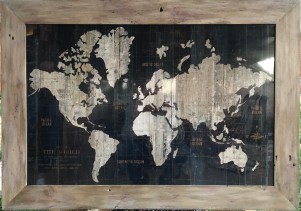
frameMy son Alex recently purchased a new piece of artwork for his room. It’s a picture of the world map, seemingly cut out of weathered boards. It has a very old word, rustic feel to it and he wanted a suitable frame for it – something that complemented the style rather than the sleek and modern options he found within his budget at retail outlets. So this weekend, we went out to the shop to build something custom together.
Finding the material was easy enough. I have a sizable stock of old wood from prior projects. He identified some old fence pickets that were straight and solid but with the right amount of character for his chosen aesthetic. After cleaning them up, milling them to accept the artwork, and cutting everything to size, it was time to address the look of the frame. Running the boards through my planer had revealed the fresh wood underneath the surface. They needed to be aged again.

I pulled out a variety of wood stains and we set to work. I’d lay down a color and Alex would follow behind me; blending each coat into the prior one to his liking. We repeated this process several times, mixing blues, reds, browns, and whites. Sometimes we used a brush, and sometimes a rag seemed like the appropriate tool to work with. Eventually, he felt like the right balance of colors was achieved and we left the pieces to dry overnight. Yesterday afternoon we assembled everything for the result you see in the picture above.

Note: It actually looks a lot better than this image represents. I need a photographer friend to give me pointers on taking pictures of artwork without getting reflections on the glass.

As we admired our handiwork last night and showed it off to the rest of the family, I couldn’t help but reflect on the process we went through… and how much it mirrors our journey through life. Each of us is a custom work of art. We are who we are as the result of a unique sequence of events. We’re just like this frame – made up of several colors, layered and blended repeatedly in a pattern of events that could never be replicated.

You have been exposed to circumstances and people that shaped who you are today. You’ve made innumerable decisions that have brought you to where you are right now. It’s the culmination of countless influences that now frame your world. And in turn, you have played a part in framing the world of those you’ve come in contact with.

Think about that last concept for just a minute. Everyone you have ever met is different because of your influence. In some way, you influence people. How you influence them is up to you. Will you provide a foundation; a basecoat upon which others will build? Will you be the splash of color that brightens up an otherwise dull corner? Or will you be the brush that helps blend various elements into a beautiful masterpiece?

Every person you meet is an opportunity to contribute to something special; to play a part in the creation of a masterpiece. No one else will ever create a piece of work like the one Alex now owns. He is extremely proud of it. And I’m proud to have played a part in helping it come to be.

More Than Just a Goal

bulls-eye-1044725_640By now, the vast majority of New Year’s resolutions made just a few weeks ago (remember those), have been forgotten. A study by U.S. News indicates that 80% of resolutions each year fail by the second week of February. Here we are in the second week of March and there’s probably no point in studying this topic anymore. Anyone who’s kept their resolutions this long is an anomaly – the exception that proves the rule.

The question is, “why do so many resolutions fail?” We make them in good faith, don’t we? I know that any time I come up with a personal goal it’s with the best of intentions. In the moment, I truly believe I have the power to change some aspect of my behavior, otherwise I wouldn’t go through the pretense of creating an expectation. What changes between the day I set a goal and the day I finally abandon it?

The answer for most of us is… nothing. Nothing changes. We’ve set a goal and allowed that to be the end of it. As humans we have a tendency to believe that a single decision invokes change. I want get in better shape and so I make the decision to join a gym. Having taken that step eases the internal tension I was feeling and I feel better about things. “I’m on my way,” I tell myself. “No turning back now.”

In reality though, I haven’t changed anything. That one decision, in and of itself, has no power. Having relived my mind of the initial conflict, I am free to return to my lazy routine. I’ll occasionally remind myself that I need to follow up on the initial commitment, but it’s never the right time to act. By mid-February, I’ll have either forgotten all about it, or decided to wait until next year. My behavior hasn’t changed.

Replace personal resolutions with work goals, and the pattern is the same. Team members will agree to adopt a new way of operating only to abandon it in fairly short order. It only takes a single, small slip-up to convince the entire group that changing isn’t possible.

To change the outcome, we have to change the way we approach the initial decision. We need to consider two factors that have enormous impact on our ability to actually achieve the goals we set. Those factors are specificity and commitment.

To start with, we’re rarely specific enough when setting goals. “I’m going to start going to the gym” or “We’re going to generate more referrals” are simply too vague to be meaningful. Real goal-setting involves developing a set of strategies to achieve the goal. We miss the mark because we haven’t thought about how we’re going to actually hit it.

Once our strategies are developed, few of us are actually committed enough to see them through. When the first unforeseen obstacle come along, we allow that to derail us. The plan is abandoned in favor of something easier to achieve. Only the strong-willed have what it takes to see things through when the going gets rough. Very few have the energy to win at the long game.

Motivational speaker Zig Ziglar used to ask his audiences “Are you a wandering generality, or a meaningful specific?” In other words, are you just bouncing from one vague goal to another, or do you have a plan to achieve what you’re after? Are you comfortable being at the mercy of your circumstances, or do have a clear picture of who you want to be that drives your actions each day?

I think I’d much prefer to be a meaningful specific. How about you?

Watch for Ice

road-587451_640The thermometer read 14 degrees when I left the house today. That’s a stark contrast to the balmy, 70 degree drive home I enjoyed on Friday afternoon. A cold front descended on West Texas this weekend. There wasn’t much precipitation; just enough to make things interesting and driving a little dangerous yesterday morning. Just enough to create patches of black ice.

While dry streets are obviously preferred, heavy rain or snow are much better for driving than the spotty conditions presented by black ice. With the really bad stuff, you know how to prepare, and you can be reasonably sure that other drivers will be just as cautious as you are. But black ice is different as it masquerades as dry pavement. The thin layer of ice allows the dark coloring of the road surface to show though, giving you a false sense of security. Often, you don’t know it’s there until it’s too late. Even if you do see it coming. It can be difficult to navigate.

We have patches of black ice at work too, don’t we? Again, I’m not talking about the “all hands on deck” type of emergencies. I’m talking about the random slick spots that we don’t see coming; the technical hiccups, the upset or demanding customer, the corporate demands that blindside us. Navigate them incorrectly, and you can spin out of control. Handled them properly though, and you can continue on to your original destination with little impact.

When you encounter one of these slick spots, the first thing you should do is put both hands on the wheel. Typical driving involves a lot of multitasking. We adjust the radio and climate controls. We drink our coffee and finish off a breakfast sandwich. But at the first sign that something is off, we need both hands on the wheel. This one act focuses our minds on the immediate situation. We can feel changes in road conditions through the steering wheel and react more quickly to changes that we sense. The simple decision to focus brings all of our resources to bear on navigating safely through the slick spot.

Next, we need to take our foot off of the gas. Make sure you read that correctly. Don’t step on the brakes and don’t accelerate. Either of those actions can make the problem worse. Hit the brakes, and you’ll create new problems as the car will quickly spin out of control. This endangers everyone around you. Trying to go faster will result in your spinning your wheels. You’ll waste a lot of effort with no result. The goal is to keep moving. Just ease off a little bit. Once the danger has passed, resume normal speed.

Finally, steer the vehicle in the right direction. A tendency is to over-correct. If the car starts sliding left, we want to jerk the wheel hard to the right. This is a recipe for disaster as once the immediate threat is over, you find yourself barreling in another wrong direction. Instead, we need to keep the wheel pointed in the direction we ultimately want to go. Keep your eyes on the desired destination and avoid the temptation to over-steer because of a single little unsteady patch.

Even when the road ahead looks to be clear, there are a million little decisions to make in order to reach our goal safely. And while it may be comfortable to set the cruise control and relax, we have to remain vigilant. When you’re behind the wheel, it’s important to make sure you are prepared to deal with the unexpected. Having the right plan ensures you can tackle whatever the road throws at you.