
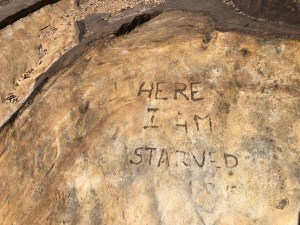
Here I Am Starved

starvedLincoln’s Rock is a remote overlook nestled in the Blue Mountains of Australia. It lies at the end of a rough dirt pathway and involves a steep scramble over rocks and scraggly brush. The view, however, is well worth the detour from the main road. The ground drops away suddenly revealing a gorgeous valley of green. It truly takes your breath away.

Yet, carved in one of the rocks leading up to the cliff’s edge, I found this message: “HERE I AM STARVED” with a date too weathered by time to be readable. In the midst of such incredible beauty was a message from someone who, long ago, felt anything but inspired by their surroundings. Gazing at this image, I imagined an explorer – someone who’d set out on an adventure to accomplish great things – suddenly overwhelmed by isolation and loneliness…either literally or figuratively, they were starving.

Even in the midst of our excess employees can often feel this same sense of exasperation. Canadian researchers found that feelings of isolation at work are not only more common, but more damaging than workplace harassment. The social aspect of work is a critical component that shouldn’t be ignored, and yet the most distant of all relationships tends to be that between an employee and their manager.

In his book “What People Want,” author Terry Bacon shares the results of an interesting survey of United Stated employees. It paints a pretty clear picture of what workers are hungry for.

Honesty: 90% said they wanted more honesty and integrity from their manager.

Fairness: 89% want their manager to be fair and to hold all employees accountable to the same standards.

Trust: More than 86% want to trust, and be trusted by, their manager.

Respect: 84% want to respect, and be respected by, their manager.

Dependability: 81% wish they could count on their manager when needed.

Collaboration: 77% want to be part of their manager’s team and be asked to contribute ideas and solutions.

Genuineness: 76% wish their manager was a more genuine person.

Appreciation: 74% want to be appreciated for who they are and what they do.

Responsiveness: 74% want to be listened to, understood, and responded to.

These nine characteristics may seem fairly basic; and as the title of Bacon’s book illustrates, you don’t have to be an employee to desire these things. They’re traits that any person hungers for, and depends on those around them to provide.

We often think of work in terms of a journey. We’re climbing a mountain, running a race, or blazing a trail. We’re on a mission to reach our goals, or maybe just the weekend. Regardless, the journey is always easier when it’s shared with others who feed you along the way.

As we make our way through the twists and turns of 2019, let’s take time to make sure those around us are getting the nourishment they need to finish the journey with us.

The Quest for Joy

person-731243_1920The hottest title on Netflix right now is Tidying Up with Marie Kondo. Based on the professional organizer’s 2014 book, and introduced to coincide with New Year’s resolutions, the show has everyone talking. Fans are quick to share how Kondo’s KonMari method has changed their lives. Detractors will tell you why it simply doesn’t work for Americans. And everyone is talking about joy.
I was introduced to this phenomenon one recent evening when I walked in on my wife watching the premier episode of Tidying Up. At the center of the show, and the KonMari method, is the idea of joy. When you hold an item, say a sweater from your closet, does it “spark joy?” If that sweater sparks joy, then keep it. Store it in a way that allows you to access it and benefit from the joy it brings. If there’s no spark, then respectfully let it go and move on.

That word “joy” is key. It’s a noun, meaning a feeling of great pleasure and happiness. The KonMari method of organizing is all about surrounding yourself with those things – and only those things – that make you feel positive emotions. If something sparks negative emotions, like anxiety, fear, or even sadness, then remove it.

But few people realize that joy is also a verb. It stems from the Latin word gaudēre, or rejoice. When the things around us spark joy they cause us to take action. We feel encouraged and affirmed; and act in order to repeat those feelings. We take further action to continue the process of sparking joy.

I spent part of the last long weekend tidying up my workshop. As I did so, I reflected on this idea of surrounding myself with things that spark joy. I wound up throwing out a lot of stuff. There were tools that didn’t work, and that I’ll likely never get around to repairing. There were wood scraps and fasteners that I’d been telling myself (for far too long) might come in handy. I kept those items that I felt brought me joy – tools that I like using because they work well and allow me to accomplish a job effectively, and materials that I plan on using in specific projects during the upcoming weeks. My next step is to organize them in ways that honor their purpose and allow me to access the joy they represent.

Back in the office, I’ve still been thinking about this idea of sparking joy. Only now, my thoughts have turned to the people around me. Have I surrounded myself with people who spark joy? Do they make me smile? Do they cause me to feel encouraged? Does their presence motivate me to take action; to contribute in meaningful ways? Am I happy to be in this space because of them?

And more importantly, what about me? Do I spark joy in others? Given the choice, would the people I interact with choose to honor me and the feelings I generate in them? Or would they decide to respectfully part ways? Would they tidy up by eliminating the clutter I represent?

Before you answer, give me some time to work on a few things. The KonMari method is an introspective process, and it takes time. Decisions this significant aren’t meant to be made lightly. I suspect there are changes I need to make in order to be capable of sparking joy in others. I believe I have a little more tidying up of my own to do.

The Conversation

conversationIn 2008, the city of Perth in Western Australia adopted a program called “Forgotten Spaces.” Focused on the city’s central business district, the plan focused on revitalizing the downtown area by updating its laneways and arcades; the narrow streets and alleys located between the towering office buildings. These spaces offered intimate potential settings for small shops and bistros – just the kind of environment city officials hoped would bring people (and their money) back to the city at the end of the workday.

As part of the plan, the laneways needed a facelift. At the time, they were used by delivery vehicles, for storage, and as trash dumps. They were dirty and uninviting; definitely not the kind of place you’d want to spend your evening. After addressing these logistical issues, officials invited local street artists in to paint murals in these forgotten spaces. This move helped to spur curiosity and the laneways slowly transitioned into desirable hangouts.

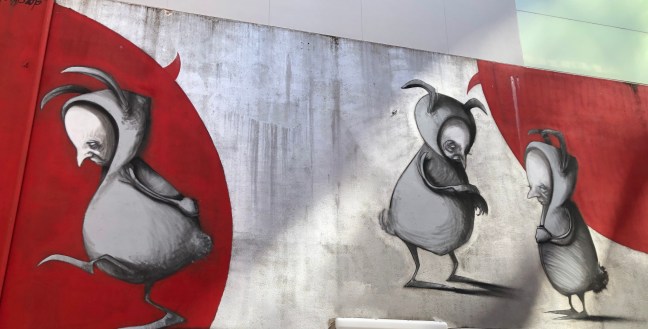
I recently toured some of these laneways and saw firsthand the results of this revitalization effort, including the artwork. On a wall overlooking Howard Lane, this piece drew my attention and really made me think. It was created by local artist Stormie Mills and is called “The Conversation.”

I don’t know about you, but there doesn’t look to be much conversation taking place in this scene. Given the goal of the “Forgotten Spaces” project, to bring people together, this piece of art appears to represent the opposite. One character isn’t even part of the discussion, while the two that are don’t appear to be very happy about it. Rather than conversation, it seems to depict isolation and exclusion. But perhaps that was the artist’s point.

Much of what passes for conversation today is anything but. In my opinion, most interactions with other people are short, one-sided, and do little to bring people together. In our rush to accomplish the next task, we’ve stopped talking with other people in favor of talking at them. In other words, we’ve forgotten what real conversation is.

When I think of meaningful conversation, here’s what comes to mind:

  • It starts with an invitation. All of the great conversations I’ve been a part of began with someone asking me to participate. They’re kicked off by one person expressing a desire to share in discourse with another. They aren’t demands, or official meeting requests; they are invitation to explore ideas with someone else.
  • It includes good questions. In a meaningful conversation, I’m asked what I think, how I feel, and how I would like to proceed. I’m not merely subjected to someone else’s ideas or given a task list. My thoughts matter.
  • It involves a lot of listening. When I’m engaged in a meaningful conversation, I’m allowed to share my thoughts without interruption. I’m not talked over, shouted down, or ignored. The other party doesn’t just hear me, they listen. That means they aren’t simply waiting for me to stop talking so they can voice their next point. They’re actively engaged in processing what I’m saying so that they understand me.
  • It’s a two-way street. A conversation is a dance. It’s a give and take. I ask a question, and you share your thoughts. Then I share some information as well. Conversations are not one-sided, so both parties honor the obligation to balance the speak/listen dynamic.
  • It’s positive. Great conversations leave you happy they took place. You walk away enriched in some way – educated, inspired, affirmed. Meaningful conversations end with both parties looking forward to the next encounter.

Perhaps Mills was trying to spark meaningful conversation through this piece of art. Maybe the intent is to create a spark so that people visiting this particular laneway would stop to think about their interactions with others. I invite you to share this image with your team and see what conversation takes place.

How’s Your Driving?

snowscapeOn Friday night Mother Nature passed through Lubbock, leaving behind our first snowfall of the season. Residents woke up Saturday to between seven and twelve inches of snow, with a steady curtain of the white stuff continuing to drop until mid-day. Cold temperatures and icy conditions led local authorities to recommend staying off of the streets if at all possible. But Christmas shopping, weekend jobs, and other responsibilities forced many people out onto the roads.

My son Alex and I were a couple of those who had to get out. We had an obligation that couldn’t be postponed so after a quick breakfast, we hit the streets in my four wheel drive pickup. Making our way through town, it didn’t take long for us encounter the wonders of winter. Children and pets played in the snow, homeowners shoveled their driveways and sidewalks, and there were plenty of great photo opportunities; such as the attached picture from my own backyard.

But it was the vehicles on the road that really grabbed our attention; well, actually it was the people driving them. There were three types of people on the road Saturday morning. Each of them had distinctive goals and observable driving patterns.

There were those like Alex and myself; people with jobs to do and a desire to accomplish those jobs as effectively as possible. These people drive slowly, being careful to avoid the slick spots and allowing other drivers plenty of room to operate. They anticipate changes and adjust their course accordingly. They give themselves plenty of time to stop at a traffic light and move at a speed that allows them to maintain control while making steady progress.

Every now and then, these drivers encounter someone else on the road who makes their commute even more difficult. These are the people who feel the need to drive at top speed regardless of the road conditions. They can’t be bothered to observe safe driving habits, so they speed by others; throwing up a wave of ice and slush (not mention a few choice words) as they pass. They tailgate, applying unnecessary pressure on the people on front of them. Their reckless behavior causes them to slip and slide, putting everyone around them in danger.

And then there are those who clear the way; the street graders and ice trucks. These people were out working in the wee hours of the night, long before the rest of us; working to remove obstacles so we could safely go about our business. It’s a thankless job, and one most of us don’t give a second thought to – unless we encounter a street that needs a little clearing.

Of course, we don’t need to travel through a snowstorm to encounter these people. All three types are out there every single day; on the roads, in our businesses, and everywhere in between. The real question is this: What kind of driver are you?

Are you the kind of driver who works to make steady progress toward your goal? Are you the kind who works to clear the way so that others have a clearer path to success? Or are you the kind who makes everyone else’s journey even more difficult?

Desirable DNA

dna-1811955_640Last year, scientists in Seoul, South Korea, approached Vanesa Semler of Dorado, Puerto Rico with an odd request. They wanted to know if they could clone her dog.
Semler’s furry friend Milly is very small, even for a Chihuahua. In fact, “Miracle Milly” holds the distinction of being the world’s smallest dog by height. According to the Guinness Book of World Records, Milly stands 3.8 inches tall and weighs about one pound. Using 50-year-old cloning technology, nuclear transfer, technicians from the Sooam Biotech Research Foundation planned to compare Milly’s original DNA to that of her clone in order to determine what causes her small size.

By focusing on a single, distinctive characteristic the scientists hope to learn better how to identify the causes of other genetic markers. The lessons they learn from Milly and her clones could pave the way to one day preventing various birth defects and genetic predisposition to disease.

Despite how you feel about the idea of cloning, I’ll bet there are attributes of certain people you know that you wish you could duplicate. Managers will often tell me how they would love to transfer the skills and personality traits of one employee to some of the others. And as a customer, there have been many times when, after interacting with a service provider, I’ve thought “I wish everyone who worked here was like this.”

I think these scientists may have a lesson to teach us about replicating desirable traits. Consider how they’re going about it.

  1. They zeroed in. The cloning experiment is focused on just one of Milly’s traits – her size. Eye color doesn’t matter. Neither does the texture of her fur or the sound of her growl. By identifying a single attribute, scientists are able to devote all of their energy to the same issue, and they are much more likely to succeed.

    What’s the single most important trait you wish you could multiply in your team?

  2. They dug in. Initially, the South Korean scientists asked for a 10 clones; nine to research and one for the owner. They quickly expanded the request, producing an initial litter of 12 puppies. To date, 49 clones have been produced; allowing them to study multiple sources for the same DNA markers and to see whether small differences impact the result. In the end, they hope to crack the code and be able apply their findings to other animals.

    How much time and effort do you devote to understanding the drivers behind team performance?

  3. They started with the best. When looking for a basis to compare their results to, the techs from Sooam didn’t pick just any dog, they decided to go with the record-holder. Milly represents an outlier in terms of dog height. They just don’t come any shorter than her. Choosing Milly ensures a strong benchmark for their tests.

    Who represents the absolute best in terms of the behavior you’re looking to duplicate?

The experiment is far from over. Specialists at the Beijing Genomics Institute have been called to collaborate on the next phase of the study. Milly’s clones all have the same eyes and markings on their coat, but they are all slightly different in height. Semler sees other similarities as well. The new dogs are “amazing to be around….they are all so smart, very playful. They are sweet and loving.” Maybe the experiment was a success after all.

Who Do You Think You Are?

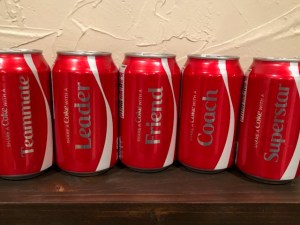
cokecansMy name is Scott Voland. It was given to me by my parents and forms the core of my identity. At the same time, I acquired other names – son, grandson, cousin. In time, I also became known as brother, schoolmate, and friend.

Over the years, I’ve added other names; other identities. Some were the result of external influences. Others were acquired by choice. Husband, father, employee, neighbor; these are identities I gave serious thought to before taking on. By accepting these roles, I’ve chosen to alter the course of my life and that of others as well.

Just like me, you have multiple names; identities that define who you are and how you act within certain situations and relationships. Many of these exist within the context of work. Think of the labels you operate under: associate, teammate, manager, leader; the list goes on. Each of these carries expectations for behavior, observable actions that indicate we have willing stepped into the role.

Hopefully, we take our identities seriously. We don’t take on roles lightly, ignoring the implications of our choices. That’s because the roles we identify with, and the way we behave within those roles, have tremendous impact on everyone involved.

When we act in accordance with the roles we’ve taken on, we realize the best version of ourselves. We feel complete and fulfilled because what we profess to be and what we are achieve alignment. Others who rely on us feed on this synchronicity and are enabled to perform in accordance with their chosen identities.

When our behavior fails to line up with expectations, we experience what can almost be described as an identity crisis. We fail to realize the best version of ourselves. We miss out on being who we are meant to be. Our coworkers feel the impact as well. They lose when we fall short of realizing our full potential.

The choice is obvious. Think about the identity you have chosen. Take stock of the behaviors associated with it. Act in accordance with those expectations. Anything less results in confusion, if not chaos.

My identity is still evolving. I continue to take on new and varied roles. I explore nuances of existing ones. Every day, I work to achieve more; to become the best version of myself possible. I do the best I can so that others can do the same. That’s who I am.

Who do you think you are?

More Stories Yet to Tell

Remington PortableJust days after writing about the inventor of Liquid Paper, I came across this typewriter. It’s a Remington Portable #2. According to my research on the serial number, it was manufactured in May of 1924. It was the 813th unit produced that month.

I discovered this treasure in an old warehouse. It was hidden away in one of a hundred boxes with a bunch of random office supplies. I just happened to open the right box – one that countless others had walked right past. I had no clue what was inside; I was just curious and wanted to see what was inside.

As I examined my new device and learned about its origins, I couldn’t help but wonder about its previous owner. Someone had purchased this machine and used it produce … what? Office memos? Legal documents? Letters to loved ones? A novel? Unfortunately, I’ll likely never know. Yet, I picture them sitting over the typewriter, pouring out the creativity welling up from within.

In many ways, the people around us are like this portable typewriter. They have ideas, plans, answers to problems we face every day – all waiting to be realized. There’s a mountain of potential inside our employees and coworkers. All we need to do is hit the right keys, and that potential can be realized.

Managers hire the people they believe hold potential to do great things. We say “yes” to job offers we feel will reward us, not just monetarily; but in even more significant ways. The sense of belonging that comes from being part of a team in pursuit of greatness is what pulls people together. We long to tell great stories.

Unfortunately, so much of this potential goes to waste. We ignore the treasures right under our noses. We don’t listen. We get bored and feel like there’s nothing new to learn. Our attention turns elsewhere, and like my typewriter, we put them in a box. There they sit; unutilized and gathering dust.

We forget about pursuing greatness and settle for mediocrity. We fill our days with mindless drudgery instead of forward progress. The comfort of the known and the safe becomes more desirable than the mystery and risk associated with blazing new trails. We become what we sought to escape.

But it might not be too late. That potential is still inside. Our people still have stories to tell and answers to give. We just need to ask them to share. If we act soon enough, maybe the rust and cobwebs haven’t set in. Maybe we can coax out some of that creativity and write great stories together.

After cleaning the Remington Portable, I fed a piece of paper into the roller and typed out a few words on the keys. A little bit of ink bled out of the dated ribbon, but the typewriter worked fine. I won’t be giving up my laptop any time soon, but something tells me this beauty has a few more stories to share.

Apart From the Crowd

lemon-3303842_640Amid a crowd, she stood apart. Without making a sound, she spoke volumes. I’d never seen her before but knew I would like her.

Last week I traveled to Austin for a couple of meetings. In the conference room of the hotel where I stayed, a soon-to-open local business was conducting interviews. Given the number of applicants waiting their turn in the hallway, this must be a great place to work.

I approached the elevator after checking in and scanned the candidates as it made its way to the first floor. Most were engrossed in their phones – their attention focused on the familiar world offered by the tiny screen. Others fidgeted with resumes and squirmed in their seats attempting to get comfortable.

And then one young lady caught my eye. She sat upright in her seat, her eyes trained straight ahead. If she had a phone with her, it was put away. Her face held a mixture of emotions. I thought I detected confidence and anticipation – and just a hint of a smile.

Do you remember your first interview – the excitement you felt, the desire to join your skills and abilities with those of others in pursuit of a common cause? If we could bottle the nervous energy that accompanies the typical job interview, we could power a small city. Those who harness the energy and channel it properly often ace the interview and find themselves ushered into a new phase of their career.

Did you know that new employees tend to outperform their peers by a factor of ten over their first 90 days? As time goes by though, the new hire’s energy wanes. The new wears off and they let their guard down. By the time that eager new employee reaches their six-month anniversary, their performance is indistinguishable from their more tenured peers.

I think that’s a shame. Time and experience should be an asset, not a liability. Performance should improve with time, not worsen. Imagine combining the focus and determination of a new hire with the know-how and wisdom of a veteran. Now imagine a team full of these people. Oh, the wonders they could accomplish.

The real challenge of business isn’t coming up with new products. It isn’t driving efficiency or improving customer service. No, the real challenge is keeping employees fired up and engaged. It’s figuring out how to retain the attitude of the new hire – and infecting others with it. Solve that equation and the other issues will fix themselves.

Upstairs, I unpacked, changed clothes, and took care of a few emails. About an hour after I arrived I headed out for dinner. As a left, I saw the stand-out candidate rise and enter the conference room. Her name had been called and it was time for her interview. I never saw her again, but the fire in her eyes has stayed with me. I hope it stays with her too.

In Search of the A-Team

team-spirit-2447163_640Last Tuesday marked the 35th anniversary of the premier of The A-Team. This NBC sitcom featured the exploits of of an ex-military group that operated as soldiers of fortune. Each week, they would assist an individual or group in rectifying an injustice or solving a seemingly impossible problem. Episodes always featured a crazy plan, unforeseen obstacles, and plenty of explosions.

The team was comprised of four members, each possessing unique abilities. Leading the group was John “Hannibal” Smith (George Peppard). He was the brains of the outfit and excelled at devising strategies that made the most of team member’s skill set. Initial plans were always straightforward, but he often had to think outside the box in order to come up with a solution to outwit the competition.

Dirk Benedict played Templeton”Faceman”Peck. He was a master appropriator. Stranded in the desert and need an ice cream truck? Face was your man. His job was to figure out what resources the team needed to succeed and get them. He was also the chief salesman of the bunch, hence the nickname.

“Howling Mad” Murdock, portrayed by Dwight Schultz, was the team’s pilot and resident crazy. He could drive or fly any vehicle and always pushed to get the team where they needed to be at any given time. His desire to move fast also meant he offered up some of the show’s most hair-brained ideas. Time after time though, those ideas proved to be just what was needed to save the day.

Rounding out the group was Bosco “B.A.” Baracus. Mr. T. played the gruff but lovable mechanic and strongman. B.A. was the skeptic, never quite sure what was going on. However, he always trusted that his teammates were moving in the right direction, he jumped in and applied his muscle to the task at hand.

Members of the team often found themselves at odds with each other. B.A. doesn’t like flying, so he usually had to be sedated or tricked in order to get him on the plane. Murdock’s off-the-wall antics tended to annoy the others, if not cause them to fear for their safety. Hannibal’s plans didn’t always make sense at first, and the other members of the team would groan about particular assignments they were given.

In the end, they always succeeded – because they performed as a team. Each member respected the others. They contributed their individual talents to the team objective, and appreciated the talents of the others. They respected Hannibal as their leader and trusted him to guide them appropriately. In return, Hannibal made sure that each one was given work that engaged them and focused on their strengths.

As much as I loved watching The A-Team back in the 1980’s, I love being part of an A-Team today even more. There’s nothing like working with a group of people you respect, admire, and know you can depend on. Together, we come up with some crazy plans.We tackle unforeseen obstacles. To date, there haven’t been any explosions, but nonetheless, we succeed together.

Not every team is an A-Team, but it can be. All it takes is a commitment from each member to do their part – to become A-players with regard to their own performance. I’ve seen sports teams make incredible turnarounds without any changes in personnel or outside influence. The same has happened to work teams I’ve been a part of.

Anytime the A-Team successfully completed a mission, Hannibal would light up a cigar and say “I love it when a plan comes together.” There’s simply no feeling like seeing your team succeed. I hope that’s part of your plan for this year.

Focus On Your Story

sci-fiAs a sci-fi fan, I particularly enjoy watching classic films and television from the 50’s and 60’s. Movies such as The Day the Earth Stood Still and Forbidden Planet or shows like Lost in Space and the original Star Trek often hold more appeal than today’s offerings. A lot of people find these gems laughable. My son in particular has a hard time watching anything created before the age of color. He says the special effects are too cheesy.

But the lack of CGI and fancy sets is what endears me to the classics. Without a huge technical budget, the creators of old had to rely on a solid story to propel the action. So many of today’s productions seem to have started as a series of planned explosions with a poor story slapped on as an afterthought.

One of television’s early master storytellers was Rod Serling, creator of The Twilight Zone. Many episodes of this groundbreaking series showcased little or no special effects. Set pieces were minimal, with the focus being placed squarely on the actors and the story being told. Serling could tell a better story using a single actor in one room than most movies today achieve with multi-million dollar budgets.

My point is this. How many times do we let the lack of “necessary” resources hold us back? How many times do we blame a lack of production, or progress, or growth on something we don’t have?

We don’t have the budget for that.
We don’t have good products.
We don’t have the right technology.

Top performers never allow themselves to be limited by things outside their control. They see the obstacle and then find a way through it, around it, over it, or under it. They don’t sit back and blame a lack of performance on something (or someone) else. That’s because top performers understand that the story is the point.

The story we are here to tell is what differentiates us from the competition. It’s what we have to offer that no one else does. Perhaps it’s our ability to find solutions that others can’t. Perhaps it’s our willingness to go the extra mile in service to our customers. Perhaps it’s the depth of relationships we build.

Our ability to perform should never be held back by a lack of _________.

One of my all-time favorite sci-fi series is called X Minus One. It was a radio drama that aired from 1955 to 1958. No sets, no visuals at all; this series had to rely solely upon the voices of the actors and basic sound effects to tell a story. Yet despite the limitations of radio, X Minus One is considered one of the best science fiction series in any medium.

What’s your team’s story? Are you focused on that, or on the things that hold you back? Is your team’s mission to share your story – to create such a compelling world that others want to be a part of it – or are you just going through the motions until __________ improves?

Rod Serling once said “Imagination… its limits are only those of the mind itself.” In other words, the only thing holding you back… is you.