Layers

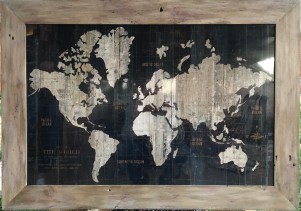
frameMy son Alex recently purchased a new piece of artwork for his room. It’s a picture of the world map, seemingly cut out of weathered boards. It has a very old word, rustic feel to it and he wanted a suitable frame for it – something that complemented the style rather than the sleek and modern options he found within his budget at retail outlets. So this weekend, we went out to the shop to build something custom together.

Finding the material was easy enough. I have a sizable stock of old wood from prior projects. He identified some old fence pickets that were straight and solid but with the right amount of character for his chosen aesthetic. After cleaning them up, milling them to accept the artwork, and cutting everything to size, it was time to address the look of the frame. Running the boards through my planer had revealed the fresh wood underneath the surface. They needed to be aged again.

I pulled out a variety of wood stains and we set to work. I’d lay down a color and Alex would follow behind me; blending each coat into the prior one to his liking. We repeated this process several times, mixing blues, reds, browns, and whites. Sometimes we used a brush, and sometimes a rag seemed like the appropriate tool to work with. Eventually, he felt like the right balance of colors was achieved and we left the pieces to dry overnight. Yesterday afternoon we assembled everything for the result you see in the picture above.

Note: It actually looks a lot better than this image represents. I need a photographer friend to give me pointers on taking pictures of artwork without getting reflections on the glass.

As we admired our handiwork last night and showed it off to the rest of the family, I couldn’t help but reflect on the process we went through… and how much it mirrors our journey through life. Each of us is a custom work of art. We are who we are as the result of a unique sequence of events. We’re just like this frame – made up of several colors, layered and blended repeatedly in a pattern of events that could never be replicated.

You have been exposed to circumstances and people that shaped who you are today. You’ve made innumerable decisions that have brought you to where you are right now. It’s the culmination of countless influences that now frame your world. And in turn, you have played a part in framing the world of those you’ve come in contact with.

Think about that last concept for just a minute. Everyone you have ever met is different because of your influence. In some way, you influence people. How you influence them is up to you. Will you provide a foundation; a basecoat upon which others will build? Will you be the splash of color that brightens up an otherwise dull corner? Or will you be the brush that helps blend various elements into a beautiful masterpiece?

Every person you meet is an opportunity to contribute to something special; to play a part in the creation of a masterpiece. No one else will ever create a piece of work like the one Alex now owns. He is extremely proud of it. And I’m proud to have played a part in helping it come to be.

Watch for Ice

road-587451_640The thermometer read 14 degrees when I left the house today. That’s a stark contrast to the balmy, 70 degree drive home I enjoyed on Friday afternoon. A cold front descended on West Texas this weekend. There wasn’t much precipitation; just enough to make things interesting and driving a little dangerous yesterday morning. Just enough to create patches of black ice.

While dry streets are obviously preferred, heavy rain or snow are much better for driving than the spotty conditions presented by black ice. With the really bad stuff, you know how to prepare, and you can be reasonably sure that other drivers will be just as cautious as you are. But black ice is different as it masquerades as dry pavement. The thin layer of ice allows the dark coloring of the road surface to show though, giving you a false sense of security. Often, you don’t know it’s there until it’s too late. Even if you do see it coming. It can be difficult to navigate.

We have patches of black ice at work too, don’t we? Again, I’m not talking about the “all hands on deck” type of emergencies. I’m talking about the random slick spots that we don’t see coming; the technical hiccups, the upset or demanding customer, the corporate demands that blindside us. Navigate them incorrectly, and you can spin out of control. Handled them properly though, and you can continue on to your original destination with little impact.

When you encounter one of these slick spots, the first thing you should do is put both hands on the wheel. Typical driving involves a lot of multitasking. We adjust the radio and climate controls. We drink our coffee and finish off a breakfast sandwich. But at the first sign that something is off, we need both hands on the wheel. This one act focuses our minds on the immediate situation. We can feel changes in road conditions through the steering wheel and react more quickly to changes that we sense. The simple decision to focus brings all of our resources to bear on navigating safely through the slick spot.

Next, we need to take our foot off of the gas. Make sure you read that correctly. Don’t step on the brakes and don’t accelerate. Either of those actions can make the problem worse. Hit the brakes, and you’ll create new problems as the car will quickly spin out of control. This endangers everyone around you. Trying to go faster will result in your spinning your wheels. You’ll waste a lot of effort with no result. The goal is to keep moving. Just ease off a little bit. Once the danger has passed, resume normal speed.

Finally, steer the vehicle in the right direction. A tendency is to over-correct. If the car starts sliding left, we want to jerk the wheel hard to the right. This is a recipe for disaster as once the immediate threat is over, you find yourself barreling in another wrong direction. Instead, we need to keep the wheel pointed in the direction we ultimately want to go. Keep your eyes on the desired destination and avoid the temptation to over-steer because of a single little unsteady patch.

Even when the road ahead looks to be clear, there are a million little decisions to make in order to reach our goal safely. And while it may be comfortable to set the cruise control and relax, we have to remain vigilant. When you’re behind the wheel, it’s important to make sure you are prepared to deal with the unexpected. Having the right plan ensures you can tackle whatever the road throws at you.

Rules of the Road

car-1149997_1920On January 2nd, I got behind the wheel of a Kia minivan, fired up the ignition, and pulled out onto the wrong side of the road. Well, at least it felt wrong to me. I was in Perth Australia where, it being a former British colony, people drive on the left side of the road. As the driver, I sat on the right hand side of the vehicle; all of the van’s knobs and switches were located on the opposite side of what I was used to.


I’d been dreading this day for months. As part of my vacation in Australia, the plan was to rent a car and drive to the rural area where my great aunts live. For six days, I was to be the chauffeur for them and the rest of my family as we took in the sights and visited locations where my ancestors had settled. I was nervous, not just because driving under such conditions took me into uncharted territory, but because so many people were counting on me to get it right.

We often avoid things that make us uncomfortable, even when we know there’s great benefit in stepping out of our comfort zone. We’re wired that way; we seek out experiences that bring us comfort or pleasure, and actively avoid those that make us nervous or bring displeasure. Yet a key aspect of leadership is the willingness to embrace the unfamiliar in search of the beneficial. Whether it’s making that dreaded sales call, coaching an employee for the first time, or driving on the left side of the road, astute leaders use the same approach to conquering each new task.

First, they start with a plan. The last thing you want to do when driving a foreign vehicle in a foreign country with foreign rules of the road is to wing it. But guess what I did? My first test was simply to get from the rental agency back to the hotel so I could pick up the rest of the family. It was only a few blocks away, and I assumed I could find my way. Naturally, I took a wrong turn and wound up on a freeway headed out of town. It was only when I stopped and pulled out the GPS app on my phone did the correct path reveal itself. With the map laid out in front of me, I quickly got back on track. Have a clearly defined plan and follow it.

Secondly, smart leaders move slowly, especially when operating in uncharted territory. I did get this one right. Driving in such unfamiliar circumstances meant I had to focus on each and every small move I made. For instance, I had to remind myself which side of the vehicle to get into for several days before it became routine. Driving required an incredible amount of mental energy simply because it was all new. I was frustrated to be struggling with what should have been (at least in my mind) a basic activity. Yet by moving slowly, I was able to ensure I did things correctly and build up a habit of properly executed moves. Take your time and get it right.

Finally, make sure you ask for help. Leaders never succeed alone. I quickly learned that any time I got behind the wheel, I wanted someone in the passenger seat to help keep me on track. Having an extra pair of eyes to look for obstacles, identify landmarks, and point out next steps made a world of difference. The same goes for any new task you take on. Ask for help. Use the resources that are available to you.

I’m happy to report that my time behind the wheel didn’t result in any traffic accidents. By following a plan for each trip, taking it slow, and relying on others to help me, I successfully navigated my way all over Western Australia. I wouldn’t say I mastered every aspect (I kept reaching for the turn signal and activating the windshield wipers), but I was able to get the team from point A to point B. Where does your team need to go this year?

How Should We Respond to Mistakes?

toaster
Photo: Uncanny Brands

New York based Uncanny Brands produces a unique blend of pop-culture toys, artwork, and small appliances. Their Star Wars line alone is impressive, featuring items such as the Death Star Popcorn Maker, Lightsaber Salt & Pepper Mills, and the Millennium Falcon Waffle Maker. Sports fans can select from NHL and NBA themed merchandise, while KISS and WWE aficionados have plenty to choose from as well.

But if you’ve been thinking that your toast is a little plain, I suggest you check out their Bob Ross Toaster. Just pop in your bread, and out comes a fairly reasonable likeness of the famous painter burned into your breakfast bread. There’s even a full color portrait of Ross on the side of the toaster, so you don’t have to feel bad about biting into his fluffy afro.

For those of you who don’t know who Bob Ross is, you owe it to yourself to check out a video or two of his PBS show The Joy of Painting. It aired from 1983 to 1994 (Ross died of lymphoma in 1995) and each half-hour episode featured Ross offering painting instruction as he completed a new landscape in real time. Ross’ belief that everyone could paint, and his soothing commentary earned him rave reviews and three Emmy Awards during its run.

After his death, Ross’ popularity continued to grow, in large part because of his fun approach to painting and his encouraging witticisms. One of his most enduring quotes references the goof-ups that inevitably happen as we pursue any endeavor. After an errant stroke of the brush, he said “We don’t make mistakes, just happy little accidents.”

Ross believed that mistakes were valuable as a natural part of the learning process. We don’t seek to make mistakes, but we should take advantage of them to grow. How we respond to our mistakes determines the value we receive from them. In particular, I see three ways we can turn our own mistakes into “happy little accidents.”

  1. Perfect your technique. There’s no doubt that some people are born with a natural inclination for painting. I’m not one of those, but thankfully I have other natural talents. Yet even the most gifted in any area will address their mistakes and practice to improve their skill level. Writers become better writers by writing. Athletes get better by competing. In every case, mistakes can point you to valuable lessons that need to be learned in order to become more proficient.
  2. Learn something new. Mistakes can often lead us to discover different ways of completing a task. I’ve lost track of how many innovative woodworking skills I’ve picked up as a result of messing up some aspect of a project in my home shop. Nine times out of ten, my second or third attempt, using a different approach, uncovers a faster, cleaner, more satisfying result. Without mistakes, I’d still be using time-intensive, less effective methods to get things done.
  3. Build a relationship. Mistakes provide us with an opportunity to establish and build relationships with people that we otherwise wouldn’t. Seeking out advice after messing up can lead you to a coworker or colleague; someone with whom you can share your own wisdom with. And while we definitely wouldn’t invite mistakes concerning customer relationships, studies show that customers who encounter a problem – and have it resolved to their satisfaction – become even more loyal than those who never have an issue in the first place.

Bob Ross once dabbed the wrong color onto one of his paintings (I’m sure it happened more than once). Instead of losing his cool or starting over, he simply moved the blob of paint around to create a bird. He turned his mistake into the focal point of a masterpiece. I’ll be keeping that in mind the next time I enjoy a slice of toast.

Future Presents

wormhole-2514312_640The story goes something like this…

In June of 1951, a number of people in New York City’s Times Square spotted a strange man standing in the middle of the street. About 20 years old, the man was dressed in late 19th century clothes and appeared confused. No one could recall seeing him arrive, and as the horrified masses watched, he was hit and killed by a taxi driving through the intersection.

At the morgue, several odd items were found in his pockets:

  • A beer token, made of copper and worth five cents at a pub no one had ever heard of.
  • An invoice from a livery stable for the card and washing of a horse and carriage.
  • Approximately $70 in old banknotes.
  • A 3rd place medal from a three-legged race.
  • Business cards for Rudolph Fentz, showcasing an address of Fifth Avenue.
  • A letter to Fentz’s address sent from Philadelphia in 1876.

Oddly enough, none of these items showed any signs of aging. It was as if this young man had suddenly been transported from the late 1800’s into 1950’s New York City. Investigation turned up no usable information on the man. The address on the business cards was that of a local business, but no one there had ever heard of Rudolph Fentz. His name was not listed in the telephone directory and fingerprints did not return a match.

There was a Rudolph Fentz, Jr. listed in an archived telephone book from 1939 though, and that turned out to be a legitimate lead. Fentz Jr.’s widow was still alive and living in Florida. She told investigators that her father-in-law had disappeared in 1876. He had gone out for a walk and simply vanished.

Imagine if you could travel 75 years into the future in just an instant. Imagine how strangely different things would appear. Your physical surroundings, the sights and sounds; everything you know suddenly transformed into the stuff of dreams. How frightening, and yet how exciting it would be at the same time.

Now think about the ways in which you might be influencing the future. How will the actions you take today impact the world 75 years from now? Are you building a future that you would be proud of? Is your team working toward a future that is bright and exciting, or will people be underwhelmed to learn of your contribution?

Most of us don’t spend a lot of time thinking so far ahead. We think in terms of today or this week. Perhaps we occasionally dream about what we want to accomplish within the next year, or possibly even the next five. But 75 years from now? That’s just a little too far off for us to consider. Or is it?

What if we approached our work, not with an eye for leaving on time at the end of the day, but for leaving a legacy for future generations? What if we knew our names would be forever attached to the things we are creating today? If we were suddenly transported 75 years into the future, would we be happy with the world we have created, or would we find ourselves standing, dazed and confused, in the middle of an intersection wondering where all that time went?

The Other Side

Sertorio FamilyThis is my great-grandfather, Cesare Sertorio. He was a timber hewer who immigrated to Australia from Italy in 1911. Pictured with him is my great-grandmother, Sarah Jessie (Creyk). She was born in Australia, but her parents came from Scotland. The cute little girl is my grandmother, Esther Lucy Sertorio. She met my grandfather, John Stinson, while he was stationed with the U.S. Navy at a submarine base in Fremantle.

They fell in love and in January of 1947, my grandmother sailed to the United States aboard the S.S. Marine Phoenix. She made her way to middle Tennessee and they were married four days after her arrival. Their first child, my mother, married a man from Ohio. Dad had come down for a short work stint and never returned. Researching his family has revealed that they came to the United States from Germany.

When I think about the history of my family, I’m struck by the amount of courage it must have taken so many of them to leave the country of their birth in order to start a new life somewhere else. Imagine leaving everything and everyone you know in pursuit of something you believe must be better. The barriers that have to be overcome were huge – language, culture, geography – everything was dramatically different from what they had known.

I can’t imagine making taking such a huge leap of faith; but I’m glad they did. Otherwise I wouldn’t be here. Each of these decisions to not just step outside of their comfort zones, but to leave them far behind, led my family to grow and expand around the globe. In the process, they impacted the communities they settled in. They added their own unique talents to the organizations they served, in some cases starting businesses of their own. I’m sure not every risk they took panned out the way they’d hoped it would. From my perspective though, things have turned out pretty well.

So, what’s my excuse?

If my ancestors could muster the courage to cross an ocean, why do I find it so difficult to take risks that are infinitesimally small by comparison? Why do I struggle to pick up the phone or introduce myself to someone new? Why do I hesitate when it comes to engaging in activities that will expand my influence, my business, and my impact?

Jack Canfield said “Everything you want is on the other side of fear.” The older I get, the more I believe this is true. The regrets I have almost always have to do with risks I didn’t take. My greatest accomplishments have come as a result of swallowing my anxiety and taking the first scary steps into the unknown. The more I try to remove doubt and potential risk… the more I wait; the more I miss out on.

Now that I think about it, I guess I’m not so different from my ancestors after all. In 1997, my wife and I left the known comforts of life in Tennessee to start over in Texas. We had no idea what lie in store for us, just a dream that things would better on the other side of our fear. I don’t regret taking that risk one bit.

What’s keeping you from taking a risk? What’s waiting for you on the other side?

The Fountain of Youth

youth-570881_640On this day in 1513, Juan Ponce de Leon, an explorer from Spain, “discovered” Florida. The peninsula that makes up our southeastern-most state had been sighted before, but Ponce de Leon was the first to make landfall, arriving near the present-day city of St. Augustine. He named the new land “La Florida” since his arrival occurred during the time of Pascua Florida – the Easter Feast.
Legend says that Ponce de Leon was searching for the Fountain of Youth, a fabled stream of water that restored health and vitality. Stories of this mysterious spring were recorded as far back as the 5th century BC, when the Greek historian Herodotus wrote about it. Myths about the Fountain of Youth have been part of various cultures across the globe.

While there may not be an actual Fountain of Youth, I think it’s safe to say that we’d all like to maintain as much energy and vitality as possible. And it isn’t necessarily age that saps you of your youth. I know teenagers who act as if they’ve given up on life and senior citizens who are more active and alert than I ever was.

Obviously, exercise and diet play huge roles in prolonging life and providing energy, but according to research, there are a handful of intangibles that are just as important. Youth isn’t simply a matter of the body; it involves the mind as well. Here are three characteristics of youthful people to take note of.

They play. Think about the amount of time you spend at work. Have you ever noticed how the time seems to pass more quickly when you enjoy what you’re doing? That’s because we lose ourselves in the work when it’s enjoyable. We aren’t as prone to distractions and don’t even think about looking at the clock when we’re mentally engaged in the task at hand.

Studies show that laughter and mental engagement are key contributors to growth. We learn faster, perform better, and contribute more when we enjoy the work we do. Just because it’s called work doesn’t mean it can’t be fun.

They pursue. One of the things that make stories like the Fountain of Youth exciting is the pursuit of it. Ponce de Leon and other explorers left the comfort of their homes behind in search of something new and exciting. They weren’t content with what already was – they desired to accomplish something new.

What are you trying to accomplish at work? Do you have a goal that drives you to explore new opportunities on a regular basis? Without something to pull you forward, there’s no excitement. Don’t wait for someone else to introduce a little adventure into your job. Be an explorer and seek out opportunities that no one else has before.

They bend. It’s no doubt that, as we age, our bodies become less flexible. The same goes for our minds – unless we take care to exercise them. I think the term “malleable” is most apt to use in this context. Substances that are malleable aren’t flexible by nature, they’ve been pressed or even hammered into shape without breaking.

The key for us to is to view change as a chance to become something different – to assume a new shape without allowing the process to break us. People who are too set in their ways have a difficult time flexing or morphing into something new. Yet, as youths we did it without even thinking about it. It’s in our nature to flex. We lose that tendency over time and start to remain fixed.

Often it seems the biggest life-suckers of all come from work. For many people, work is drudgery – a grind. They live for the five o’clock whistle and the weekend. But that’s no way to live. It’s a definite recipe for growing old. And there’s no reason why it has to be that way.

Seek to incorporate some play into your profession. Pursue a goal that’s bigger than yourself. Try to roll with the changes that come your way, maybe even initiate a few yourself. Odds are, the Fountain of Youth is closer than you think.

Moving to Mastery

the-nature-is-stronger-695013_640Do you remember your first day on the job? What emotions did you feel? I bet there was excitement, nervousness, and pride all at once. There was a sense of anticipation; almost an eagerness to see what challenges you could accept.

Even before you started, in that middle ground between accepting a new job and actually starting, the mind starts racing with the possibilities. You can’t help but imagine what stepping into this new role will be like. You begin to picture yourself in action, solving problems and making a difference. In your mind’s eye, everything goes perfectly. You can’t fail.

This is called Fantasy; by definition, an idea with no basis in reality. During this fantasy stage of employment, we can’t help but think about a potential version of the journey we’re about to embark on. Our mind turns our conscious and unconscious wishes into a fantastic, and fantastical, scenario that we play over and over and over again.

But pretty soon, reality sets in. Before you know it, that perfect world imagery has been replaced with real-world … well, reality. Things don’t go exactly as we’d planned. There are obstacles we cannot overcome. There are personalities that we struggle to get along with, and job expectations that aren’t exactly the stuff of dreams. The fantasy is over. We find ourselves in a new phase of our career called Survival.

In survival mode, the emotions are much different. There’s frustration, anxiety, and disappointment. Days are filled with either fire-fighting and never-ending to-do lists, or the monotonous drudgery of repetitious, mindless button-pushing. Goals seem further and further away, with progress coming only sporadically. We begin each day, not with anticipation, but with dread.

It’s here, in survival mode, that most people spend the entirety of their careers. Decades go by. The dreams that once inspired you to step into a new adventure fade away into the fog of a daily routine and the promise of an all-too-short weekend. Good times, huh?

But what if I told you that there’s another phase of your career just around the corner? What if there was something more than just survival? Would you be interested in that? Would you be willing to do what it takes to escape from survival and embrace something more? Are you ready to turn the corner?

There’s a phase of your career called Mastery; and it’s incredibly compelling.

Mastery represents control. It is, by definition, accomplishment. Masters dominate a particular skill or skill set. They are in control of their day, not the other way around. Back in the 13th century, “mastery” meant “victory.”

Mastery represents a return of the confidence and pride that colors the Fantasy stage. This time, though, those emotions are indeed based in reality – a reality that you have created for yourself. To-do lists are replaced with systems. Fire-fighting gives way to efficiency. Stagnation becomes progress and growth.

The great thing about moving to mastery is that you don’t have to wait for it to happen. You don’t need special tools or the right circumstances. All you need is the right attitude. You see, mastery is a mind-set. It’s a belief that you have been created for a purpose and a determination to see that purpose fulfilled.

Masters are merely those who have decided that survival is not enough. They are the few who have made the choice to live their lives intentionally. Roadblocks still exist. Problems still pop up. Nothing about the job or the environment is different. That’s because mastery is not a circumstance; it is a decision.

How do you see yourself today? Are you a survivor, or a master?

What’s Your Plan? (Part 4)

district-1264717_640So far this month, we’ve looked at the importance of having a strategic plan, steps for developing a strategic plan, and some tips for ensuring execution. I want to close out this series of articles by focusing on idea of plan review.

Even the best plans need periodic review to make sure they are still relevant. Any number of things can lead to a necessary course adjustment. Market fluctuations, competitive positioning, regulatory restrictions, personnel changes, and policy or procedure adjustments – all could mean your well-defined plan just went out the window. On top of that, it’s a good idea to periodically check the numbers and take the pulse of the team.

Approximately every 90 days, I suggest pulling the team back together for a strategic plan review. This is your opportunity to kick the tires and make any tweaks needed to keep the plan moving forward. Here are a few questions you can ask as part of your review:

  • Did we get what we expected from each particular strategy?
  • How far off the mark are we?
  • How far over the goal did we get?
  • What worked, and why?
  • Can we do more of those activities that seem to be bearing fruit?
  • What could have been done to make it even more effective?
  • What fell short, and why?
  • Can we fix it, or was this just a bad idea to begin with?
  • What should we have anticipated that we didn’t?
  • What are our team’s strengths?
  • How can we capitalize on these in stronger ways?
  • What internal issues need to be addressed so we can be more effective going forward?
  • What outside forces need to be dealt with?
  • How needs to happen to improve our FOCUS?
  • How needs to happen to improve our MOTIVATION?
  • How needs to happen to improve our ACCOUNTABILITY?

These and other questions can help stimulate a discussion about the state of the team’s performance against the plan. Based on the insights gleaned from your discussion, you should update your plan. Plug the holes in viable strategies.  Reinforce the efforts put into the best ones. Replace the worst ideas with new ones that seem promising.

These periodic reviews are a great way to reenergize the team. You’ll find people recommitting themselves to the process and approaching their work with a renewed energy. Ownership will go up and the dedication they show to the plan will bleed over into other aspects of the job.

So, the strategic planning cycle looks like this:

DEVLOP > EXECUTE > REVIEW > REPEAT

The bottom line is to treat your strategic plan less like a one-time event and more like a living, breathing part of your team. Like any employee, your plan needs support, attention, and ongoing development. The more you put into the strategic planning process, the more you will get out of it.

What’s Your Plan? (Part 2)

They say that the first step to success is having clearly defined goals. They should be written down and reviewed regularly. In fact, many experts speak to studies that show individuals who take the time to articulate their goals in writing have a much higher likelihood of actually achieving them.

If goals are the first step toward success, I believe having a strategy is definitely the second. A goal without a plan is just a dream. And like your goals, your strategic plan should be as clearly defined as possible. It should be written down and referred to on a regular basis.

Last week I promised to walk through the steps to creating a basic strategic plan. If you’ll follow this outline, you should wind up with a roadmap for achieving the goals that have been set out for your team. That’s what a well-written plan does. It not only points you in the right direction, but spells out the steps required to arrive at the desired destination.

There are five steps to developing your strategic plan.

1. DEFINE. Start by defining your goals as narrowly as possible. Perhaps your goal is to grow sales by 5% over the next year. Well, 5% of what, exactly? What specific products do you need to focus on? What group of customers or prospects? What are the interim goals you need to achieve so that a 5% growth becomes possible? What are the deadlines involved?

By defining the goal as much as possible, you start to break the journey down into more manageable pieces. When staring at a forest, it can be difficult to determine which tree you should cut down first. The more you define the expectations in front of you, the more you start to focus in on specific solutions

2. DESIGN. Having identified, as specifically as possible, what it is you are after, the second step is to create a rough outline of your action plan. Pull the team together and brainstorm activities that will help you achieve each goal. This process involves the entire team. Anyone involved in executing the plan ought to be part of developing it.

When brainstorming, remember that the goal of the exercise is to come up with as many ideas as possible. In order to achieve this, you must create an environment conducive to sharing ideas. Make sure the team understands the rules of brainstorming:
* No negativity. We don’t judge the ideas presented by others.

* Limit distractions. Try to eliminate outside influences that will interfere with the team’s ability to focus on the exercise.

* Crazy ideas are ok. Some ideas might be laughable, but they are still valuable as conduits to other lines of thinking.

* Keep moving. Don’t dig too deep into any the specifics of any one idea. The goal of brainstorming is volume. Talking through any one idea at length will bring the flow of ideas to a halt.

* Start individually. Have team members walk into the meeting having already written down a few ideas of their own. This will help jump start the process.


3. REFINE.
Now that you have a list of potential strategies, it’s time to start trimming it down and refining the best ones. Settle on the best ideas and then start tightening each one up by asking a series of questions.

What does that look like? What will we get? What would this strategy to fail? Keep asking questions until you have a plan of action that can’t be refined any further.

4. ALIGN. Determine what resources you need in order to execute your plan. Are there people outside the team you need to bring in? Are there marketing resources you need to create? Are there budget or approval hurdles that need to be cleared? Make sure you have all the necessary pieces aligned to help ensure your team’s success.

5. ASSIGN. The final step in developing your strategic plan is to assign responsibility for each bit. Determine who has ownership of each step and verify understanding of expectations. Don’t walk away from a great strategic plan without addressing this part.

Now that you have a plan, it may feel like the work is done, but it’s just beginning. The plan is meaningless without action. Next week, we’ll take a look at some tips for implementing your strategic plan.